Skip to main content
Nutrition
My Course
Learn
Exam Prep
AI Tutor
Study Guides
Flashcards
Try the app
My Course
Learn
Exam Prep
AI Tutor
Study Guides
Flashcards
Try the app
Back
Nutrition & Physical Activity quiz
You can tap to flip the card.
How does physical activity affect macronutrient needs?
You can tap to flip the card.
👆
How does physical activity affect macronutrient needs?
Physical activity increases energy and macronutrient needs, especially for high-performance athletes who may require more carbohydrates and proteins.
Track progress
Control buttons has been changed to "navigation" mode.
1/15
Related flashcards
Related practice
Recommended videos
Nutrition & Physical Activity definitions
Nutrition & Physical Activity
15 Terms
Nutrition & Physical Activity exam
Nutrition & Physical Activity
29 Terms
Nutrition & Physical Activity
11. Nutrition & Fitness
10 problems
Topic
Ergogenic Aids
11. Nutrition & Fitness
10 problems
Topic
11. Nutrition & Fitness
5 topics
15 problems
Chapter
01:25
Nutrition & Physical Activity Example 1
106
views
1
rank
Guided course
02:20
Timing Meals Around Exercise
128
views
Guided course
01:43
The Role of Micronutrients in Athletic Performance
209
views
Terms in this set (15)
Hide definitions
How does physical activity affect macronutrient needs?
Physical activity increases energy and macronutrient needs, especially for high-performance athletes who may require more carbohydrates and proteins.
What is the recommended carbohydrate intake for non-athletes per kilogram of body weight per day?
Non-athletes should consume 3-5 grams of carbohydrates per kilogram of body weight per day.
How much protein do high-performance athletes need per kilogram of body weight per day?
High-performance athletes may need 1.2-2.4 grams of protein per kilogram of body weight per day.
Why do high-performance athletes require more carbohydrates?
They need more carbohydrates to restore glycogen, which is a critical energy source during high-intensity exercise.
What is the recommended fat intake for both non-athletes and high-performance athletes?
Both groups should consume 0.8-1.2 grams of fat per kilogram of body weight per day.
Why is it not recommended to increase saturated and trans fat intake, even for athletes?
Increasing saturated and trans fat intake can raise the risk of disease, even in high-performance athletes.
When should you consume a meal before exercising, and what should it contain?
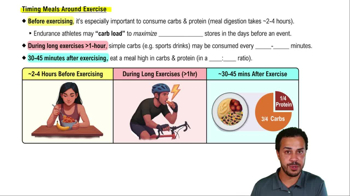
Consume a meal high in carbohydrates and proteins 2-4 hours before exercising to allow for digestion and optimal energy.
What is carbohydrate loading and who uses it?
Carbohydrate loading is a strategy used by endurance athletes to maximize glycogen stores in muscles before an event.
During long-duration exercise, what should be consumed and how often?
Simple carbohydrates should be consumed every 15-20 minutes during exercises lasting longer than one hour.
What is the recommended macronutrient ratio for a post-exercise meal?
A 3:1 carbohydrate to protein ratio is recommended within 30-45 minutes after exercise.
Why is the 30-45 minute window after exercise important for nutrition?
The body is most receptive to replenishing glycogen stores and promoting muscle recovery during this time.
Which micronutrients may be needed in higher amounts by physically active people?
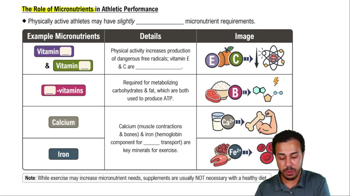
Physically active people may need more vitamins E and C, B vitamins, calcium, and iron.
Why are vitamins E and C important for athletes?
They act as antioxidants to stabilize free radicals produced during physical activity.
What roles do calcium and iron play in athletic performance?
Calcium is important for muscle contractions and bone health, while iron is essential for oxygen transport in the blood.
Are micronutrient supplements usually necessary for athletes with a healthy diet?
No, supplements are usually not necessary if the athlete maintains a healthy diet.
 BackBack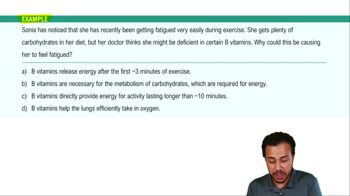
 01:25
01:25