Skip to main content
Nutrition
My Course
Learn
Exam Prep
AI Tutor
Study Guides
Flashcards
Try the app
My Course
Learn
Exam Prep
AI Tutor
Study Guides
Flashcards
Try the app
Back
Other Trace Minerals definitions
You can tap to flip the card.
Zinc
You can tap to flip the card.
👆
Zinc
A trace mineral serving as a cofactor for over 300 enzymes, crucial for gene regulation, protein structure, and immune support.
Track progress
Control buttons has been changed to "navigation" mode.
1/15
Related flashcards
Related practice
Recommended videos
Other Trace Minerals quiz
Other Trace Minerals
15 Terms
Other Trace Minerals exam
Other Trace Minerals
30 Terms
Other Trace Minerals quiz #1
Other Trace Minerals
10 Terms
Other Trace Minerals
8. Water and Minerals
10 problems
Topic
Trace minerals: Fluoride and Iodine
8. Water and Minerals
10 problems
Topic
8. Water and Minerals
10 topics
15 problems
Chapter
03:53
Zinc (Zn)
179
views
2
rank
03:41
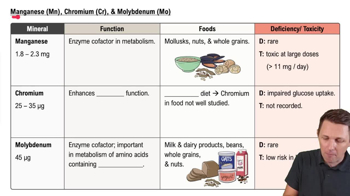
Manganese (Mn), Chromium (Cr), & Molybdenum (Mo)
146
views
2
rank
02:56
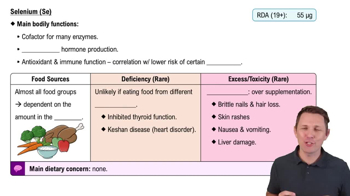
Selenium (Se)
163
views
1
rank
Terms in this set (15)
Hide definitions
Zinc
A trace mineral serving as a cofactor for over 300 enzymes, crucial for gene regulation, protein structure, and immune support.
Cofactor
A non-protein component required by enzymes to function, often a mineral like zinc, selenium, or manganese.
Gene Expression
The process by which information from DNA is regulated, often influenced by minerals such as zinc for proper development.
Phytates
Plant compounds found in whole grains and unleavened bread that can bind minerals and inhibit their absorption.
Leavened Bread
Bread made with yeast, which breaks down phytates, improving mineral absorption such as zinc.
Selenium
A trace mineral essential for thyroid hormone production, antioxidant defense, and immune function, with soil-dependent availability.
Thyroid Hormone
A hormone requiring selenium and iodine for synthesis, vital for metabolism and growth regulation.
Antioxidant Activity
A protective cellular process involving minerals like selenium to neutralize harmful free radicals.
Keishan Disease
A heart disorder linked to selenium deficiency, historically observed in regions with low soil selenium.
Manganese
A trace mineral acting as an enzyme cofactor, especially in metabolic processes, found in nuts, grains, and mollusks.
Chromium
A trace mineral that enhances insulin function, supporting glucose regulation, with deficiencies rare outside clinical settings.
Molybdenum
A trace mineral serving as a cofactor for enzymes involved in sulfur amino acid metabolism, present in beans, grains, and dairy.
Selenosis
A toxic condition from excessive selenium intake, marked by symptoms like brittle nails, hair loss, and liver damage.
Non Heme Iron
A form of dietary iron from plant sources that competes with zinc for absorption in the digestive tract.
Toxicity
A harmful state caused by excessive intake of trace minerals, often due to over-supplementation rather than diet.
 BackBack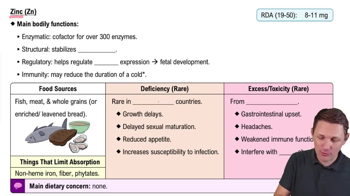
 03:53
03:53