Skip to main content
Nutrition
My Course
Learn
Exam Prep
AI Tutor
Study Guides
Flashcards
Try the app
My Course
Learn
Exam Prep
AI Tutor
Study Guides
Flashcards
Try the app
Back
Protein Synthesis quiz
You can tap to flip the card.
What are genes and what do they code for?
You can tap to flip the card.
👆
What are genes and what do they code for?
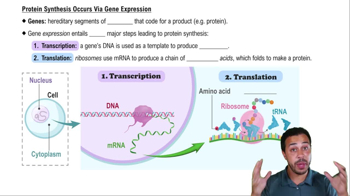
Genes are hereditary segments of DNA that code for a product, usually a protein.
Track progress
Control buttons has been changed to "navigation" mode.
1/15
Related flashcards
Related practice
Recommended videos
Protein Synthesis definitions
Protein Synthesis
15 Terms
Protein Synthesis exam
Protein Synthesis
28 Terms
Protein Synthesis
6. Proteins
10 problems
Topic
Why Do We Need Protein?
6. Proteins
10 problems
Topic
6. Proteins
7 topics
15 problems
Chapter
Guided course
03:42
Epigenetics & Nutrigenomics
269
views
5
rank
Guided course
03:00
Protein Synthesis Occurs Via Gene Expression
327
views
7
rank
Guided course
02:45
Protein Synthesis Example 1
211
views
2
rank
Terms in this set (15)
Hide definitions
What are genes and what do they code for?
Genes are hereditary segments of DNA that code for a product, usually a protein.
What are the two major steps of gene expression leading to protein synthesis?
The two major steps are transcription and translation.
Where does transcription occur within the cell?
Transcription occurs inside the nucleus of the cell.
What is produced during transcription?
Messenger RNA (mRNA) is produced using DNA as a template.
Where does translation take place in the cell?
Translation occurs in the cytoplasm of the cell.
What is the role of ribosomes in protein synthesis?
Ribosomes use mRNA to synthesize a chain of amino acids, forming proteins.
What is the function of transfer RNA (tRNA) during translation?
tRNA delivers amino acids to the ribosome during protein synthesis.
How do proteins achieve their functional structure after translation?
The amino acid chain folds into four levels of protein structure to become functional.
Why are different cell types (like muscle and nerve cells) different if they have the same DNA?
Different cell types express different genes, leading to the production of different proteins.
What is epigenetics?
Epigenetics refers to chemical modifications that alter gene expression without changing the DNA sequence.
How does epigenetics affect protein production in cells?
Epigenetics can activate or suppress genes, increasing or decreasing the amount of protein produced.
What is the result of epigenetic differences between cell types?
Epigenetic differences lead to the production of different types and amounts of proteins in different cells.
What is nutrigenomics?
Nutrigenomics is the study of how nutrients and diet impact gene expression.
How could nutrigenomics influence future nutrition recommendations?
Nutrigenomics could enable personalized nutrition plans to minimize chronic disease risk based on individual gene expression.
How is nutrigenomics related to epigenetics?
Nutrigenomics is a branch of epigenetics that connects dietary factors to changes in gene expression.
 BackBack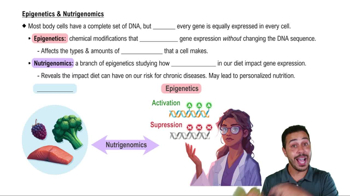
 03:42
03:42