Skip to main content
Nutrition
My Course
Learn
Exam Prep
AI Tutor
Study Guides
Flashcards
Try the app
My Course
Learn
Exam Prep
AI Tutor
Study Guides
Flashcards
Try the app
Back
Water definitions
You can tap to flip the card.
Intracellular Fluid
You can tap to flip the card.
👆
Intracellular Fluid
Fluid located inside cells, making up about two-thirds of total body water and serving as the main environment for cellular processes.
Track progress
Control buttons has been changed to "navigation" mode.
1/15
Related flashcards
Related practice
Recommended videos
Water quiz
Water
15 Terms
Water exam
Water
30 Terms
Water quiz #1
Water
10 Terms
Water
8. Water and Minerals
10 problems
Topic
Introduction to Minerals
8. Water and Minerals
10 problems
Topic
8. Water and Minerals
10 topics
15 problems
Chapter
05:47
Water Requirements
189
views
3
rank
04:15
Osmosis
231
views
4
rank
03:15
Water Example 2
182
views
2
rank
Terms in this set (15)
Hide definitions
Intracellular Fluid
Fluid located inside cells, making up about two-thirds of total body water and serving as the main environment for cellular processes.
Extracellular Fluid
Fluid found outside cells, including interstitial fluid, blood, and lymph, accounting for about one-third of body water.
Interstitial Fluid
Fluid that surrounds and bathes cells within tissues, facilitating nutrient and waste exchange between blood and cells.
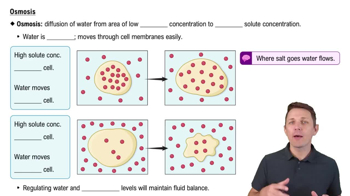
Osmosis
Movement of water across a membrane from areas of low solute concentration to high solute concentration, balancing fluid compartments.
Electrolyte
Dissolved salts in body fluids, such as sodium, that regulate water movement and are essential for fluid balance.
Fluid Balance
State achieved when fluid intake equals fluid loss, maintaining proper hydration and supporting physiological functions.
Hypothalamus
Brain region that monitors blood sodium and volume, triggering thirst and hormone release to regulate hydration.
Antidiuretic Hormone
Hormone released by the pituitary gland that signals kidneys to retain water, reducing urine output to conserve body fluids.
Diuretic
Substance that increases urine production, leading to greater water loss and potential dehydration if not balanced.
Dehydration
Condition resulting from insufficient body water, causing symptoms like dark urine, thirst, headaches, and impaired function.
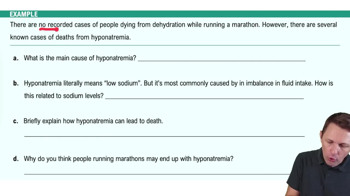
Hyponatremia
Dangerous drop in blood sodium concentration, often from excessive water intake, leading to brain swelling and possible fatality.
Universal Solvent
Property of water that allows it to dissolve a wide range of substances, enabling most cellular reactions and transport.
Sensible Loss
Measurable fluid loss from the body, such as through urine, sweat, or vomiting, that can be perceived or felt.
Insensible Loss
Unnoticed fluid loss occurring through skin evaporation and respiration, contributing to daily water requirements.
Recommended Daily Allowance
Guideline specifying optimal daily water intake, set at 3.7 liters for males and 2.7 liters for females, including fluids from food.
 BackBack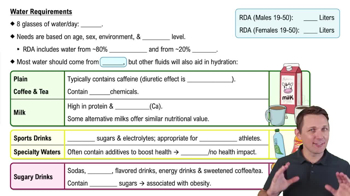
 05:47
05:47