Skip to main content
Nutrition
My Course
Learn
Exam Prep
AI Tutor
Study Guides
Flashcards
Try the app
My Course
Learn
Exam Prep
AI Tutor
Study Guides
Flashcards
Try the app
Back
Why Do We Need Protein? definitions
You can tap to flip the card.
Enzyme
You can tap to flip the card.
👆
Enzyme
Molecule that accelerates chemical reactions, enabling essential life processes to occur rapidly within the body.
Track progress
Control buttons has been changed to "navigation" mode.
1/15
Related flashcards
Related practice
Recommended videos
Why Do We Need Protein? quiz
Why Do We Need Protein?
15 Terms
Why Do We Need Protein? exam
Why Do We Need Protein?
26 Terms
Why Do We Need Protein?
6. Proteins
10 problems
Topic
Protein Digestion
6. Proteins
10 problems
Topic
6. Proteins
7 topics
15 problems
Chapter
Guided course
05:22
Proteins Are Required in Our Diet
308
views
4
rank
Guided course
01:49
Why Do We Need Protein? Example 1
214
views
1
rank
Terms in this set (15)
Hide definitions
Enzyme
Molecule that accelerates chemical reactions, enabling essential life processes to occur rapidly within the body.
Hormone
Chemical messenger that regulates physiological activities, such as metabolism and growth, by signaling between organs and tissues.
Transport Protein
Molecule that moves nutrients, gases, or other substances across cell membranes or within the bloodstream.
Antibody
Immune protein that binds and neutralizes harmful pathogens, playing a key role in defending the body against infections.
Collagen
Most abundant structural protein in the body, providing support and strength to skin, bones, ligaments, tendons, and muscles.
Actin
Muscle protein involved in contraction and movement, working alongside myosin to enable muscle function.
Myosin
Protein in muscle fibers that interacts with actin to produce muscle contraction and movement.
Neurotransmitter
Molecule that transmits signals between nerve cells, facilitating communication within the nervous system.
Blood Clotting Factor
Protein that assists in forming clots to prevent excessive bleeding and promote wound healing.
Fluid Balance
State maintained by proteins in the blood, drawing fluid from tissues to prevent swelling and ensure proper circulation.
Electrolyte Balance
Regulation of sodium and potassium gradients by protein pumps, essential for nerve impulses and muscle contractions.
Acid-Base Balance
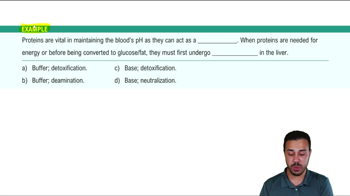
Regulation of blood pH by proteins acting as buffers, keeping the body's pH within a narrow, life-supporting range.
Deamination
Process involving removal of an amine group from an amino acid, enabling its use for energy production.
Keto Acid
Compound produced after deamination of an amino acid, which can be converted into energy, glucose, or fat.
Edema
Swelling caused by fluid accumulation in tissues, often prevented by adequate protein levels in the blood.
 BackBack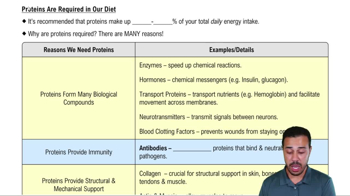
 05:22
05:22