 Back
BackCritical Evaluation of Nutrition Research: Methods, Challenges, and Interpretation
Study Guide - Smart Notes
 Tailored notes based on your materials, expanded with key definitions, examples, and context.
Science of Nutrition
Understanding Nutrition Research
Nutrition science seeks to understand the relationship between dietary intake and health outcomes. However, the field is complicated by methodological challenges, including difficulties in accurately measuring what people eat and interpreting the results of observational studies.
Nutrition Research Methods: Common methods include food diaries, 24-hour recall surveys, and food frequency questionnaires (FFQs). Each method has strengths and weaknesses in terms of accuracy and practicality.
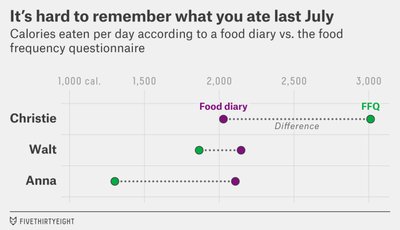
Food Diaries: Participants record everything they eat and drink over a set period, providing detailed short-term data but often failing to capture long-term habits.
Food Frequency Questionnaires (FFQs): These surveys ask participants how often they consume specific foods over months or a year, aiming to estimate habitual intake but relying heavily on memory and estimation.
Challenges in Data Collection: People often underreport foods considered unhealthy and may misjudge portion sizes, leading to systematic errors in dietary assessment.
Validation Studies: Researchers attempt to validate FFQs by comparing them to other self-reported methods, but this can introduce circular reasoning since all methods are subject to similar biases.

Tools for Healthful Eating
Interpreting Nutrition Study Results
Nutrition studies often produce large datasets with many variables, increasing the risk of finding statistically significant but meaningless correlations. Understanding the difference between correlation and causation is essential for interpreting these results.
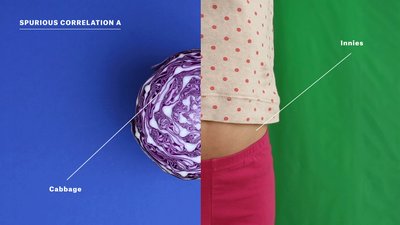
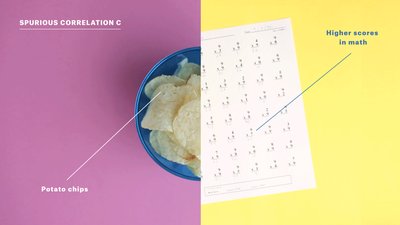
Spurious Correlations: With enough data, random associations between unrelated variables can appear statistically significant. These do not imply a causal relationship.
Statistical Significance vs. Practical Significance: A result may be statistically significant (e.g., p-value < 0.05) but have little real-world importance if the effect size is trivial or biologically implausible.
Relative vs. Absolute Risk: Studies often report relative risk (e.g., a threefold increase), which can exaggerate the perceived importance compared to absolute risk (the actual difference in risk between groups).
Example of Spurious Correlations | Variables |
|---|---|
Correlation A | Cabbage consumption & Innie bellybuttons |
Correlation B | Egg roll consumption & Dog ownership |
Correlation C | Potato chip consumption & Higher math scores |
Correlation D | Lemonade consumption & Movie preferences |
Correlation E | Shellfish consumption & Right-handedness |
Correlation F | Steak fat trimming & Lack of belief in a god |
Correlation G | Banana consumption & Higher verbal SAT scores |
Correlation H | Beer consumption & Frequent smoking |
Correlation I | Coffee consumption & Cat ownership |
Correlation J | Table salt use & Positive relationship with ISP |

The Human Body & Digestion
Limits of Observational Nutrition Studies
Observational studies can identify associations but cannot prove causation. Many reported links between foods and health outcomes are weak, inconsistent, or biologically implausible. Randomized controlled trials (RCTs) are needed to establish causality, but are often impractical for long-term dietary patterns.
Biological Plausibility: Some reported effects (e.g., a 40% reduction in mortality from eating nuts) are likely exaggerated due to study design limitations.
Population Differences: Different cultures thrive on diverse diets, suggesting that the human body is adaptable and that no single "perfect" diet exists for everyone.
Practical Takeaway: While we know the basics (adequate calories, protein, essential nutrients), the search for "superfoods" or magic nutrients is often misguided.
Summary Table: Strengths and Weaknesses of Dietary Assessment Methods
Method | Strengths | Weaknesses |
|---|---|---|
Food Diary | Detailed, real-time recording | Short-term, may alter behavior, burdensome |
24-Hour Recall | Guided, less burden on memory | Snapshot, not representative of usual intake |
FFQ | Estimates long-term intake | Relies on memory, portion size errors, validation issues |
Conclusion
Nutrition research is essential for understanding the links between diet and health, but current methods have significant limitations. Students and practitioners must critically evaluate study designs, recognize the difference between correlation and causation, and interpret findings within the broader context of biological plausibility and population diversity.
Key Terms: Food diary, Food frequency questionnaire (FFQ), Observational study, Randomized controlled trial (RCT), Statistical significance, Relative risk, Absolute risk, Spurious correlation.
Additional info: The images included above illustrate the challenges of dietary self-reporting and the pitfalls of spurious correlations in nutrition research. They are directly relevant to the discussion of research methods and interpretation in nutrition science.
