 Back
Energy Metabolism: Pathways and Regulation in Nutrition
Study Guide - Smart Notes
 Tailored notes based on your materials, expanded with key definitions, examples, and context.
Energy Metabolism
Introduction to Metabolism
Metabolism refers to the sum of all chemical reactions occurring in the body, which are essential for maintaining life and supporting cellular functions. These reactions follow specific metabolic pathways, converting compounds into new forms and releasing or storing energy as needed. - Metabolic Pathways: Sequences of reactions converting compounds from one form to another. - Energy Storage: Energy is stored in the chemical bonds of carbohydrates, proteins, and fats. - Energy Release: Occurs when these bonds are broken, either through aerobic (with oxygen) or anaerobic (without oxygen) reactions.
Cellular Metabolism
Metabolism takes place within cells, with different organelles playing distinct roles. The mitochondria are central to aerobic metabolism, while the cytosol is involved in anaerobic processes. - Plasma Membrane: Encloses cell contents. - Mitochondria: Site of aerobic ATP production. - Cytosol: Site of anaerobic metabolism. 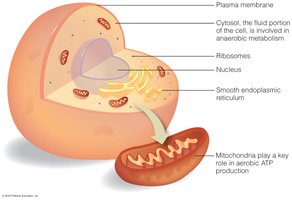
The Liver's Role in Metabolism
The liver is the most metabolically active organ, responsible for metabolizing, storing, and distributing nutrients after absorption. It converts monosaccharides, amino acids, glycerol, and fatty acids into new compounds, energy, or storage forms such as triglycerides and glycogen.
Anabolic and Catabolic Reactions
Metabolic reactions are classified as anabolic (building up) or catabolic (breaking down). - Anabolic Reactions: Absorb energy to combine simple molecules into larger ones (e.g., glucose to glycogen, amino acids to proteins). - Catabolic Reactions: Release energy by breaking down large molecules into simpler ones. 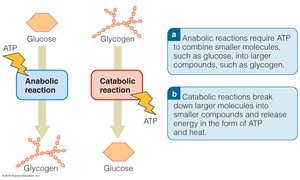
Regulation of Metabolism
Enzymes and coenzymes facilitate metabolic reactions, while hormones regulate the balance between anabolic and catabolic processes.
Hormone | Function |
|---|---|
Insulin | Promotes anabolic reactions and storage of nutrients |
Glucagon | Promotes catabolic reactions and release of energy |
Epinephrine | Stimulates energy release during stress |
Cortisol | Promotes breakdown of macronutrients |
ATP: The Energy Currency of Cells
Structure and Function of ATP
Adenosine triphosphate (ATP) is a high-energy molecule composed of adenine, ribose, and three phosphate groups. It serves as the direct energy source for cellular activities. - Energy Storage: Energy is stored in the bonds between phosphate groups. - ATP Hydrolysis: Removal of a phosphate group releases energy and forms adenosine diphosphate (ADP). 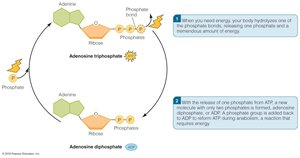
Regeneration of ATP
ATP can be regenerated from ADP using inorganic phosphate or creatine phosphate, especially during short bursts of activity. - Creatine Phosphate: Provides rapid ATP regeneration in muscle cells. - Anaerobic Metabolism: Supports high-intensity, short-duration activities. - Aerobic Metabolism: Supports low-intensity, long-duration activities.
Metabolic Pathways for Macronutrients
Overview of Metabolic Pathways
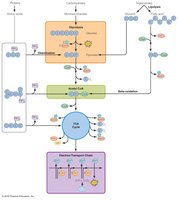
Carbohydrates, fats, and proteins enter metabolic pathways to produce ATP. The main stages are glycolysis, conversion to acetyl CoA, the TCA cycle, and the electron transport chain. 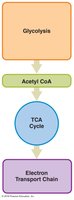
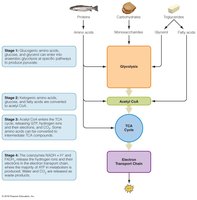
Glycolysis
Glycolysis is a 10-step anaerobic pathway in the cytosol that transforms glucose into pyruvate, generating ATP and NADH. - Start: One 6-carbon glucose molecule - End: Two 3-carbon pyruvate molecules, two net ATP, and two NADH - Hydrogen Ions: Transported to the electron transport chain via NADH
Metabolism of Other Monosaccharides
Fructose and galactose are metabolized through specific steps before entering glycolysis.
Pyruvate to Lactate and the Cori Cycle
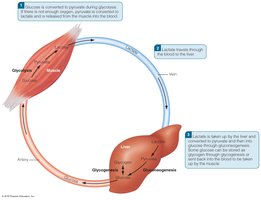
Under anaerobic conditions, pyruvate is reduced to lactate, which diffuses to the liver and is converted back to glucose via the Cori cycle. 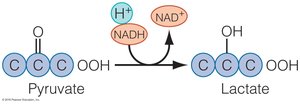
Amino Acid Metabolism
- Glucogenic Amino Acids: Can be converted to pyruvate or TCA cycle intermediates for gluconeogenesis. - Ketogenic Amino Acids: Converted to acetyl CoA and can form ketone bodies. 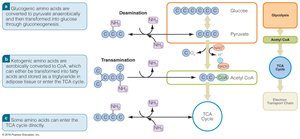
Glycerol Metabolism
Only the glycerol portion of triglycerides is glucogenic and can be used to make glucose, though it yields little energy.
Summary of Glycolysis
- Products: 2 ATP, 2 pyruvate, 2 NADH, 2 H+, 2 water molecules
Pyruvate to Acetyl CoA
In the presence of oxygen, pyruvate is converted to acetyl CoA in the mitochondria, which then enters the TCA cycle or is stored as fat. 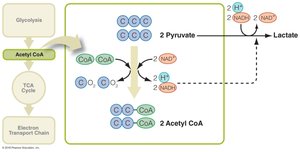
Fatty Acid Metabolism
Fatty acids are released from triglycerides by lipolysis, activated, and then disassembled by beta-oxidation in the mitochondria to form acetyl CoA. - Beta-Oxidation: Sequential removal of two-carbon units, forming acetyl CoA. - Ketogenic Nature: Fatty acids can form ketone bodies. 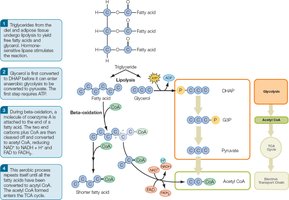
The TCA Cycle (Citric Acid/Krebs Cycle)
The TCA cycle oxidizes acetyl CoA, releasing high-energy electrons and hydrogen ions, which are transferred to coenzymes for use in the electron transport chain. - Location: Mitochondria - Products: CO2, NADH, FADH2 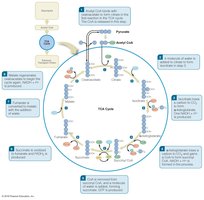
Electron Transport Chain and Oxidative Phosphorylation
The electron transport chain, located in the inner mitochondrial membrane, produces the majority of ATP by transferring electrons through protein complexes and generating water. - Flavoproteins: Contain riboflavin - Cytochromes: Contain iron and copper 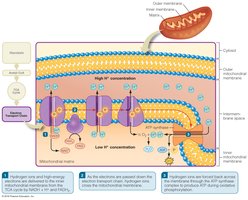
Overview of Energy Metabolism
Metabolic Changes During Feeding and Fasting
Absorptive State
The absorptive state occurs within four hours after a meal, when anabolic processes dominate and nutrients are stored. - Carbohydrates: Stored as glycogen in liver and muscle - Excess Carbohydrates/Amino Acids: Converted to triglycerides - Fatty Acids: Stored as triglycerides 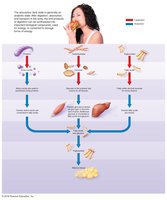
Postabsorptive State
After four hours without food, catabolic processes dominate, and stored nutrients are mobilized for energy. - Short-term Fasting: Glycogen and fatty acids provide energy - Long-term Fasting: Ketone bodies supply energy to the brain; muscle tissue is broken down 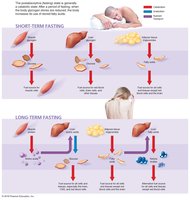
Ketogenesis
During prolonged fasting or carbohydrate restriction, ketone bodies are formed from acetyl CoA and used as an energy source, especially by the brain. - Ketoacidosis: Excess ketone bodies can lead to dangerous health conditions, particularly in untreated type 1 diabetes. 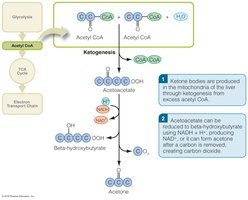
Alcohol Metabolism
Alcohol Metabolism Pathways
Alcohol is metabolized primarily in the liver via three pathways: alcohol dehydrogenase (ADH), microsomal ethanol oxidizing system (MEOS), and catalase. - ADH Pathway: Converts alcohol to acetyl CoA for energy or fat storage - MEOS Pathway: Used during chronic alcohol consumption; also metabolizes drugs - Catalase Pathway: Occurs in the brain; may contribute to psychological effects 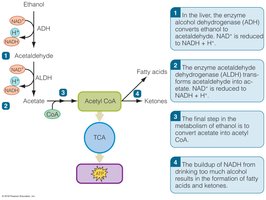
Effects of Excess Alcohol
Excess alcohol is stored as fat, leading to fat deposits in the liver and potentially cirrhosis.
Inborn Errors of Metabolism
Common Genetic Disorders
Inborn errors of metabolism are genetic conditions resulting from the lack of specific enzymes, leading to the buildup of toxins and requiring dietary management.
Disorder | Cause | Treatment |
|---|---|---|
Phenylketonuria (PKU) | Lack of phenylalanine hydroxylase | Limit phenylalanine, supplement tyrosine, avoid aspartame |
Maple Syrup Urine Disease (MSUD) | Inability to metabolize branched-chain amino acids | Special formulas, avoid high-protein foods |
Homocystinuria | Inability to convert homocysteine to cystathione | Low methionine diet, B vitamin supplements |
Galactosemia | Inability to convert galactose to glucose | Avoid lactose and galactose |
Glycogen Storage Disease | Inability to break down glycogen | Avoid sucrose, lactose, galactose, fructose |
Key Equations and Concepts
ATP Hydrolysis
Glycolysis Summary
Beta-Oxidation
TCA Cycle
Electron Transport Chain
Summary
Energy metabolism is a complex, regulated process involving the breakdown and synthesis of macronutrients to produce ATP, the energy currency of cells. Understanding these pathways is essential for nutrition students, as they underpin the body's ability to utilize food for energy, growth, and maintenance. Additional info: Academic context was added to clarify metabolic pathways, regulatory hormones, and genetic disorders for completeness.
