 Back
BackEssentials of Human Nutrition – Course Syllabus and Study Guide
Study Guide - Smart Notes
 Tailored notes based on your materials, expanded with key definitions, examples, and context.
Essentials of Human Nutrition (BIOL-1262-L01) – Syllabus Study Guide
Course Overview
This course provides a foundational understanding of human nutrition, focusing on the physiological and biochemical roles of nutrients, their impact on health, and the application of nutritional principles across the lifespan. It is designed to support students in the Practical Nursing program and those seeking to improve their knowledge of nutrition for personal and professional development.
Course Objectives & Student Learning Outcomes
Explain fundamental principles of nutritional science, including digestion, absorption, and metabolism of macronutrients (carbohydrates, proteins, fats) and micronutrients (vitamins, minerals).
Apply evidence-based nutritional knowledge to assess and improve health across the lifespan, from childhood to older adulthood.
Analyze the impact of nutrition on health and disease, including wellness promotion, chronic disease prevention (e.g., diabetes, heart disease), weight management, exercise performance, and eating disorders.
Communicate nutrition concepts effectively to diverse audiences.
Course Content Outline
I. The Nutrients in Food
Nutrition and Health Promotion: Understanding how nutrients support body functions and promote overall health.
Understanding Food Choices: Factors influencing dietary habits and preferences.
The Science of Nutrition: Introduction to nutrition as a scientific discipline, including research methods and evidence-based practice.
II. Tools for Healthful Eating
Dietary Guidelines for Americans: Key recommendations and standards (DRI, EAR, RDA, AI, UL, EER, AMDR).
Challenges of Dietary Guidelines: Barriers to following recommendations.
Introducing MyPlate: Visual guide for balanced meals.
Food Labels: How to interpret and use nutrition facts panels.
III. The Human Body & Digestion
The Digestive System: Structure and function of the gastrointestinal tract.
Metabolism: Overview of metabolic pathways and energy production.
Common Digestive Problems: Issues such as lactose intolerance, GERD, and constipation.
IV. Carbohydrates
Simple and Complex Carbohydrates: Definitions and dietary sources.
The Body’s Use of Glucose: Role in energy metabolism.
Dietary Fiber: Types, benefits, and recommended intake.
Sugar and Health: Impact of added sugars on health.
Hypoglycemia and Diabetes: Blood sugar regulation and disorders.
V. Lipids
Types of Lipids: Triglycerides, phospholipids, sterols.
Lipids in the Body: Functions and storage.
Saturated, Unsaturated, and Trans Fats: Health implications and dietary sources.
Essential Fatty Acids: Omega-3 and omega-6 fatty acids.
VI. Proteins
Essential and Nonessential Amino Acids: Definitions and dietary importance.
Functions of Proteins: Roles in structure, function, and regulation of the body’s tissues and organs.
Digestion and Absorption: How proteins are broken down and utilized.
Protein Quality: Complete vs. incomplete proteins.
Recommended Intake: Consequences of deficiency and excess.
VII. Vitamins
Fat-Soluble Vitamins: Vitamins A, D, E, K – functions, sources, and toxicity risks.
Water-Soluble Vitamins: B-complex and vitamin C – roles and deficiency symptoms.
Choosing Foods Rich in Vitamins: Dietary strategies for adequate intake.
VIII. Water and Minerals
Drinking Water: Types, safety, and sources.
Water, Minerals, and Fluid Balance: Importance of hydration and electrolyte balance.
Major and Trace Minerals: Functions and dietary sources.
Impact of Alcohol on Nutrition: Effects on nutrient absorption and metabolism.
IX. Energy Balance: Body Weight, Obesity, & Eating Disorders
Body Weight vs. Body Fatness: Methods of assessment and health implications.
Control of Appetite: Physiological and psychological factors.
Weight Loss and Gain: Mechanisms and strategies.
Causes of Obesity: Multifactorial etiology.
Medical Treatment of Obesity: Approaches and interventions.
Eating Disorders: Types, risk factors, and health consequences.
X. Nutrition & Fitness
Benefits of Fitness: Physical and mental health advantages.
Energy for Physical Activity: Anaerobic vs. aerobic metabolism.
The Body’s Use of Fuels: Carbohydrates, fats, and proteins during exercise.
Hydration: Importance during physical activity.
Vitamins and Minerals for Physical Activity: Special considerations for athletes.
XI. Food Safety & Regulation
Microbes and Food Safety: Foodborne illnesses and prevention.
Pesticides and Environmental Contaminants: Health risks and regulations.
Food Additives: Types and safety evaluation.
XII. Food Insecurity in the US and the World
Global and Domestic Food Security: Causes, consequences, and solutions.
XIII. Nutrition: Pregnancy Through Infancy
Nutrition for Pregnancy: Nutrient needs and recommendations.
Nutrition During Lactation: Maternal and infant health.
Nutrition for Infants: Feeding practices and nutrient requirements.
XIV. Nutrition: Toddlers to Late Adulthood
Nutrition for Early and Middle Childhood: Growth, development, and childhood obesity.
Nutrition for Adolescence: Special needs during growth spurts.
Nutrition for Older Adults: Age-related changes and dietary strategies.
Assessment & Grading
Exams: Three non-cumulative exams (100 points each) and one cumulative final (100 points). Multiple choice, matching, labeling, true/false, and fill-in-the-blank questions.
Quizzes: Online chapter quizzes, syllabus quiz, academic integrity quiz, and pop quizzes as assigned.
Homework & Projects: Assignments and discussions to reinforce learning.
Grading Scale: A = 90%+, B = 80-89%, C = 70-79%, D = 60-69%, F = below 60%.
Course Policies & Success Strategies
Attendance: Regular attendance is expected; absences must be documented for make-up eligibility.
Academic Integrity: Cheating and plagiarism are strictly prohibited and subject to disciplinary action.
Preparation: Read assigned chapters, attend class, participate actively, and complete all assignments on time.
Accommodations: Students with disabilities should contact the Office of Disability Services for support.
Recommended Textbook
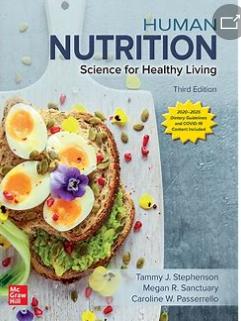
Human Nutrition: Science for Healthy Living (3rd Edition) by Tammy Stephenson & Wendy Schiff, McGraw-Hill, 2024.
Weekly Schedule (Sample)
Week | Chapter | Topic | Assessment |
|---|---|---|---|
1 | 1 | The Nutrients in Foods | Quiz 1 |
2 | 2 | The ABCs of Eating for Health | Quiz 2 |
3 | 3 | The Digestive System | Quiz 3 |
4 | 4 | Carbohydrates | Quiz 4, Exam 1 |
5 | 5 | Lipids | Quiz 5 |
6 | 6 | Proteins | Quiz 6, Exam 2 |
7 | 7 | Vitamins | Quiz 7 |
8 | 8 | Minerals, Water, and Other Beverages | Quiz 8 |
9 | 9 | Energy Balance & Weight | Quiz 9 |
10 | 10 | Nutrition for Fitness & Sport | Quiz 10 |
11 | 11 | Diet & Cardiovascular Disease | Quiz 11, Exam 3 |
12 | 12 | Food Safety & Global Food Supply | Quiz 12 |
13-15 | 13-15 | Nutrition Across the Life Cycle | Quiz 13, Final Exam |
Keys to Success
Read the textbook and review lecture materials regularly.
Participate actively in class and online discussions.
Complete all assignments and quizzes on time.
Ask questions and seek clarification when needed.
Utilize recommended resources and office hours for additional support.
