 Back
BackFat-Soluble Vitamins: Structure, Function, and Dietary Sources
Study Guide - Smart Notes
 Tailored notes based on your materials, expanded with key definitions, examples, and context.
Fat-Soluble Vitamins
Overview of Fat-Soluble Vitamins
Fat-soluble vitamins include Vitamins A, D, E, and K. These vitamins require bile and dietary fat for absorption, are transported with fats through the lymphatic system in chylomicrons, and are stored in body fat. Unlike water-soluble vitamins, they are not easily excreted, which increases the risk of toxicity if consumed in excess.
Vitamins: A, D, E, K
Absorption: Requires bile and dietary fat
Transport: Via chylomicrons in the lymphatic system
Storage: In body fat
Excretion: Not easily excreted
Vitamin A
Forms, Functions, and Dietary Sources
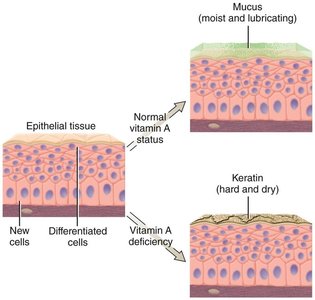
Vitamin A is found in the diet as preformed vitamin A (from animal products or supplements) and as provitamin A carotenoids (from plant foods). It plays a key role in night vision, cell differentiation, growth regulation, and maintenance of epithelial tissue. Retinoids (retinol, retinal, retinoic acid) are the active forms, while carotenoids (such as beta-carotene) are plant pigments that can be converted to vitamin A and may act as antioxidants.
Key Functions: Night vision, cell differentiation, growth, immune function, maintenance of epithelial tissue
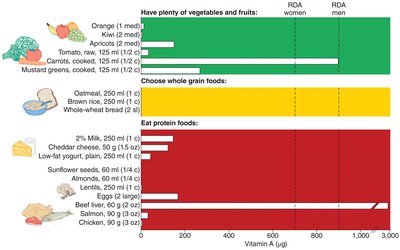
Sources: Animal products (eggs, dairy, liver, fish), orange/yellow/dark green vegetables (carrots, sweet potatoes, spinach)
RDA: Males: 900 µg/day; Females: 700 µg/day

Deficiency and Toxicity
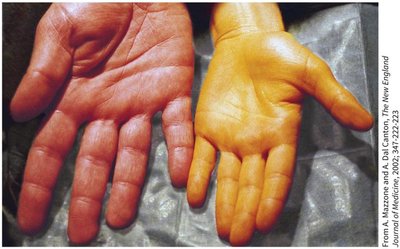
Vitamin A deficiency can lead to xerophthalmia (night blindness progressing to permanent blindness), abnormal jaw bone growth in children, and increased susceptibility to infections. Excess intake can cause toxicity, resulting in symptoms such as nausea, vomiting, headache, dizziness, blurred vision, lack of muscle coordination, birth defects, liver damage, and bone fractures. Excess beta-carotene can cause hypercarotenemia, a harmless condition where the skin turns orange.
Deficiency Symptoms: Night blindness, xerophthalmia, poor growth, dry skin, impaired immunity
Toxicity Symptoms: Headache, vomiting, hair loss, liver damage, skin changes, bone and muscle pain, birth defects
UL (Upper Limit): 3,000 µg/day of preformed vitamin A
Vitamin A in the Diet
Vitamin A is present in a variety of foods. Animal sources provide preformed vitamin A, while plant sources provide carotenoids. The following chart illustrates the vitamin A content in common foods relative to the recommended dietary allowance (RDA).
Vitamin D
Functions, Synthesis, and Dietary Sources
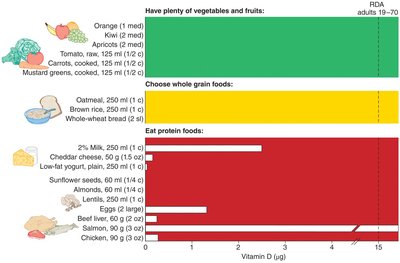
Vitamin D is known as the "sunshine vitamin" because it can be synthesized in the skin upon exposure to ultraviolet (UV) light. It is inactive until modified in the liver and kidneys. Vitamin D is essential in the diet when sunlight exposure is limited. It is found in few foods naturally, such as liver, fatty fish, mushrooms, and egg yolks, and is often added to fortified foods.
Key Functions: Maintains normal blood levels of calcium and phosphorus, bone health, gene expression, immune function, hormone-like activity
Sources: Liver, egg yolks, oily fish (salmon), fortified foods
RDA: Adults ≤70 years: 600 IU (15 µg)/day
Deficiency and Toxicity
Vitamin D deficiency impairs calcium absorption, leading to rickets in children (soft, misshapen bones) and osteomalacia in adults (weak bones and muscle pain). Excess vitamin D can cause high calcium concentrations in blood and urine, calcium deposition in soft tissues, and cardiovascular damage.
Deficiency Symptoms: Rickets, osteomalacia, increased risk of autoimmune diseases and chronic conditions
Toxicity Symptoms: Hypercalcemia, kidney damage, growth retardation
UL (Upper Limit): 100 µg/day
Vitamin E
Functions and Dietary Sources
Vitamin E (tocopherol) is a potent antioxidant that protects cell membranes and lipids from oxidative damage. The form absorbed by the human body is alpha-tocopherol. Vitamin E absorption depends on normal fat absorption and is incorporated into chylomicrons after absorption.
Key Functions: Antioxidant, immune modulation, inflammation reduction, gene regulation, inhibition of blood clot formation
Sources: Seeds, nuts, plant oils, leafy-green vegetables, wheat germ, fortified cereals
RDA: Adults: 15 mg alpha-tocopherol/day
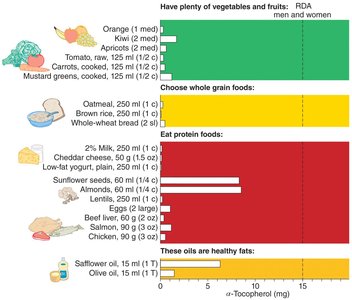
Deficiency and Toxicity
Vitamin E deficiency is rare in adults but can cause hemolytic anemia in newborns, poor muscle coordination, weakness, and impaired vision. There are no reported adverse effects from food sources, but large supplement doses can interfere with blood clotting.
Deficiency Symptoms: Hemolytic anemia, nerve damage, muscle weakness
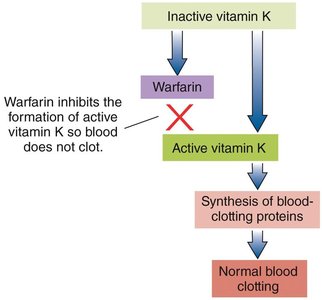
Toxicity Symptoms: Inhibition of vitamin K activity, increased bleeding risk
UL (Upper Limit): 1,000 mg/day from supplemental sources
Vitamin K
Functions and Dietary Sources
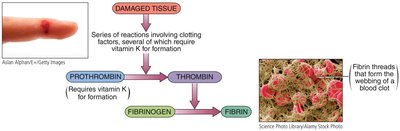
Vitamin K is essential for the synthesis of blood-clotting proteins and proteins involved in bone metabolism. It exists in several forms, including phylloquinone (from plants) and menaquinones (from bacteria and animal sources). Vitamin K also helps regulate cell growth and inhibits blood vessel calcification.
Key Functions: Blood clotting, bone formation, inhibition of vascular calcification, cell growth regulation
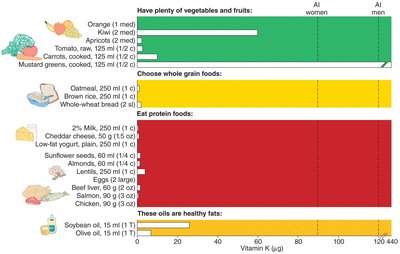
Sources: Leafy-green vegetables, some vegetable oils, synthesis by intestinal bacteria
RDA: Males: 120 µg/day; Females: 90 µg/day
Deficiency and Toxicity
Vitamin K deficiency leads to abnormal blood coagulation, resulting in bruising and uncontrolled bleeding, and reduced bone density. There are no reported adverse effects from food sources, but large doses can interfere with blood clotting, especially in those taking anticoagulant medications.
Deficiency Symptoms: Hemorrhage, reduced bone density
Toxicity Symptoms: Anemia and brain damage in infants (rare)
UL (Upper Limit): Not determined (ND)
Summary Table: Fat-Soluble Vitamins
Vitamin | Sources | Recommended Intake | Major Functions | Deficiency Symptoms | Groups at Risk | Toxicity/UL |
|---|---|---|---|---|---|---|
Vitamin A | Liver, fish, fortified milk, eggs, carrots, leafy greens, sweet potatoes | 700–900 µg/d | Vision, epithelial health, cell differentiation, immunity | Night blindness, xerophthalmia, poor growth, dry skin | Children, pregnant women, low-fat/protein diets | 3,000 µg/d (preformed) |
Vitamin D | Egg yolk, liver, fish oils, fortified milk, sunlight | 15–20 µg/d | Calcium/phosphorus absorption, bone health | Rickets, osteomalacia | Infants, elderly, low sun exposure | 100 µg/d |
Vitamin E | Vegetable oils, leafy greens, seeds, nuts | 15 mg/d | Antioxidant, cell membrane protection | Hemolytic anemia, nerve damage | Poor fat absorption, premature infants | 1,000 mg/d (supplements) |
Vitamin K | Leafy greens, vegetable oils, gut bacteria | 90–120 µg/d | Blood clotting, bone metabolism | Hemorrhage, bone fractures | Newborns, long-term antibiotics | ND |
Benefits and Risks of Fat-Soluble Vitamin Supplements
Supplement | Marketing Claim | Actual Benefits or Risks |
|---|---|---|
Vitamin A (retinoids) | Improves vision, prevents skin disorders, enhances immunity | Needed for vision, growth, reproduction, immunity; toxic at high doses, can cause birth defects and bone loss |
Carotenoids | Needed for vision, prevents skin disorders, antioxidant | Antioxidant; high doses can cause orange skin and increase lung cancer risk in smokers |
Vitamin D | Bone health, prevents multiple sclerosis | Needed for calcium absorption and bone maintenance; high doses cause heart and kidney damage |
Vitamin E | Prevents heart disease, improves immune function, reduces scar formation | Antioxidant; little evidence for heart disease prevention; high doses interfere with anticoagulant medications |
