 Back
BackFood Labels and Nutrition Facts: Study Guide with Step-by-Step Guidance
Study Guide - Smart Notes
 Tailored notes based on your materials, expanded with key definitions, examples, and context.
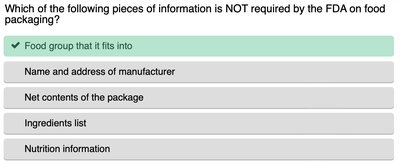
Q1. Which of the following pieces of information is NOT required by the FDA on food packaging?
Background
Topic: Food Labeling Regulations
This question tests your understanding of what information is legally required by the FDA to appear on packaged food labels in the United States.
Key Terms:
FDA (Food and Drug Administration): The federal agency responsible for regulating most food labeling.
Required Label Elements: These typically include the name and address of the manufacturer, net contents, ingredients list, and nutrition information.
Step-by-Step Guidance
Review the list of options and recall which elements are mandated by the FDA for packaged foods.
Think about the purpose of each required element (e.g., ingredients list for allergies, nutrition facts for dietary choices).
Identify which option is not directly related to consumer safety or nutrition transparency.
Eliminate the options that you know are always present on packaged foods due to FDA regulations.
Try solving on your own before revealing the answer!
Final Answer: Food group that it fits into
The FDA does not require food packaging to state the food group; the other options are all required elements.
Q2. Food manufacturers are not required to list allergens contained in a product. True or False?
Background
Topic: Allergen Labeling
This question tests your knowledge of allergen labeling laws and whether food manufacturers must disclose the presence of common allergens.
Key Terms:
Allergen Labeling: Refers to the requirement to list major food allergens (such as milk, eggs, peanuts, etc.) on food packaging.
Step-by-Step Guidance
Recall the Food Allergen Labeling and Consumer Protection Act (FALCPA) and its requirements.
Think about why allergen information is important for consumer safety.
Consider whether you have seen allergen statements on packaged foods and what they typically include.
Try solving on your own before revealing the answer!
Final Answer: False
Manufacturers are required to list major allergens on food labels to protect consumers with allergies.
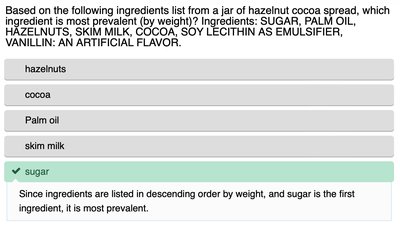
Q3. Based on the following ingredients list from a jar of hazelnut cocoa spread, which ingredient is most prevalent (by weight)?
Background
Topic: Ingredient List Order
This question tests your understanding of how ingredients are listed on food labels and what that order means for the product's composition.
Key Terms:
Ingredient List: Ingredients are listed in descending order by weight, meaning the first ingredient is present in the largest amount.
Step-by-Step Guidance
Read the provided ingredients list carefully.
Recall that the first ingredient listed is the one present in the highest quantity by weight.
Identify which ingredient appears first in the list.

Try solving on your own before revealing the answer!
Final Answer: Sugar
Since ingredients are listed in descending order by weight, and sugar is the first ingredient, it is the most prevalent.
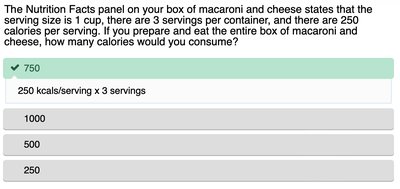
Q4. The Nutrition Facts panel on your box of macaroni and cheese states that the serving size is 1 cup, there are 3 servings per container, and there are 250 calories per serving. If you prepare and eat the entire box of macaroni and cheese, how many calories would you consume?
Background
Topic: Calculating Total Calories Consumed
This question tests your ability to use serving size and calories per serving to determine the total caloric intake if the entire package is consumed.
Key Terms and Formula:
Serving Size: The amount of food that is customarily eaten at one time.
Calories per Serving: The energy provided by one serving.
Total Calories Consumed:
Step-by-Step Guidance
Identify the number of servings per container (3 servings).
Identify the calories per serving (250 calories).
Multiply the number of servings by the calories per serving to find the total calories if the whole box is eaten.
Try solving on your own before revealing the answer!
Final Answer: 750 calories
250 calories per serving × 3 servings = 750 calories if you eat the entire box.
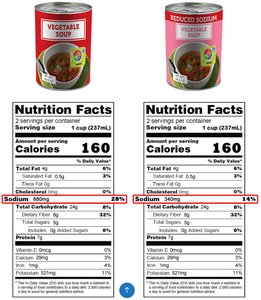
Q5. Check the vegetable soup labels in the “Putting the Nutrition Facts panel to work for you” section of this page. Based on the Nutrition Facts, both soup cans would be considered high in which nutrient?
Background
Topic: Interpreting Percent Daily Value (%DV)
This question tests your ability to use the Nutrition Facts panel to determine which nutrients are present in high amounts, based on %DV.
Key Terms:
% Daily Value (%DV): Indicates how much a nutrient in a serving of food contributes to a daily diet. 20% or more is considered high.
Step-by-Step Guidance
Look at the %DV for each nutrient listed on the soup labels.
Identify which nutrients have a %DV of 20% or higher in both soups.
Recall that a %DV of 20% or more means the food is considered high in that nutrient.
Try solving on your own before revealing the answer!
Final Answer: Fiber
Both soups have 32% DV for fiber, which is considered high (20% or more).
Q6. "Good source of fiber" is an example of a ________. "Low fat diets rich in fiber-containing grain products, fruits, and vegetables may reduce the risk of some types of cancer, a disease associated with many factors." is an example of a ________. "Supports digestive health" is an example of a ________.
Background
Topic: Types of Claims on Food Labels
This question tests your ability to distinguish between nutrient claims, health claims, and structure-function claims on food packaging.
Key Terms:
Nutrient Claim: Describes the level of a nutrient in a food (e.g., "good source of fiber").
Health Claim: Describes a relationship between a food or nutrient and a disease or health-related condition.
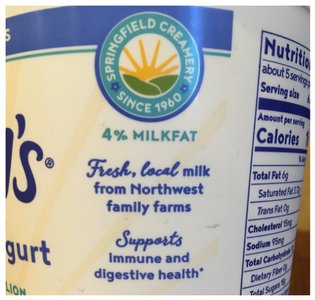
Structure-Function Claim: Describes the role of a nutrient or ingredient on the structure or function of the human body (e.g., "supports digestive health").
Step-by-Step Guidance
Read each statement and identify what it is describing (nutrient content, disease risk, or body function).
Recall the definitions of nutrient claims, health claims, and structure-function claims.
Match each statement to the correct type of claim based on its content and wording.
Try solving on your own before revealing the answer!
Final Answer:
"Good source of fiber" = Nutrient claim
"Low fat diets rich in fiber-containing grain products, fruits, and vegetables may reduce the risk of some types of cancer..." = Health claim
"Supports digestive health" = Structure-function claim
