 Back
BackGrowth, Development, and Aging: Prenatal to Late Adulthood
Study Guide - Smart Notes
 Tailored notes based on your materials, expanded with key definitions, examples, and context.
Growth, Development, and Aging
Introduction to Human Development
Human development is a continuous biological process involving modification and change from conception through late adulthood. Understanding the stages of development helps in studying the physiological, nutritional, and health needs at each life stage.
Development refers to the progressive changes in size, shape, and function throughout the lifespan.
Life stages are labeled for convenience but represent a continuum.

Prenatal Development
Fertilization to Implantation
The prenatal period begins at conception and continues until birth. The science of fetal growth and development is called embryology. Human life starts as a single cell and develops into a complex organism through a series of well-defined stages.
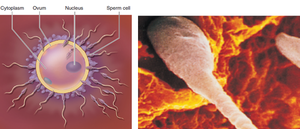
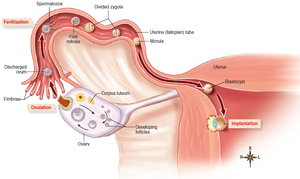
Fertilization typically occurs in the outer third of the oviduct (fallopian tube).
The fertilized ovum is called a zygote, which is genetically complete.
After about 3 days, the zygote becomes a morula (solid ball of cells).
Implantation in the uterine wall occurs about 10 days after fertilization.
Blastocyst Development and Implantation
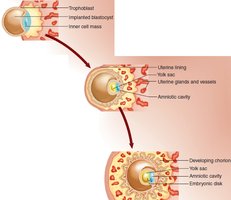
Continued cell division of the morula forms a blastocyst, a hollow ball of cells that implants in the uterine wall. The blastocyst forms the amniotic cavity and chorion, which are essential for fetal protection and nutrient exchange.
Amniotic cavity: Fluid-filled sac protecting the embryo.
Chorion: Develops into the placenta, facilitating nutrient and waste exchange between mother and fetus.
Chorionic villi: Extensions that connect embryonic circulation to the placenta.
Prenatal Periods of Development
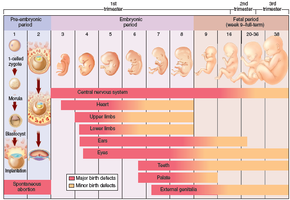
The prenatal period is divided into the embryonic and fetal phases, each characterized by specific developmental milestones.
Gestation period: Approximately 39 weeks.
Embryonic phase: Week 3 to week 8 after fertilization; major organ systems begin to form.
Fetal phase: Week 8 to birth; growth and maturation of organ systems.
Formation of the Primary Germ Layers
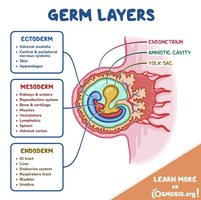
After implantation, three primary germ layers form in the embryo, each giving rise to specific tissues and organs.
Ectoderm: Outer layer; forms skin, nervous system, and sense organs.
Mesoderm: Middle layer; forms muscles, bones, cardiovascular system, and other organs.
Endoderm: Inner layer; forms the lining of the digestive and respiratory tracts, and associated organs.
Stem cells: Unspecialized cells capable of differentiating into specialized cell types.
Histogenesis and Organogenesis
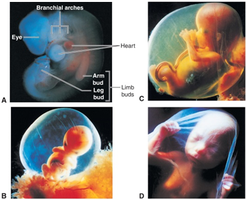
Organogenesis is the formation of organs from the primary germ layers, while histogenesis refers to the formation of tissues. By the fourth month of gestation, all organ systems are formed and functional, and subsequent development is primarily growth.
Key processes: cell differentiation, multiplication, growth, and rearrangement.
Birth and Labor
Parturition (Birth)
Birth, or parturition, marks the end of gestation. It involves a series of physiological events leading to the delivery of the fetus and placenta.
Uterus becomes irritable at the end of gestation.
Fetus assumes a head-down position.
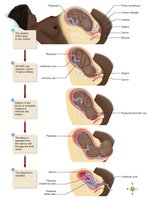
Labor begins with muscular contractions, rupture of the amniotic sac, and cervical dilation.
Stages of Labor
Stage One: Onset of contractions to complete cervical dilation.
Stage Two: Maximal cervical dilation to delivery of the baby.
Stage Three: Expulsion of the placenta.
Stage Four (sometimes used): Immediate recovery period after placenta delivery.
Multiple Births and Pregnancy Conditions
Monozygotic and Dizygotic Twins
Multiple births can result from the development of more than one embryo during a single pregnancy. Twins are classified based on their origin:
Monozygotic (identical) twins: Develop from a single fertilized egg that splits; genetically identical.
Dizygotic (fraternal) twins: Develop from two separate eggs fertilized by two different sperm; genetically distinct.
Fertility treatments can increase the likelihood of multiple births.
Major Conditions of Pregnancy
Ectopic pregnancy: Implantation outside the uterus, often in the fallopian tube.
Placenta previa: Placenta grows near or over the cervical opening, risking separation and hemorrhage.
Abruptio placentae: Premature separation of a normally placed placenta, causing fetal and maternal risk.
Preeclampsia: Pregnancy-induced hypertension, proteinuria, and edema; may progress to eclampsia.
Miscarriage: Spontaneous abortion before 20 weeks; stillbirth after 20 weeks.
Congenital conditions: Present at birth, may be inherited or caused by teratogens.
Postnatal Development
Divisions of the Postnatal Period
The postnatal period begins at birth and continues through the lifespan. It is divided into several stages, each with characteristic developmental changes.
Infancy: Birth to 18 months; rapid growth and development of motor skills.
Childhood: End of infancy to puberty; continued growth and development of coordination.
Adolescence: Puberty to adulthood; sexual maturation and growth spurts.
Adulthood: Maintenance of body tissues; eventual onset of degenerative changes.
Older adulthood (senescence): Degenerative changes in all organ systems; culminates in death.
Infancy
First 4 weeks: Neonatal period; major physiological adjustments (e.g., respiration, circulation).
By 4 months: Birth weight doubles; by 1 year, it triples.
By 12 months: 50% increase in body length.
Development of normal spinal curvature by 15 months.
Progression of motor skills: raising head (3 months), crawling (10 months), standing (12 months), running (18 months).
Childhood and Adolescence
Childhood: Rapid but decelerating growth; loss of baby teeth, development of permanent teeth.
Adolescence: Rapid growth, sexual maturation, appearance of secondary sex characteristics, growth spurts (girls ~10 years, boys ~12 years).
Adulthood and Older Adulthood
Adulthood: Growth plates close; maintenance of tissues; onset of degeneration.
Older adulthood (senescence): Degenerative changes in all organ systems; study of aging is called gerontology.
Theories of aging: Free-radical theory, genetic programming, diminished cellular reproduction.
Effects of Aging on Body Systems
Skeletal System
Changes in bone texture, calcification, and shape.
Development of bone spurs, increased porosity, and risk of fractures.
Degenerative joint diseases (e.g., osteoarthritis) are common.
Integumentary System
Skin becomes thin, dry, wrinkled, and inelastic.
Pigmentation problems and hair loss are frequent.
Central Nervous System
Increased risk of dementia and other degenerative conditions.
Some risk of depression.
Special Senses
Gradual decline in vision, hearing, taste, and smell.
Presbyopia (farsightedness), cataracts, glaucoma, and hearing loss are common.
Cardiovascular System
Degenerative heart and blood vessel diseases (e.g., atherosclerosis, arteriosclerosis).
Increased risk of hypertension and stroke.
Respiratory System
Calcification of costal cartilages, resulting in barrel chest.
Decreased respiratory efficiency and thickening of respiratory membrane.
Urinary System
Decrease in nephron number and kidney function.
Bladder muscle wasting leads to incomplete voiding.
Reproductive System and Menopause
Changes in sexual response and fertility.
Menopause in women (cessation of reproductive cycling, age 45–60).
Decreased estrogen leads to symptoms such as hot flashes and increased risk of osteoporosis and heart disease.
Hormone replacement therapy (HRT) has risks and benefits; new therapies are being developed.
