 Back
BackLipids: Structure, Function, Digestion, and Health Implications
Study Guide - Smart Notes
 Tailored notes based on your materials, expanded with key definitions, examples, and context.
Types of Lipids
Overview of Lipids
Lipids are a structurally and functionally diverse group of substances that are insoluble in water but soluble in organic solvents. They are classified as fats (solid at room temperature) and oils (liquid at room temperature). The main types of lipids include triglycerides, phospholipids, and sterols.
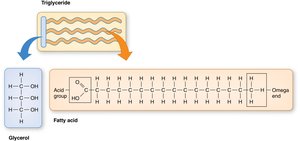
Triglycerides: The most abundant lipid in the diet and body, composed of three fatty acids and one glycerol molecule.
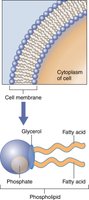
Phospholipids: Essential components of cell membranes, composed of glycerol, two fatty acids, and a phosphate group.
Sterols: Lipids with a ring structure, including cholesterol and phytosterols.

Triglycerides: Structure and Function
Triglycerides consist of three fatty acids attached to a glycerol backbone. Fatty acids are long chains of carbon atoms surrounded by hydrogen atoms.
Energy Provision: Triglycerides provide 9 kcal/gram and are the largest energy store in the body.
Structural Role: Building blocks for cell membranes.
Protection and Insulation: Protect internal organs and retain body heat.
Transport: Aid in the absorption of fat-soluble vitamins.
Satiety: Promote fullness and take longer to digest than carbohydrates or proteins.
Phospholipids: Structure and Function
Phospholipids are composed of a glycerol backbone, two fatty acids, and a phosphate group.
Cell Membrane: Structural components maintaining cell integrity.
Emulsification: Act as emulsifiers, keeping lipids soluble in water.
Amphiphilic Nature: Soluble in both water and fat.
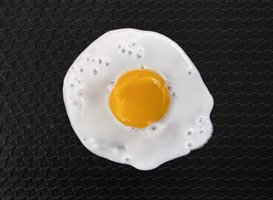
Example: Lecithin, found in egg yolks, wheat germ, peanuts, soybeans, and organ meats.
Sterols: Structure and Function
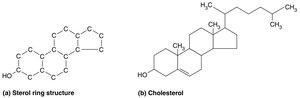
Sterols, such as cholesterol, have a multi-ring structure and are lipophilic.
Cholesterol: Found in animal products and synthesized by the liver and intestine.
Phytosterols: Found in plants and reduce cholesterol absorption.
Functions: Structural component of cell membranes, precursor for hormone synthesis (e.g., estrogen), bile acid synthesis, and vitamin D production. Cholesterol is not used for energy.
Classification of Fatty Acids
Chain Length
Fatty acids are classified by the length of their carbon chain:
Short chain: <6 carbons
Medium chain: 6–12 carbons
Long chain: >14 carbons
Chain length affects digestion, absorption, and transport.
Degree of Saturation
Fatty acids are also classified by their degree of saturation:
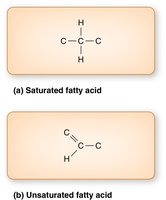
Saturated fatty acids (SFA): No double bonds; all carbons are saturated with hydrogen.
Monounsaturated fatty acids (MUFA): One double bond.
Polyunsaturated fatty acids (PUFA): Two or more double bonds.
Shape and Physical Properties
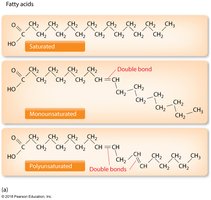
Saturated fatty acids: Straight chains, pack tightly, solid at room temperature.
Unsaturated fatty acids: Kinked/bent chains, do not stack well, liquid at room temperature.
Dietary Sources
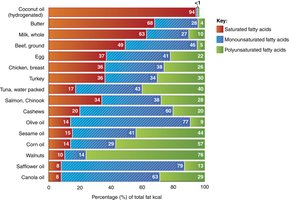
Animal fats: High in SFAs (e.g., butter, cream, whole milk, beef, lard).
Plant fats: Usually lower in SFAs, except coconut and palm kernel oil.
MUFA and PUFA: Found in olive oil, canola oil, nuts, seeds, and fish; generally protective for health.
Unsaturated Fatty Acids: Configuration
Cis and Trans Configurations
The hydrogen atoms at the unsaturated region can be arranged in different positions:
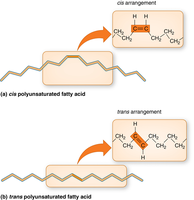
Cis: Hydrogens on the same side of the double bond; bent shape; most common in nature.
Trans: Hydrogens on opposite sides; straighter chain; acts like SFA; created by hydrogenation.
Essential Fatty Acids
Omega-6 and Omega-3 Fatty Acids
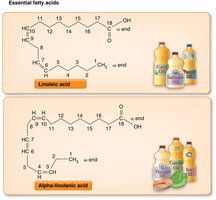
Essential fatty acids cannot be synthesized by the body and must be obtained from the diet.
Omega-6 (Linoleic acid): Found in vegetable and nut oils.
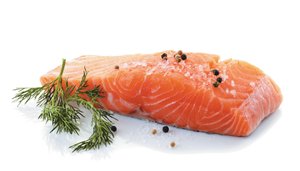
Omega-3 (Alpha-linolenic acid): Found in dark green leafy vegetables, flaxseeds, soybeans, walnuts, and canola oil. EPA and DHA are found in fish and fish oils.
Functions and Deficiency
Essential fatty acids are precursors to eicosanoids, which regulate blood clotting, blood pressure, inflammation, and immune function. Deficiency can result in growth failure, scaly skin, reproductive failure, and poor immunity.
Digestion and Absorption of Lipids
Overview of Lipid Digestion
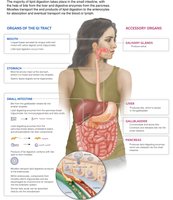
Lipid digestion begins in the mouth and stomach but is primarily completed in the small intestine.
Mouth: Lingual lipase initiates minimal digestion.
Stomach: Gastric lipase and mixing break lipids into smaller droplets.
Liver: Produces bile, which emulsifies fats.
Pancreas: Secretes pancreatic lipases into the small intestine.
Small Intestine: Bile and Lipase Action
Bile is secreted from the gallbladder into the small intestine, increasing the surface area for digestion. Pancreatic lipase breaks triglycerides into monoglycerides and fatty acids. 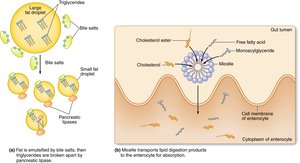
Micelle Formation and Absorption
Micelles are water-soluble spheres of bile and phospholipids that trap digestion byproducts and transport them to enterocytes for absorption. 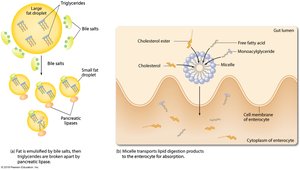
Transport of Lipids
Lipoproteins
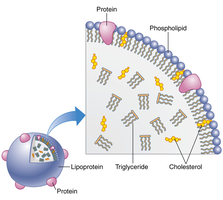
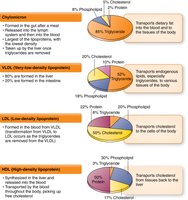
Lipoproteins are transport vehicles made of lipids and proteins, carrying triglycerides and cholesterol in the bloodstream. Types include:
Chylomicrons: Remove absorbed fats from the small intestine.
VLDL: Transport triglycerides from the liver to cells.
LDL: Deliver cholesterol to cells; high levels increase CVD risk.
HDL: Pick up cholesterol and bring it to the liver; high levels decrease CVD risk.
Cardiovascular Disease and Lipids
Overview and Pathology
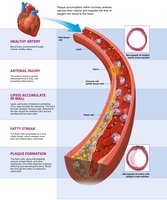
Cardiovascular disease (CVD) includes dysfunction of the heart or blood vessels, such as coronary heart disease and stroke. Atherosclerosis is the hardening of arteries due to plaque buildup, which can lead to angina, ischemia, and myocardial infarction. 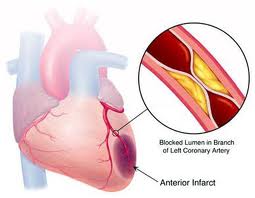
Risk Factors and Prevention
Nonmodifiable: Age, sex, heredity.
Modifiable: Diet, physical activity, tobacco use, sleep, weight, cholesterol, blood sugar, blood pressure.
Dietary Strategies for CVD Prevention
Reduce total fat and saturated fat intake.
Decrease trans fat and dietary cholesterol.
Increase omega-3 fatty acid and dietary fiber intake.
Consume vitamins B6, B12, and folate.
Maintain healthy blood glucose, avoid smoking, and stay active.
Lifestyle Strategies
Exercise most days of the week.
Maintain a healthful body weight.
Reduce caloric intake and increase physical activity.
Decrease stress and increase HDL levels.
Summary Table: Types of Lipids
Type | Structure | Function | Food Sources |
|---|---|---|---|
Triglycerides | 3 fatty acids + glycerol | Energy, insulation, protection | Animal fats, plant oils |
Phospholipids | Glycerol + 2 fatty acids + phosphate | Cell membrane, emulsification | Egg yolk, soybeans |
Sterols | Multi-ring structure | Cell membrane, hormone precursor | Animal products, plants |
Key Equations
Energy from fat:
Fatty acid notation: (e.g., for oleic acid)
