 Back
Nutrition 225 Midterm 1 Study Guide: Key Concepts and Mechanisms
Study Guide - Smart Notes
 Tailored notes based on your materials, expanded with key definitions, examples, and context.
Science of Nutrition
Factors Influencing Food Choice
Food choices are influenced by a variety of factors, with taste being one of the most significant. Other influences include cultural preferences, health concerns, availability, and social factors.
Taste: Primary determinant for most individuals.
Additional info: Other factors may include cost, convenience, and advertising.
Tools for Healthful Eating
Experimental vs. Observational Research
Nutrition science relies on both experimental and observational research to understand dietary impacts.
Experimental Research: Researcher assigns interventions (e.g., diet, supplement) to participants.
Observational Research: Researcher observes existing behaviors and looks for associations.
Key Difference: Experimental research can establish causation; observational research identifies correlations.
Dietary Reference Intakes (DRIs)
DRIs are a set of reference values used to assess and plan nutrient intakes.
EAR (Estimated Average Requirement): Meets needs of 50% of a specific group.
RDA (Recommended Dietary Allowance): Meets needs of 97–98% of a group.
UL (Tolerable Upper Intake Level): Highest daily intake unlikely to cause harm.
Acceptable Macronutrient Distribution Ranges (AMDR)
AMDRs provide recommended ranges for macronutrient intake as a percentage of total calories.
Carbohydrates: 45–65%
Fat: 20–35%
Protein: 10–35%
Label Claims
Food labels may include several types of claims, each regulated differently.
Nutrient Content Claim: Describes amount of nutrient (e.g., "low sodium").
Structure/Function Claim: Describes role of nutrient in normal body function (e.g., "Calcium builds strong bones").
Authorized Health Claim: Links food to reduced disease risk (e.g., "Diets low in saturated fat may reduce heart disease risk").
Mindful Eating S's
Mindful eating encourages awareness and enjoyment of food.
Smile
Slow
Savor
2020 Nutrition Label Updates
Americans are encouraged to consume more of certain nutrients, as reflected in updated nutrition labels.
Vitamin D
Iron
Potassium
Calcium
Nutrient Density
Nutrient density refers to the amount of nutrients per calorie in a food.
High Nutrient Density: Spinach, berries, salmon
Low Nutrient Density: Donuts, soda, candy
The Human Body & Digestion
Enzymes in Digestion and Location of Action
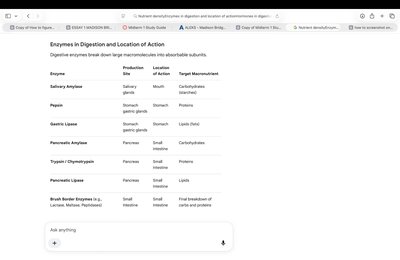
Digestive enzymes break down macromolecules into absorbable subunits. Each enzyme has a specific site of production and action, targeting particular nutrients.
Salivary Amylase: Produced in salivary glands; acts in mouth; targets carbohydrates.
Pepsin: Produced in stomach glands; acts in stomach; targets proteins.
Gastric Lipase: Produced in stomach glands; acts in stomach; targets lipids.
Pancreatic Amylase: Produced in pancreas; acts in small intestine; targets carbohydrates.
Trypsin/Chymotrypsin: Produced in pancreas; acts in small intestine; targets proteins.
Pancreatic Lipase: Produced in pancreas; acts in small intestine; targets lipids.
Brush Border Enzymes: Produced in small intestine; act in small intestine; target final breakdown of carbohydrates and proteins.
Hormones in Digestion
Digestive hormones regulate the process of digestion by controlling enzyme release, motility, and nutrient absorption.
Insulin: Signals cells to store glucose; released after eating.
Glucagon: Signals release of stored glucose; released when blood glucose drops.
Additional info: Other hormones include gastrin, secretin, and cholecystokinin (CCK).
Transportation of Nutrients
Nutrients are absorbed from the small intestine and transported via two main routes.
Blood (Portal Vein): Water-soluble nutrients go directly to the liver.
Lymph: Fat-soluble nutrients enter the lymphatic system before reaching the bloodstream.
Types of Absorption
Absorption mechanisms include passive and active transport.
Passive Absorption: Nutrients move from high to low concentration without energy.
Additional info: Active absorption requires energy and carrier proteins.
Carbohydrates
Types of Carbohydrates
Carbohydrates are classified based on their chemical structure.
Monosaccharides: Single sugar units (e.g., glucose, fructose).
Disaccharides: Two sugar units (e.g., sucrose).
Parts of a Whole Grain
Whole grains contain three main components, each with unique nutritional benefits.
Endosperm: Starch-rich center.
Bran: Fiber-rich outer layer.
Germ: Nutrient-rich core.
Hormones Insulin and Glucagon
Insulin and glucagon are key hormones in carbohydrate metabolism.
Insulin: Promotes storage of glucose.
Glucagon: Promotes release of glucose from storage.
Purpose of Glycogen
Glycogen serves as the body's stored carbohydrate, providing quick access to glucose when needed.
Stored in: Liver and muscles.
Function: Maintains blood glucose during fasting or intense activity.
4-4-9 Rule for Calculating Calories
The 4-4-9 rule helps determine the caloric value of macronutrients.
Protein: 4 kcal/gram
Carbohydrate: 4 kcal/gram
Fat: 9 kcal/gram
Example Calculation:
10g protein x 4 = 40 kcal
15g carbs x 4 = 60 kcal
5g fat x 9 = 45 kcal
Total = 145 kcal
Proteins, Lipids, and Other Nutrients
6 Essential Nutrients
The body requires six essential nutrients for health and function.
Carbohydrates
Lipids
Proteins
Vitamins
Minerals
Water
Nutrition & Genetics
Nutrigenetics
Nutrigenetics studies how individual genetic differences affect responses to nutrients and diet.
Application: Personalized nutrition recommendations based on genetic profile.
Functional Foods & Phytochemicals
Phytonutrients, Zoochemicals, Functional Foods
Functional foods contain bioactive compounds that provide health benefits beyond basic nutrition.
Phytonutrients: Natural chemicals made by plants (e.g., flavonoids).
Zoochemicals: Compounds found in animal-derived foods (e.g., omega-3 fatty acids).
Functional Foods: Foods with added health benefits (e.g., fortified cereals).
Gut Health
Prebiotics vs. Probiotics
Gut health is supported by both prebiotics and probiotics.
Probiotics: Live beneficial microbes (bacteria or yeast) that support gut health.
Prebiotics: Foods that feed beneficial microbes (e.g., fiber).
Mnemonic: Pro = the bugs; Pre = the food for bugs.
Additional Carbohydrate Terms
Glycogen, Glucagon, Gluconeogenesis, Glycogenolysis, Insulin, Sucrose
These terms describe key processes and molecules in carbohydrate metabolism.
Glycogen: Stored form of glucose in liver and muscles.
Glucagon: Hormone released when blood glucose drops; stimulates glycogen breakdown.
Gluconeogenesis: Formation of glucose from non-carbohydrate sources.
Glycogenolysis: Breakdown of glycogen to release glucose.
Insulin: Hormone that promotes glucose uptake and storage.
Sucrose: Disaccharide composed of glucose and fructose.
