 Back
BackStudy Guide: Understanding Dietary Reference Intakes (DRIs) and Nutritional Guidelines
Study Guide - Smart Notes
 Tailored notes based on your materials, expanded with key definitions, examples, and context.
Q1. According to the AMDR, which macronutrient should make up the largest proportion of a healthy person's energy intake?
Background
Topic: Acceptable Macronutrient Distribution Range (AMDR)
This question tests your understanding of the recommended distribution of macronutrients (carbohydrates, protein, fat) in a healthy diet, as defined by the AMDR.
Key Terms and Formulas
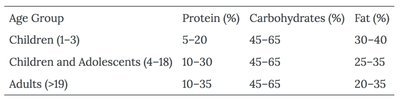
AMDR: The range of intake for a particular energy source (macronutrient) that is associated with reduced risk of chronic disease while providing adequate intakes of essential nutrients.
Carbohydrates: Typically recommended to provide the largest percentage of daily energy intake.
Protein and Fat: Also essential, but recommended in smaller proportions compared to carbohydrates.
Step-by-Step Guidance
Review the AMDR values for each macronutrient (protein, carbohydrates, fat) for adults and children.
Compare the percentage ranges for each macronutrient to determine which is the largest.
Recall that the macronutrient with the highest recommended percentage should make up the largest proportion of energy intake.
Try solving on your own before revealing the answer!
Final Answer: Carbohydrate
According to the AMDR, carbohydrates should make up the largest proportion of a healthy person's energy intake (45–65%).
Q2. The Estimated Energy Requirement represents a __________ estimate for how many calories a person should consume each day.
Background
Topic: Estimated Energy Requirement (EER)
This question tests your understanding of what the EER represents in terms of accuracy and purpose for daily calorie recommendations.
Key Terms and Formulas
EER: The average dietary energy intake that is predicted to maintain energy balance in a healthy individual.
It is based on factors such as age, sex, weight, height, and physical activity level.
Step-by-Step Guidance
Recall that the EER is not an exact value but an estimate based on population averages and individual characteristics.
Consider the options: complete, ballpark, exact, precise. Which best describes an estimate that is not exact but gives a reasonable range?
Think about why the EER is used in nutrition planning and how it helps guide, but not dictate, calorie intake.
Try solving on your own before revealing the answer!
Final Answer: ballpark
The EER is a 'ballpark' estimate, meaning it provides a reasonable range rather than an exact number.
Q3. Which of the DRI values is the amount of a nutrient that meets the requirements of 50 percent of people within a group of the same life stage and sex?
Background
Topic: Dietary Reference Intakes (DRIs) – Estimated Average Requirement (EAR)
This question tests your knowledge of the different types of DRI values and their definitions, specifically the EAR.
Key Terms and Formulas
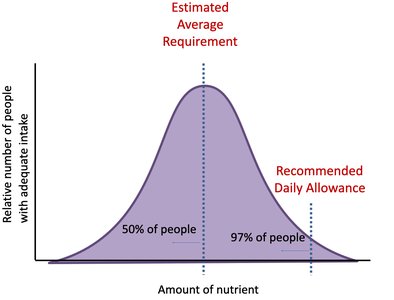
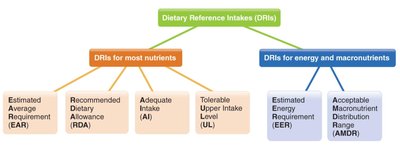
EAR (Estimated Average Requirement): The daily intake value estimated to meet the requirement of half the healthy individuals in a particular life stage and gender group.
RDA (Recommended Dietary Allowance): Meets the needs of nearly all (97–98%) healthy individuals.
AI (Adequate Intake): Used when there is not enough evidence to establish an EAR.
AMDR: Range for macronutrient intake.
Step-by-Step Guidance
Review the definitions of each DRI value (EAR, RDA, AI, AMDR).
Identify which value is specifically set to meet the needs of 50% of the population.
Recall that this value is used as the basis for setting the RDA.
Try solving on your own before revealing the answer!
Final Answer: EAR
The EAR is the DRI value that meets the requirements of 50% of people in a group.
Q4. Which of the DRI values is a "best guess" of how much of a nutrient is needed, when there isn't enough evidence to establish a more precise recommended amount?
Background
Topic: Adequate Intake (AI)
This question tests your understanding of when and why the AI value is used instead of the EAR or RDA.
Key Terms and Formulas
AI (Adequate Intake): Set when there is not enough evidence to establish an EAR and RDA. It is based on observed or experimentally determined estimates of nutrient intake by a group of healthy people.
UL (Tolerable Upper Intake Level): Maximum daily intake unlikely to cause adverse health effects.
Step-by-Step Guidance
Recall the situations in which an AI is established (lack of sufficient scientific evidence for EAR/RDA).
Consider the definition of a "best guess" in the context of nutrition recommendations.
Compare AI to other DRI values to see which fits this description.
Try solving on your own before revealing the answer!
Final Answer: AI
AI is used as a "best guess" when there is not enough evidence to set an EAR or RDA.
Q5. Which DRI value for vitamins and minerals is the average daily intake level required to meet the needs of 97-98% of healthy people in a particular life stage and sex group?
Background
Topic: Recommended Dietary Allowance (RDA)
This question tests your understanding of the RDA and how it is used to set nutrient recommendations for the majority of the population.
Key Terms and Formulas
RDA (Recommended Dietary Allowance): The average daily dietary intake level sufficient to meet the nutrient requirement of nearly all (97–98%) healthy individuals in a particular life stage and gender group.
EAR: Meets the needs of 50% of the population.
Step-by-Step Guidance
Review the definitions of RDA, EAR, AI, and AMDR.
Identify which value is set to cover the needs of nearly all healthy individuals (97–98%).
Recall that the RDA is statistically derived from the EAR.
Try solving on your own before revealing the answer!
Final Answer: RDA
The RDA is set to meet the needs of 97–98% of healthy people in a group.
Q6. There is both an RDA and AI established for each nutrient. True or False?
Background
Topic: DRI Values – RDA and AI
This question tests your understanding of how DRI values are established and whether both RDA and AI exist for every nutrient.
Key Terms and Formulas
RDA: Established when there is enough scientific evidence.
AI: Used when there is not enough evidence to set an RDA.
Step-by-Step Guidance
Recall the process for establishing RDA and AI values.
Consider whether both values are set for every nutrient, or if only one is used depending on available evidence.
Think about examples where only an AI is set (e.g., for some nutrients in infants).
Try solving on your own before revealing the answer!
Final Answer: False
Not every nutrient has both an RDA and an AI; usually, only one is established depending on the evidence.
Q7. Your brother tells you that he's taking a high-dose zinc supplement, because he's heard it might help prevent the common cold. You want to be sure the supplement is safe and doesn't contain excessive levels of zinc. Which DRI value would be most helpful to you in answering this question?
Background
Topic: Tolerable Upper Intake Level (UL)
This question tests your understanding of which DRI value is used to assess the safety of nutrient intake, especially regarding the risk of toxicity from excessive intake.
Key Terms and Formulas
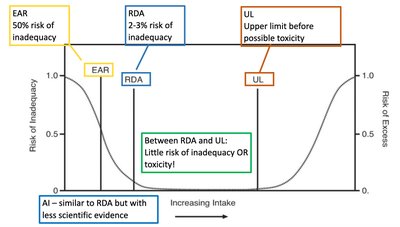
UL (Tolerable Upper Intake Level): The highest average daily nutrient intake level likely to pose no risk of adverse health effects for almost all individuals.
Intake above the UL increases the risk of toxicity.
Step-by-Step Guidance
Recall which DRI value is specifically designed to indicate the maximum safe intake of a nutrient.
Consider why the UL is important when evaluating supplements or fortified foods.
Think about the consequences of exceeding the UL for a nutrient like zinc.
Try solving on your own before revealing the answer!
Final Answer: UL
The UL helps determine the maximum safe intake of a nutrient to avoid toxicity.
Q8. Every vitamin and mineral has a UL established for it. True or False?
Background
Topic: Tolerable Upper Intake Level (UL)
This question tests your understanding of whether all nutrients have a UL value established, or if some do not due to insufficient evidence or low risk of toxicity.
Key Terms and Formulas
UL: Only established when there is enough evidence to determine a safe upper intake level.
Some nutrients do not have a UL due to lack of data or low risk of toxicity.
Step-by-Step Guidance
Recall the criteria for establishing a UL for a nutrient.
Consider whether all vitamins and minerals have sufficient evidence to set a UL.
Think about examples where a UL is not determined (e.g., vitamin K).
Try solving on your own before revealing the answer!
Final Answer: False
Not every vitamin and mineral has a UL; some do not due to insufficient evidence or low risk of toxicity.
