 Back
BackThe Digestive System: Structure, Function, and Nutrient Absorption
Study Guide - Smart Notes
 Tailored notes based on your materials, expanded with key definitions, examples, and context.
The Human Body & Digestion
Levels of Organization in the Human Body
The human body is organized into hierarchical levels, each contributing to overall function and health. Understanding these levels is essential for comprehending how nutrients are processed and utilized.
Cellular Level: Cells are the basic structural and functional units of life. All cells contain DNA, proteins, and a cell membrane.
Tissue Level: Tissues are groups of similar cells working together. Four main types: connective, epithelial, muscle, and nerve.
Organ Level: Organs are structures composed of multiple tissue types, performing specific functions (e.g., brain, liver, heart).
Organ System Level: Organ systems are groups of organs working together for a common purpose, such as the digestive system.
Organism Level: The complete living entity capable of all life processes.
Example: The digestive system is an organ system responsible for breaking down food and absorbing nutrients. 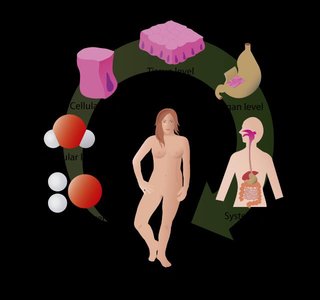
Overview of Digestion
Digestion is a multistep process that breaks down food into absorbable nutrients. It involves both mechanical and chemical processes.
Mechanical Digestion: Physical breakdown of food (e.g., chewing, churning).
Chemical Digestion: Enzymatic and acid-mediated breakdown of macromolecules.
Absorption: Uptake of nutrients into the circulatory or lymphatic systems.
Excretion: Removal of indigestible substances and waste.
Example: Salivary amylase begins starch digestion in the mouth. 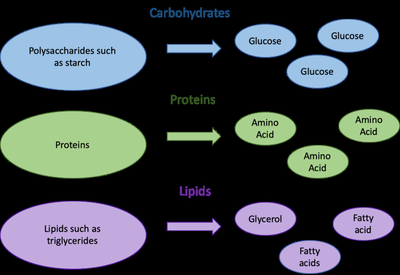
The Digestive Tract and Accessory Organs
Anatomy of the Digestive System
The digestive system consists of a continuous tube (digestive tract) and accessory organs that aid in digestion.
Digestive Tract: Mouth, pharynx, esophagus, stomach, small intestine, large intestine, rectum, and anus.
Accessory Organs: Salivary glands, liver, gallbladder, pancreas.
Mucosal Tissue: Lines the tract, secreting digestive juices and mucus.
Muscle Tissue: Smooth muscle contracts to move food via peristalsis.
Example: The liver produces bile, which is stored in the gallbladder and released into the small intestine. 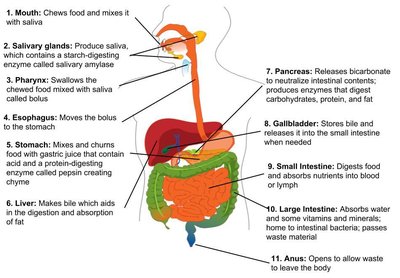
Processes of Digestion: From Mouth to Stomach
Digestion begins with ingestion and continues with mechanical and chemical breakdown.
Ingestion: Intake of food, triggered by hunger and sensory cues.
Mechanical Breakdown: Mastication (chewing) forms a bolus for swallowing.
Chemical Breakdown: Enzymes like salivary amylase and lingual lipase start digestion.
Swallowing: Bolus moves from mouth to pharynx, then esophagus.
Peristalsis: Wave-like muscle contractions propel food to the stomach.
Sphincters: Muscular valves regulate passage between sections.
Example: The epiglottis prevents food from entering the trachea during swallowing. 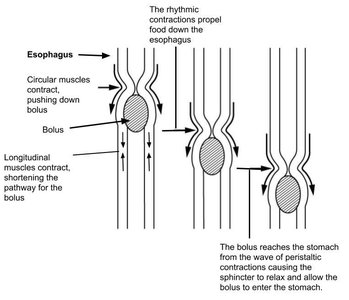
Stomach and Small Intestine: Digestion and Absorption
The stomach and small intestine are key sites for digestion and nutrient absorption.
Stomach: Produces gastric juice (hydrochloric acid and pepsin) for protein digestion and bacterial destruction.
Chyme: Semiliquid mass formed by stomach churning.
Pyloric Sphincter: Controls passage of chyme to the small intestine.
Small Intestine: Divided into duodenum, jejunum, and ileum. Receives pancreatic juice (enzymes and bicarbonate) and bile for digestion.
Pancreas: Secretes enzymes for protein, carbohydrate, and lipid digestion.
Gallbladder: Releases bile to emulsify fats.
Muscle Contractions: Peristalsis propels chyme; segmentation mixes and slows movement for absorption.
Example: Bile acts like detergent, aiding lipid digestion in the watery environment of the intestine. 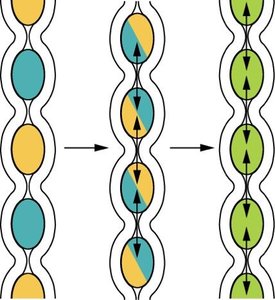
Structure and Function of the Small Intestine
The small intestine is specialized for efficient nutrient absorption.
Surface Area: Over 200 square meters due to folds, villi, and microvilli.
Villi: Finger-like projections increase absorption area.
Microvilli: Further increase surface area and contain transport proteins.
Absorptive Cells: Transport nutrients into blood or lymph.
Example: Amino acids and sugars enter capillaries; lipids enter lymphatic vessels. 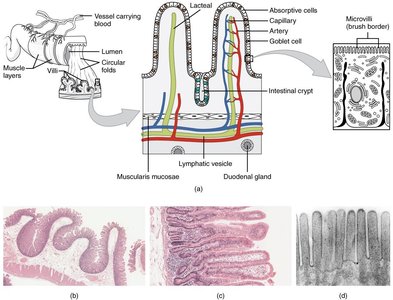
From Small Intestine to Large Intestine and Excretion
The large intestine absorbs water and compacts waste for excretion.
Ileocecal Valve: Regulates passage from small to large intestine.
Water Absorption: Conserves water from digestive juices and food.
Bacterial Action: Microbes digest some fibers and produce beneficial compounds.
Excretion: Feces are formed and expelled through the anus.
Example: Nearly 50% of fecal content is live and dead bacteria.
Nutrient Absorption and Distribution
Absorption Pathways
Nutrients are absorbed and distributed to cells for energy and building blocks.
Water-Soluble Nutrients: Glucose, amino acids, vitamins, and minerals enter blood and travel to the liver via the portal vein.
Lipid-Soluble Nutrients: Lipids and fat-soluble vitamins enter the lymphatic system before reaching the bloodstream.
Liver Function: Regulates nutrient distribution and metabolic homeostasis.
Fed vs. Fasted State: Liver stores nutrients after eating and exports them during fasting.
Example: The liver releases glucose in response to blood hormone signals. 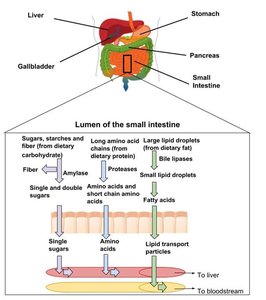
Summary Table: Digestive System Functions
Region/Organ | Main Function |
|---|---|
Mouth | Mechanical breakdown, saliva production, starch digestion |
Pharynx & Esophagus | Swallowing, peristalsis |
Stomach | Churning, protein digestion, acid secretion |
Small Intestine | Enzymatic digestion, nutrient absorption |
Large Intestine | Water absorption, bacterial fermentation, waste formation |
Liver | Bile production, nutrient regulation |
Gallbladder | Bile storage and release |
Pancreas | Enzyme and bicarbonate secretion |
Key Terms and Concepts
Peristalsis: Wave-like muscle contractions moving food through the digestive tract.
Segmentation: Circular muscle contractions mixing chyme and enhancing absorption.
Chyme: Semiliquid mass of partially digested food.
Villi & Microvilli: Structures increasing surface area for absorption.
Bile: Fluid produced by the liver, stored in the gallbladder, emulsifies fats.
Portal Vein: Major blood vessel transporting nutrients from intestine to liver.
Relevant Equations
ATP Production from Glucose:
Protein Digestion:
Starch Digestion:
Additional info: Academic context was added to clarify the function of each digestive region and the absorption pathways.
