 Back
BackThe Science of Taste: Structure and Function in Human Nutrition
Study Guide - Smart Notes
 Tailored notes based on your materials, expanded with key definitions, examples, and context.
The Human Body & Digestion
The Sense of Taste: Evolutionary Importance
The sense of taste is a critical component of human nutrition, serving as an evolutionary mechanism for identifying safe and nutritious foods. Taste is closely linked to emotion and survival, as certain flavors signal the presence of nutrients or potential toxins.
Survival Function: Bitter and sour tastes often indicate poisonous or spoiled foods, while sweet and salty flavors are associated with nutrient-rich foods.
Emotional Response: Taste is strongly connected to emotional reactions due to its link with the involuntary nervous system.
Flavor Perception: The full experience of flavor involves not only taste but also smell, texture, and temperature.
Smell and Taste: The sense of smell enhances taste perception; impairment of smell dulls taste.
Basic Tastes and Their Chemical Basis
Humans perceive at least five basic tastes, each with distinct chemical triggers and physiological functions. These tastes are detected by specialized sensory cells on the tongue and throughout the oral cavity.
Sweet: Caused by sugars (e.g., glucose, fructose, lactose), some amino acids, and alcohols. Indicates energy-rich foods.
Sour: Triggered by hydrogen ions () from acids in solution (e.g., lemon juice, organic acids).
Salty: Resulting from mineral salts, primarily sodium chloride (), but also potassium and magnesium salts.
Bitter: Produced by a wide variety of substances; about 35 different proteins in sensory cells respond to bitterness. Evolutionarily important for detecting toxins.
Savory (Umami): Caused by amino acids such as glutamic acid and aspartic acid, found in protein-rich foods (e.g., meat, cheese, tomatoes).
Additional info: Research is ongoing regarding other possible basic tastes, including fatty, alkaline, metallic, and water-like sensations. Fatty taste is thought to be detected by receptors responding to fatty acids such as linoleic acid.
Myths and Facts About Taste Zones
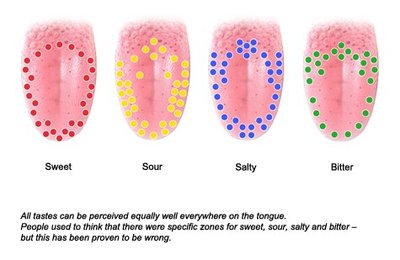
Contrary to popular belief, all basic tastes can be perceived across the entire surface of the tongue, with only slight variations in sensitivity.
Myth: The tongue has specific zones for each taste.
Fact: All tastes are sensed by all parts of the tongue, though the sides are generally more sensitive.
Exception: The back of the tongue is particularly sensitive to bitter tastes, aiding in the detection of toxins before swallowing.
Structure of Taste Perception: From Substance to Signal
Taste perception begins when chemical substances in food interact with sensory cells on the tongue. These cells transmit signals to the brain, resulting in the conscious experience of flavor.
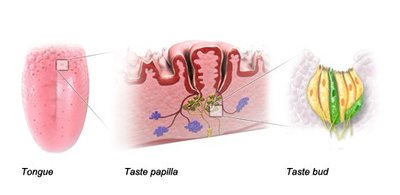
Taste Papillae: Wart-like bumps on the tongue's mucous membrane that contain sensory cells.
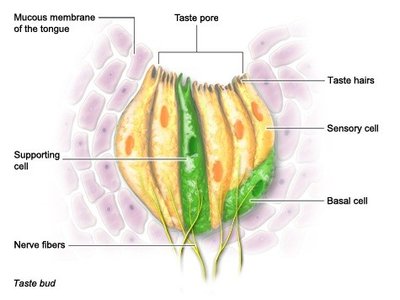
Taste Buds: Clusters of sensory cells within papillae, shaped like flower buds or oranges, with a central pore for detecting dissolved substances.
Signal Transmission: Chemical substances activate proteins in sensory cells, which then release messenger substances to nerve cells. These signals are sent to the brain via cranial nerves.
Types of Taste Papillae
There are three main types of taste papillae, each with distinct locations and functions:
Fungiform Papillae: Most numerous (200–400), found mainly at the tip and edges of the tongue. Each contains 3–5 taste buds and also detects touch and temperature.
Circumvallate Papillae: Large, round, and located at the base of the tongue. Each contains several thousand taste buds and is surrounded by a trench with glands for rinsing taste substances.
Foliate Papillae: Found on the rear edges of the tongue, arranged in folds. Each has several hundred taste buds.
Taste Buds: Anatomy and Renewal
Taste buds are the primary organ for taste, containing numerous sensory cells connected to nerve fibers. Adults have between 2,000 and 4,000 taste buds, which are renewed weekly.
Structure: Each taste bud contains 10–50 sensory cells, forming a capsule with a fluid-filled pore at the tip.
Taste Hairs: Finger-shaped extensions that bind chemicals for tasting.
Location: Mostly on the tongue, but also in the throat, epiglottis, nasal cavity, and upper esophagus.
Renewal: Sensory cells are replaced approximately every week.
Neural Pathways and Flavor Perception
Taste signals are transmitted to the brain via several cranial nerves, reaching both conscious and unconscious centers. The combination of taste, smell, touch, and temperature creates a virtually limitless palette of flavors.
Signal Processing: Some nerve fibers carry taste signals to conscious perception, while others go directly to survival-related brain regions.
Flavor Complexity: Sensory cells vary in sensitivity, allowing for a wide range of flavor experiences.
Flavor Calculation: Assuming 5 basic tastes and 10 intensity levels, up to 100,000 different flavors are possible.
Example: The combination of sweet and sour in fruit, or salty and savory in meat dishes, demonstrates the complexity of flavor perception.
Additional info: The full experience of flavor is produced by integrating signals from multiple sensory modalities, including touch, temperature, and smell.
