 Back
BackWeight Management and Energy Balance: Study Notes
Study Guide - Smart Notes
 Tailored notes based on your materials, expanded with key definitions, examples, and context.
Weight Management
Energy Balance
Energy balance is a fundamental concept in nutrition, referring to the relationship between energy intake (from food and beverages) and energy output (expenditure). Maintaining body weight requires that energy intake equals energy output. Positive energy balance leads to weight gain, while negative energy balance results in weight loss. Many factors influence both intake and expenditure, some controllable and others not.
Energy Intake: Calories consumed from macronutrients (carbohydrates, proteins, fats).
Energy Output: Calories expended through basal metabolism, digestion, and physical activity.
Body Weight: Reflects overall energy balance; maintained when intake equals output.
Positive Energy Balance: Intake > Output; excess nutrients stored or used for growth.
Negative Energy Balance: Intake < Output; body uses stored molecules for energy.
Factors Affecting Energy Balance: Age, sex, genetics, physical activity, nutritional status.
Estimating Energy Requirement (EER)
The Estimated Energy Requirement (EER) is a standardized formula used to predict daily energy needs, considering age, sex, weight, height, and physical activity level (PA). These formulas are suitable for healthy adults over 18 who are not trying to gain or lose weight.
EER Formula for Adult Males:
EER Formula for Adult Females:
Unit Conversions: - Pounds to kilograms: divide by 2.2 - Feet to meters: divide by 3.3
Physical Activity (PA) Values: - Sedentary: 1.00 - Low: 1.11 (men), 1.12 (women) - Moderate: 1.25 (men), 1.27 (women) - High: 1.48 (men), 1.45 (women)
Example Calculation
Female, age 49, moderately active, weighing 77 kg (170 lbs), height 180 cm (5'11"):
kcal/day
Estimated Daily Calorie Needs
Calorie needs vary by sex, age, and activity level. The following table summarizes estimated daily requirements:
Sex | Age (years) | Sedentary | Moderately Active | Active |
|---|---|---|---|---|
Child (female and male) | 2–3 | 1,000 | 1,000–1,400 (male), 1,000–1,200 (female) | 1,000–1,400 |
Female | 4–8 | 1,200–1,400 | 1,400–1,600 | 1,400–1,800 |
Female | 9–13 | 1,400–1,600 | 1,600–2,000 | 1,800–2,200 |
Female | 14–18 | 1,800 | 2,000 | 2,400 |
Female | 19–30 | 1,800–2,000 | 2,000–2,200 | 2,400 |
Female | 31–50 | 1,800 | 2,000 | 2,200 |
Female | 51+ | 1,600 | 1,800 | 2,000–2,200 |
Male | 4–8 | 1,200–1,400 | 1,400–1,600 | 1,600–2,000 |
Male | 9–13 | 1,600–2,000 | 1,800–2,200 | 2,000–2,600 |
Male | 14–18 | 2,000–2,400 | 2,400–2,800 | 2,800–3,200 |
Male | 19–30 | 2,400–2,600 | 2,600–2,800 | 3,000 |
Male | 31–50 | 2,200–2,400 | 2,400–2,600 | 2,800–3,000 |
Male | 51+ | 2,000–2,200 | 2,200–2,400 | 2,400–2,800 |
Acceptable Macronutrient Distribution Ranges (AMDRs)
AMDRs specify the recommended percentage of calories from carbohydrates, protein, and fat for different age groups:
Age | Carbohydrates (% of Calories) | Protein (% of Calories) | Fat (% of Calories) |
|---|---|---|---|
Young Children (1–3) | 45–65 | 5–20 | 30–40 |
Older children/adolescents (4–18) | 45–65 | 10–30 | 25–35 |
Adults (19 and older) | 45–65 | 10–35 | 20–35 |
Total Energy Expenditure (TEE)
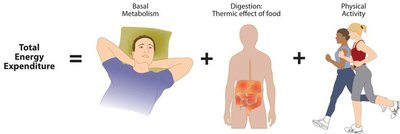
Total energy expenditure is the sum of three categories: basal metabolism, thermic effect of food, and physical activity. Each category contributes differently to daily energy output.
Basal Metabolism: Energy required for basic bodily functions at rest (breathing, heartbeat, organ function). Largest component (50–70% of TEE).
Thermic Effect of Food (TEF): Energy used for digestion and absorption (~10% of kcal intake).
Physical Activity: Energy expended in movement (15–30% of TEE); most variable and controllable.
Energy Breakdown by Organ
Different organs contribute to basal metabolism at varying rates. The following table summarizes the percent of energy expended by major organs:
Organ | Percent of Energy Expended |
|---|---|
Liver | 27 |
Brain | 19 |
Heart | 7 |
Kidneys | 10 |
Skeletal muscle (at rest) | 18 |
Other organs | 19 |
How to Calculate Total Energy Expenditure
TEE depends on age, sex, height, weight, and physical activity level. Standardized formulas and online calculators are available for estimation. Recording daily activities and their duration can help estimate individual energy expenditure.
Basal Metabolic Rate (BMR): Influenced by body size, composition, sex, age, nutritional status, and genetics.
Physical Activity: Increasing activity is the main way to raise TEE.
Nutritional Status: Caloric restriction lowers BMR as the body adapts by slowing basic functions.
Additional info: Online calculators and spreadsheets are available for personalized TEE estimation. See references for links.
