- Download the worksheet to save time writing
- Start solving the practice problems
- If you're stuck, watch the video solutions
- See your summary to get more insights

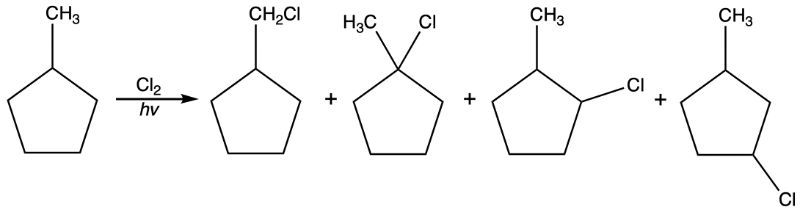
Without any knowledge of the mechanism for following substitution reaction:

Predict the ratio of the products formed for the reaction (in whole numbers) based on random statistical distribution when iodine (I) replaces hydrogen (H) in isopentane (C5H12).
The equation below defines the deuterium kinetic isotope effect for the halogenation of an alkane (X・ = Cl・ or Br・). Is the deuterium kinetic isotope effect greater in chlorination or bromination?

Draw the product(s) of the reaction below. If the reaction is selective, only draw the major product. Otherwise, draw all possible products.

Determine the expected relative yield of the major product in the following reaction.

Determine the product that will have the highest yield in the reaction below. Explain.