Back

1H NMR:Spin-Splitting Patterns definitions

Control buttons has been changed to "navigation" mode.
1/14
  • Spin-Splitting

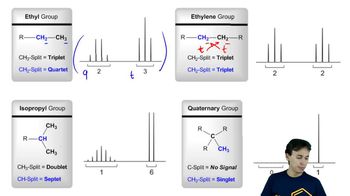
    Pattern in proton NMR where neighboring hydrogens cause a signal to split into multiple peaks, revealing molecular connectivity.
  • Triplet

    Signal split into three peaks, typically indicating two neighboring hydrogens on an adjacent carbon.
  • Quartet

    Signal split into four peaks, usually arising from three neighboring hydrogens, as seen in ethyl groups.
  • Doublet

    Signal split into two peaks, often resulting from one neighboring hydrogen, such as in isopropyl groups.
  • Septet

    Signal split into seven peaks, characteristic of a hydrogen adjacent to six equivalent hydrogens.
  • Singlet

    Single, unsplit peak in NMR, indicating no neighboring hydrogens or the presence of a heteroatom.
  • Ethyl Group

    Structural unit CH2CH3, recognized in NMR by a triplet and a quartet appearing together.
  • Ethylene Group

    Structural unit with two adjacent CH2 groups, producing dual triplets in NMR spectra.
  • Isopropyl Group

    Structural unit with a central hydrogen split by six neighbors, yielding a doublet and a septet.
  • Quaternary Group

    Carbon atom bonded to four non-hydrogen atoms, often producing singlets due to lack of neighboring hydrogens.
  • Heteroatom

    Non-carbon, non-hydrogen atom (like O or N) that can cause singlets by preventing hydrogen splitting.
  • N+1 Rule

    Guideline stating that a hydrogen's NMR signal splits into one more peak than the number of neighboring hydrogens.
  • J Value

    Coupling constant measuring the interaction strength between neighboring hydrogens, affecting splitting patterns.
  • Structure Determination

    Process of deducing molecular structure using NMR splitting patterns and signal combinations.