Back

Birch Reduction definitions

Control buttons has been changed to "navigation" mode.
1/14
  • Birch Reduction

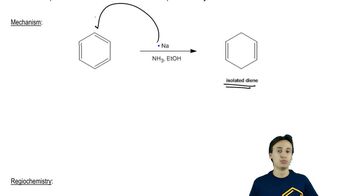
    A reaction converting benzene into an isolated diene using sodium, an amine, and alcohol under radical conditions.
  • Benzene

    An aromatic six-membered ring that serves as the starting material for transformation into a non-aromatic diene.
  • Isolated Diene

    A cyclohexadiene with two double bonds separated by at least one single bond, formed as the main product.
  • Elemental Sodium

    A metallic reagent supplying single electrons to initiate radical formation in the aromatic ring.
  • Amine

    A solvent, often liquid ammonia, that stabilizes charged intermediates during the reduction process.
  • Alcohol

    A hydrogen source, such as ethanol or tert-butanol, that protonates anionic intermediates in the reaction.
  • Radical Anion

    An intermediate featuring both a single unpaired electron and a negative charge, crucial for the reaction's progress.
  • Carbanion

    A negatively charged carbon species formed after electron addition, awaiting protonation.
  • Protonating Agent

    A compound, typically an alcohol, that donates a hydrogen atom to stabilize anionic intermediates.
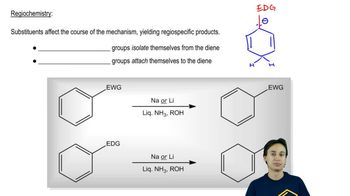
  • Regiochemistry

    The pattern determining the positions of new bonds or groups on the ring, influenced by substituents.
  • Electron-Withdrawing Group

    A substituent that stabilizes negative charge by pulling electron density away from the ring, affecting product placement.
  • Electron-Donating Group

    A substituent that destabilizes negative charge by pushing electron density into the ring, altering diene location.
  • Dissolving Metal Reduction

    A related reaction using metals and alcohols to reduce unsaturated systems via radical intermediates.
  • Cyclohexadiene

    A six-membered ring with two non-adjacent double bonds, representing the typical product structure.