Back

Electronegativity definitions

Control buttons has been changed to "navigation" mode.
1/13
  • Electronegativity

    A measure of an atom's ability to attract shared electrons in a chemical bond, with fluorine being the highest on the scale.
  • Valence Electrons

    The outermost electrons of an atom that participate in forming chemical bonds through sharing or transfer.
  • Chemical Bond

    A connection formed by the sharing or transfer of valence electrons between two atoms, determining molecular structure.
  • Dipole Moment

    A vector quantity representing the separation of charge due to unequal electron sharing between two bonded atoms.
  • Pauling Electronegativity Scale

    A numerical scale ranking elements by their tendency to attract electrons, used to predict bond polarity.
  • Covalent Bond

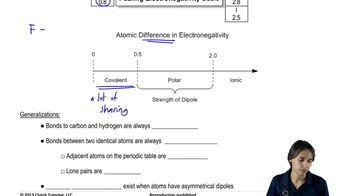
    A bond where electrons are shared equally or nearly equally between two atoms, typically with a small electronegativity difference.
  • Polar Covalent Bond

    A bond with unequal electron sharing, resulting in partial charges due to a moderate electronegativity difference.
  • Ionic Bond

    A bond formed when one atom nearly completely takes electrons from another, resulting in full positive and negative charges.
  • Partial Charge

    A slight positive or negative charge on an atom within a molecule, indicated by a lowercase delta, due to unequal electron sharing.
  • Net Dipole

    The overall dipole moment of a molecule, resulting from the vector sum of individual bond dipoles; present if dipoles do not cancel.
  • Lone Pair

    A pair of valence electrons not involved in bonding, which can create its own dipole moment within a molecule.
  • Spectrum of Bond Polarity

    The continuous range from purely covalent to purely ionic bonds, determined by the difference in electronegativity.
  • Adjacent Atoms

    Elements next to each other on the periodic table, which often form polar bonds when bonded together.