Pearson+ LogoPearson+ Logo

Functional Groups quiz #13 Flashcards

Back
Functional Groups quiz #13
Control buttons has been changed to "navigation" mode.
1/10
  • What are some common functional groups in organic chemistry that do not contain nitrogen?

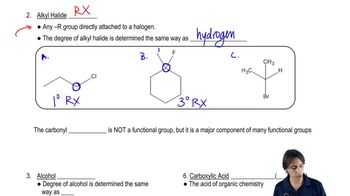
    Common functional groups that do not contain nitrogen include alcohols (R-OH), ethers (R-O-R), alkyl halides (R-X), ketones (R-CO-R), aldehydes (R-CHO), carboxylic acids (R-COOH), esters (R-COOR), acyl chlorides (R-COCl), anhydrides, and sulfur-containing groups like thiols (R-SH) and sulfides (R-S-R).
  • What is the purpose of using the 'R group' notation in organic chemistry structures?

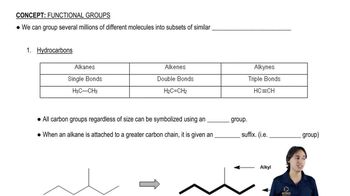
    The 'R group' notation represents any carbon-containing group not being focused on in a molecule. It simplifies complex structures by allowing chemists to generalize parts of molecules.
  • How is the degree (primary, secondary, tertiary) of an amine determined?

    The degree of an amine is based on the number of carbon groups directly attached to the nitrogen atom. For example, a secondary amine has two carbons attached to the nitrogen.
  • What distinguishes a ketone from an aldehyde in terms of structure and location within a molecule?

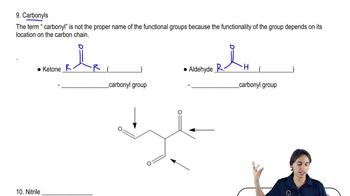
    A ketone has a carbonyl group flanked by two carbon groups and is internal, while an aldehyde has a carbonyl group at the end of a chain with at least one hydrogen attached. This means ketones are internal and aldehydes are terminal.
  • What is the condensed structural formula for a carboxylic acid, and why is it important to memorize?

    The condensed formula for a carboxylic acid is COOH or sometimes CO2H. Memorizing this helps quickly identify carboxylic acids in organic structures.
  • How does adding a carbonyl group to an alcohol or amine change the functional group?

    Adding a carbonyl to an alcohol forms a carboxylic acid, while adding it to an amine forms an amide. This addition significantly alters the chemical reactivity of the original group.
  • What is the difference between a phenyl and a benzyl group in terms of their attachment to a carbon chain?

    A phenyl group is a benzene ring directly attached to a chain, while a benzyl group has a CH2 group between the benzene ring and the chain. This structural difference affects their chemical properties and naming.
  • How is an anhydride structurally different from an ether?

    An anhydride has two carbonyl groups flanking an oxygen atom, while an ether has two carbon groups flanking an oxygen atom. This makes anhydrides more reactive than ethers.
  • What is the structural analogy between thiols and alcohols, and between sulfides and ethers?

    Thiols are sulfur analogs of alcohols, with an SH group instead of OH, and sulfides are sulfur analogs of ethers, with an S atom between two carbon groups. This analogy arises because sulfur is directly below oxygen in the periodic table.
  • What is the condensed formula for a nitrile group, and what does it represent?

    The condensed formula for a nitrile group is CN, representing a carbon triple-bonded to a nitrogen. This functional group is distinct due to its triple bond and nitrogen content.