Back

Halohydrin definitions

Control buttons has been changed to "navigation" mode.
1/15
  • Halohydrin

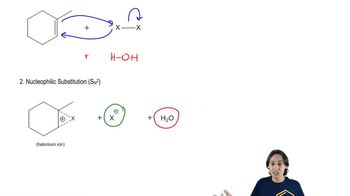
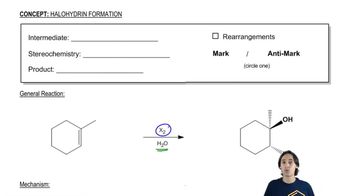
    A molecule featuring an alcohol and a halogen on adjacent carbons, formed by adding halogen and water across a double bond.
  • Halonium Ion

    A three-membered, positively charged intermediate with a halogen bridging two carbons during addition to a double bond.
  • Nucleophile

    A species with electron pairs available to attack an electron-deficient center, such as water in halohydrin formation.
  • Markovnikov's Rule

    A guideline stating that the nucleophile adds to the more substituted carbon due to its greater positive character.
  • Regiochemistry

    The aspect of a reaction that determines which atom or group attaches to which position in the product.
  • Stereochemistry

    The spatial arrangement of atoms in molecules, influencing whether products are formed on opposite sides of a ring.
  • Anti Addition

    A process where two substituents add to opposite faces of a double bond or ring, resulting from ring opening.
  • Racemic Mixture

    A 1:1 blend of two enantiomers, produced when nucleophilic attack can occur from either side of a planar intermediate.
  • Carbocation

    A positively charged carbon intermediate, notably absent in halohydrin formation, preventing rearrangements.
  • Deprotonation

    The removal of a proton (H+) from a molecule, often the final step to yield an alcohol in halohydrin synthesis.
  • Enantiomer

    One of a pair of non-superimposable mirror-image molecules, both formed in halohydrin reactions.
  • Double Bond

    A region of high electron density between two carbons, serving as the reactive site for halohydrin formation.
  • Diatomic Halogen

    A molecule consisting of two identical halogen atoms, such as Br2 or Cl2, used to initiate halohydrin formation.
  • Leaving Group

    An atom or group that departs with a pair of electrons during a reaction, such as a halide ion in this mechanism.
  • Nucleophilic Attack

    The step where an electron-rich species forms a bond with an electron-poor center, crucial in ring opening.