Back

Hydroboration definitions

Control buttons has been changed to "navigation" mode.
1/15
  • Hydroboration-Oxidation

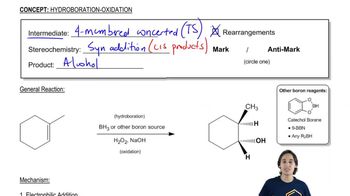
    A two-step reaction adding alcohol to a double bond with anti-Markovnikov orientation and syn addition, avoiding carbocation rearrangement.
  • Anti-Markovnikov Orientation

    A regioselectivity where the new group attaches to the less substituted carbon of a double bond, opposite to typical Markovnikov addition.
  • Syn Addition

    A process where two groups add to the same side of a double bond, resulting in cis products.
  • Transition State

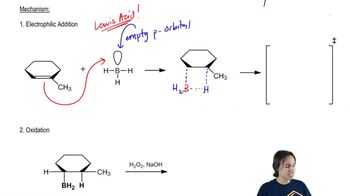
    A fleeting, high-energy arrangement where bonds are simultaneously forming and breaking, not a true intermediate.
  • BH3

    A common boron-containing reagent with an empty p orbital, acting as a strong Lewis acid in hydroboration.
  • B2H6

    A dimeric boron hydride, functionally equivalent to two BH3 units, used as a boron source in hydroboration.
  • Catecholborane

    An alternative boron reagent for hydroboration, sometimes preferred by specific instructors or textbooks.
  • 9-BBN

    A boron-containing reagent used in hydroboration, notable for its bulky structure and selectivity.
  • Lewis Acid

    A species capable of accepting an electron pair, such as boron with its empty p orbital in hydroboration.
  • Steric Hindrance

    A spatial effect where bulky groups prevent reagents from approaching certain positions on a molecule.
  • Oxidation Step

    The second phase of hydroboration-oxidation, using hydrogen peroxide and base to convert a boron intermediate into an alcohol.
  • Cis Product

    A result where two newly added groups are on the same side of a former double bond, due to syn addition.
  • Carbocation Intermediate

    A positively charged, electron-deficient species not formed in hydroboration, preventing rearrangement.
  • Electron Pair Acceptor

    A role played by boron in hydroboration, allowing it to interact with the double bond's electrons.
  • Base

    A substance used in the oxidation step to facilitate conversion of the boron intermediate to an alcohol.