Back

Markovnikov definitions

Control buttons has been changed to "navigation" mode.
1/14
  • Markovnikov's Rule

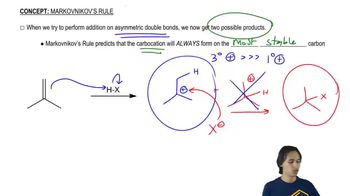
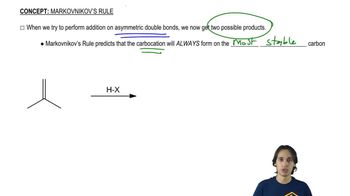
    Predicts that the most stable carbocation intermediate forms during addition to asymmetric alkenes, guiding product outcome.
  • Asymmetric Alkene

    A double bond with different groups attached to each carbon, leading to multiple possible addition products.
  • Carbocation

    A positively charged carbon species formed as an intermediate during electrophilic addition reactions.
  • Electrophile

    A species that accepts electron pairs, initiating addition to a double bond in organic reactions.
  • Intermediate

    A transient species formed during a reaction, often dictating the final product's structure.
  • Tertiary Carbocation

    A positively charged carbon bonded to three alkyl groups, offering maximum stability among carbocations.
  • Primary Carbocation

    A positively charged carbon bonded to only one alkyl group, resulting in low stability.
  • R Group

    An alkyl substituent that stabilizes carbocations by electron donation through inductive effects.
  • Addition Reaction

    A process where atoms or groups are added across a double bond, converting it to a single bond.
  • Product Formation

    The outcome of a reaction, determined by the stability of intermediates and the position of group addition.
  • Double Bond

    A chemical bond involving two shared pairs of electrons, commonly found in alkenes.
  • Leaving Group

    An atom or group that departs with an electron pair during a reaction, often replaced by another group.
  • Stability

    A measure of how likely an intermediate or product is to persist, influenced by surrounding groups.
  • Markovnikov Product

    The major product formed when the electrophile adds to the carbon with more hydrogens in an asymmetric alkene.