Back

Mutarotation quiz

Control buttons has been changed to "navigation" mode.
1/15
  • What is mutarotation in sugars like glucose?

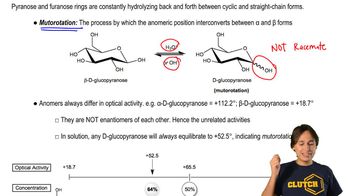
    Mutarotation is the process where the anomeric carbon interconverts between alpha and beta forms, involving equilibrium between cyclic and straight-chain forms.
  • What evidence supports the existence of mutarotation?

    Optical activity measurements show that the rotation equilibrates to a specific value, indicating a mixture of alpha and beta forms.
  • Are alpha and beta anomers enantiomers or diastereomers?

    Alpha and beta anomers are diastereomers, not enantiomers, so their optical activities are unrelated.
  • What is the equilibrium ratio of beta to alpha forms in glucose after mutarotation?

    The equilibrium ratio is 64% beta and 36% alpha for glucose.
  • Does mutarotation result in a racemic mixture of anomers?

    No, mutarotation results in a mixture, but not a racemate; the proportions depend on the sugar's equilibrium.
  • What is the observed optical rotation of glucose at equilibrium after mutarotation?

    The optical rotation equilibrates to +52.5 degrees, reflecting the equilibrium mixture of alpha and beta forms.
  • How does the optical activity of alpha and beta D-glucopyranose compare?

    Alpha D-glucopyranose has a rotation of +112, while beta D-glucopyranose has a rotation of about +18; both are positive but not opposites.
  • What role does acid play in the mutarotation mechanism?

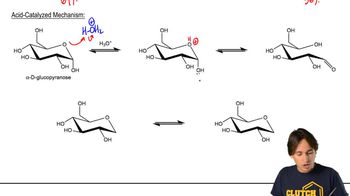
    Acid catalyzes mutarotation by protonating the ring oxygen, facilitating ring opening and reformation.
  • What happens to the chirality of the anomeric carbon during mutarotation?

    The chirality is temporarily lost when the carbon forms a double bond and becomes trigonal planar.
  • How does the ring reform during mutarotation to create a new anomer?

    The ring reforms when the oxygen attacks from either the top or bottom, creating either the alpha or beta anomer.
  • Why is the equilibrium optical rotation not the midpoint between alpha and beta values?

    Because the equilibrium mixture is not 50:50; it reflects the actual proportions of alpha and beta forms.
  • Can mutarotation occur in both acid and base conditions?

    Yes, but the acid-catalyzed mechanism is usually shown because base-catalyzed reactions can produce complex products.
  • What is the final step in the acid-catalyzed mutarotation mechanism?

    The final step is deprotonation, which regenerates the catalytic acid and yields the new anomer.
  • Does the equilibrium ratio of anomers differ for different sugars?

    Yes, the equilibrium ratio depends on the specific sugar; for glucose, beta is favored, but other sugars may favor alpha.
  • What does the squiggly line notation indicate in sugar structures after mutarotation?

    It indicates a mixture of alpha and beta anomers, with the specific ratio determined by equilibrium.