Back

Optical Activity definitions

Control buttons has been changed to "navigation" mode.
1/13
  • Optical Activity

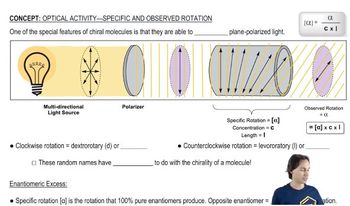
    Property where chiral substances rotate plane-polarized light, revealing molecular asymmetry through measurable angular change.
  • Chiral Molecule

    Type of compound lacking superimposability on its mirror image, responsible for rotating plane-polarized light.
  • Plane-Polarized Light

    Light oscillating in a single plane after passing through a polarizer, used to detect optical rotation.
  • Polarimeter

    Instrument that quantifies the angle by which a chiral sample rotates plane-polarized light.
  • Polarizer

    Device or lens that filters light so it vibrates in only one direction, producing plane-polarized light.
  • Specific Rotation

    Constant value indicating the maximum rotation a pure enantiomer imparts under standard conditions.
  • Observed Rotation

    Measured angle of light rotation after passing through a chiral sample, dependent on several experimental factors.
  • Concentration

    Amount of chiral substance present in solution, directly influencing the degree of optical rotation.
  • Tube Length

    Distance light travels through the sample in a polarimeter, affecting the total observed rotation.
  • Dextrorotary

    Characteristic of a substance that rotates plane-polarized light in a clockwise direction, denoted by a positive sign.
  • Levorotary

    Characteristic of a substance that rotates plane-polarized light in a counterclockwise direction, denoted by a negative sign.
  • Enantiomer

    One of a pair of non-superimposable mirror-image molecules, each potentially exhibiting distinct optical activity.
  • Chiral Center

    Atom, typically carbon, bonded to four different groups, creating molecular asymmetry and enabling optical activity.