Skip to main content
Organic Chemistry
My Course
Learn
Exam Prep
AI Tutor
Study Guides
Textbook Solutions
Flashcards
Explore
Try the app
My Course
Learn
Exam Prep
AI Tutor
Study Guides
Textbook Solutions
Flashcards
Explore
Try the app
Back
Phenol Acidity definitions
You can tap to flip the card.
Phenol
You can tap to flip the card.
👆
Phenol
A benzene ring bonded to a hydroxyl group, notable for its higher acidity compared to typical alcohols due to resonance stabilization.
Track progress
Control buttons has been changed to "navigation" mode.
1/14
Related flashcards
Related practice
Recommended videos
Phenol Acidity quiz
Acidity of Phenols
9 Terms
Phenol Acidity
20. Phenols
5 problems
Topic
Johnny
Oxidation of Phenols to Quinones
20. Phenols
5 problems
Topic
25. Phenols
4 topics
12 problems
Chapter
Johnny
02:48
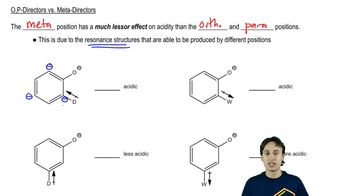
O,P-positions vs. Meta-Positions
2517
views
15
rank
6
comments
00:52
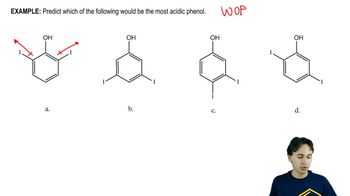
Identify the most acidic phenol
2040
views
11
rank
6
comments
02:27
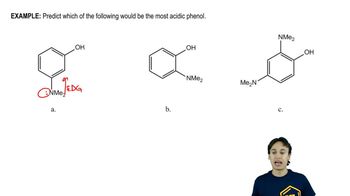
Identify the most acidic phenol
2255
views
9
rank
6
comments
Terms in this set (14)
Hide definitions
Phenol
A benzene ring bonded to a hydroxyl group, notable for its higher acidity compared to typical alcohols due to resonance stabilization.
Alcohol
An organic compound with a hydroxyl group attached to a saturated carbon atom, generally less acidic than phenols.
Resonance
A phenomenon where electrons are delocalized across multiple positions, stabilizing charged intermediates like the phenoxide ion.
Conjugate Base
The species formed after an acid donates a proton, whose stability directly influences the acidity of the original molecule.
Phenoxide
The anionic form of phenol after deprotonation, stabilized by delocalization of negative charge within the aromatic ring.
pKa
A numerical value indicating acid strength; lower values correspond to stronger acids, with phenol having a value around 10.
Electron-Donating Group
A substituent that increases electron density in the aromatic ring, destabilizing the conjugate base and reducing acidity.
Electron-Withdrawing Group
A substituent that decreases electron density in the aromatic ring, stabilizing the conjugate base and enhancing acidity.
Ortho Position
A location on the benzene ring adjacent to the reference group, significantly influencing acidity when substituted.
Para Position
A location on the benzene ring directly opposite the reference group, crucial for resonance effects on acidity.
Meta Position
A location on the benzene ring one carbon removed from the reference group, with minimal impact on resonance stabilization.
Acidity
A measure of a molecule's tendency to donate a proton, influenced by resonance and substituent effects in phenols.
Resonance Structure
An alternative Lewis structure showing different electron arrangements, used to explain charge delocalization in phenoxide.
WAP
An acronym summarizing that electron-withdrawing groups at ortho and para positions maximize phenol acidity.
 BackBack
 02:48
02:48