Back

Polymers Structure and Properties definitions

Control buttons has been changed to "navigation" mode.
1/15
  • Crystallinity

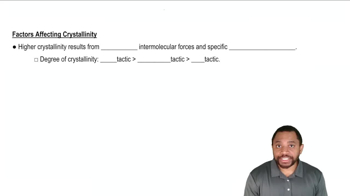
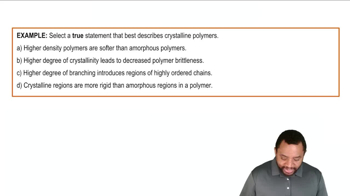
    Degree of ordered regions within a polymer, directly impacting density, rigidity, and strength.
  • Crystallite

    Small, ordered segment within a polymer, contributing to overall structural organization.
  • Amorphous Region

    Disordered area in a polymer where chains lack regular arrangement, reducing rigidity and density.
  • Density

    Measure of mass per unit volume in a polymer, increasing with greater structural order.
  • Rigidity

    Resistance to deformation in a polymer, enhanced by higher structural order and intermolecular forces.
  • Strength

    Ability to withstand applied force without breaking, closely linked to degree of structural order.
  • Intermolecular Forces

    Attractive interactions between polymer chains, promoting structural order and higher thermal stability.
  • Stereochemistry

    Spatial arrangement of atoms in polymer chains, influencing the degree of structural order.
  • Isotactic

    Polymer configuration with identical substituents on the same side, maximizing structural order.
  • Syndiotactic

    Polymer configuration with alternating substituents, resulting in intermediate structural order.
  • Atactic

    Polymer configuration with random substituent placement, leading to minimal structural order.
  • Glass Transition Temperature

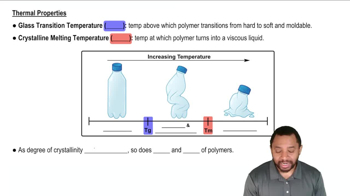
    Threshold above which a polymer shifts from hard and brittle to soft and moldable.
  • Tg

    Abbreviation for the temperature marking the onset of polymer chain mobility and flexibility.
  • Crystalline Melting Temperature

    Point where a polymer transitions from solid to viscous liquid due to disruption of ordered regions.
  • Tm

    Abbreviation for the temperature at which ordered regions in a polymer melt into a viscous state.