Back

Radical Polymerization definitions

Control buttons has been changed to "navigation" mode.
1/15
  • Radical Initiator

    Substance that decomposes under heat or UV light to generate radicals, starting the polymerization process.
  • Peroxide

    Compound with an O–O bond, often used to generate radicals for initiating polymerization.
  • Homolytic Cleavage

    Bond breaking process where each atom retains one electron, producing two radicals.
  • Monomer

    Small molecule that joins with others to form a repeating unit in a polymer chain.
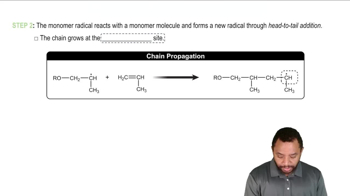
  • Propagation Site

    Location at the end of a growing polymer chain where new monomers add during chain growth.
  • Head-to-Tail Addition

    Pattern where the reactive end of a chain adds to the less substituted end of a monomer, ensuring regularity.
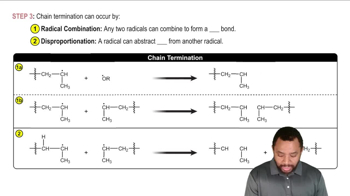
  • Termination

    Final step in polymerization where active chain ends are deactivated, stopping further growth.
  • Disproportionation

    Termination process where a radical abstracts a hydrogen, forming a new bond and an unsaturated group.
  • Chain Transfer

    Event where the active site shifts to a new location, altering the growth path of the polymer.
  • Backbiting

    Intramolecular chain transfer causing short branches by hydrogen abstraction within the same molecule.
  • Intramolecular Process

    Reaction occurring within a single molecule, often leading to short branches in polymers.
  • Intermolecular Process

    Reaction between different molecules, typically resulting in long branches in the polymer.
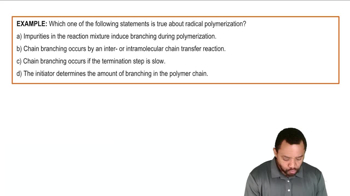
  • Branching

    Formation of side chains off the main polymer backbone, influencing physical properties.
  • Sigma Bond

    Single covalent bond formed when two radicals combine during termination.
  • Addition Polymer

    Macromolecule formed by sequential addition of monomers without loss of atoms.