Skip to main content
Organic Chemistry
My Course
Learn
Exam Prep
AI Tutor
Study Guides
Textbook Solutions
Flashcards
Explore
Try the app
My Course
Learn
Exam Prep
AI Tutor
Study Guides
Textbook Solutions
Flashcards
Explore
Try the app
Back
Reductive Amination definitions
You can tap to flip the card.
Reductive Amination
You can tap to flip the card.
👆
Reductive Amination
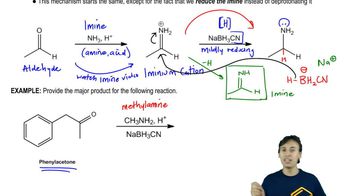
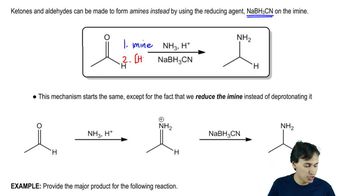
A two-step process converting a carbonyl compound to an amine via imine formation and subsequent reduction.
Track progress
Control buttons has been changed to "navigation" mode.
1/13
Related flashcards
Related practice
Recommended videos
Reductive Amination quiz
Reductive Amination
15 Terms
Reductive Amination
26. Amines
3 problems
Topic
Ernest
Curtius Rearrangement
26. Amines
5 problems
Topic
23. Amines - Part 1 of 3
4 topics
11 problems
Chapter
Nicole
23. Amines - Part 2 of 3
5 topics
13 problems
Chapter
Nicole
26. Amines - Part 3 of 3
1 topic
3 problems
Chapter
07:12
Reductive Amination
2435
views
11
rank
2
comments
03:07
Provide the Major Product
2402
views
17
rank
6
comments
Terms in this set (13)
Hide definitions
Reductive Amination
A two-step process converting a carbonyl compound to an amine via imine formation and subsequent reduction.
Imine
A functional group where a nitrogen atom replaces the oxygen of a carbonyl, bonded to one R group and hydrogen.
Iminium Cation
A positively charged intermediate with a nitrogen atom bearing a formal positive charge, formed before imine generation.
Ketone
A carbonyl-containing compound with two alkyl groups attached to the carbonyl carbon.
Aldehyde
A carbonyl-containing compound with at least one hydrogen attached to the carbonyl carbon.
Primary Amine
A nitrogen-containing compound where the nitrogen is bonded to one alkyl group and two hydrogens.
Reducing Agent
A substance that donates hydrogens to another molecule, facilitating the conversion of double bonds to single bonds.
Sodium Cyanoborohydride
A mildly reducing reagent, NaBH3CN, used to selectively reduce imines without affecting other groups.
Electron-Withdrawing Group
A substituent, such as a cyano group, that decreases electron density on adjacent atoms, moderating reactivity.
Equilibrium
A state in a reversible reaction where the forward and reverse processes occur at equal rates.
Acidic Environment
A reaction condition with excess protons, necessary for imine formation from carbonyl compounds and amines.
Double Bond
A chemical bond involving two shared pairs of electrons, present in imines and reduced during reductive amination.
Lone Pair
A pair of valence electrons on an atom, such as nitrogen, not involved in bonding after reduction.
 BackBack

 07:12
07:12