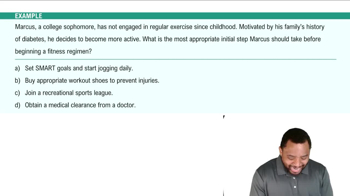
What is the first step you should take before starting an exercise program if you've been inactive for several months?
You should check with your healthcare provider to ensure it is safe to begin exercising.
Why is it important to identify activities that match your fitness level when starting an exercise program?
Choosing activities that match your fitness level helps prevent injury and makes it easier to stick with your program.
What is a key factor in choosing physical activities to include in your exercise program?
Activities should be convenient and enjoyable to increase the likelihood of maintaining the program.
Give an example of how you can incorporate more physical activity into your daily routine.
You can take the stairs instead of the elevator to increase your daily physical activity.
What does the acronym SMART stand for in goal setting for exercise programs?
SMART stands for Specific, Measurable, Achievable, Relevant, and Time-bound.
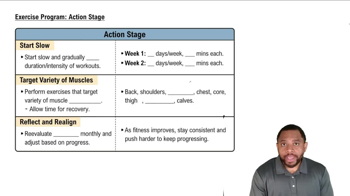
Why is it important to start slow and gradually increase the duration and intensity of your workouts?
Starting slow helps your body adapt and reduces the risk of injury as you build fitness.
How should you progress your workout schedule in the first few weeks of a new exercise program?
Begin with fewer days and shorter sessions, then gradually increase both frequency and duration over time.
Why is it important to target a variety of muscle groups in your exercise program?
Targeting different muscle groups allows for recovery and helps prevent overuse injuries.
What should you do if you notice your exercise routine has become too easy or too difficult?
Adjust the intensity or duration of your workouts to match your current fitness level and continue progressing.
How often should you reflect on and realign your exercise goals?
You should reevaluate your goals monthly and adjust them based on your progress.
What are the three main components of a well-structured workout session?
A workout session should include a warm-up, cardiorespiratory or resistance training, and a cool-down phase.
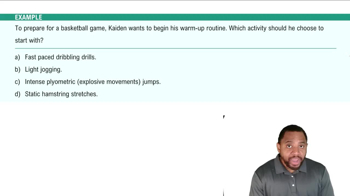
What is the purpose of a warm-up before exercising?
A warm-up increases blood flow, improves flexibility, and helps prevent injuries.
What type of stretching is recommended during the warm-up phase?
Dynamic stretching, which involves low-intensity movements through a full range of motion, is recommended.
What is the main goal of cardiorespiratory exercises in a workout program?
Cardiorespiratory exercises strengthen the heart and lungs by using large muscle groups.
Name two examples of cardiorespiratory exercises.
Walking and cycling are examples of cardiorespiratory exercises.
What is resistance training and what does it improve?
Resistance training uses body weight or additional weights to increase muscle strength and endurance.
What is the difference between isometric and isotonic exercises?
Isometric exercises involve muscle contraction without length change (no movement), while isotonic exercises involve contraction with length change (producing movement).
What is the purpose of the cool-down phase after a workout?
The cool-down gradually returns the body to its resting condition and helps with recovery.
What type of stretching is performed during the cool-down phase?
Static stretching, where a muscle is held in a stretch position for a period of time, is performed during cool-down.
Why is it important to avoid exercising the same muscle group repeatedly without rest?
Repeatedly exercising the same muscle group can lead to injury and hinder muscle growth due to lack of recovery.
 Back
Back


 1:27
1:27