 Back
AP Physics 1: Newtonian Mechanics – Forces, Motion, and Newton's Laws
Study Guide - Smart Notes
 Tailored notes based on your materials, expanded with key definitions, examples, and context.
Q5. A woman is straining to lift a large crate, but without success. We denote the forces on the crate as follows: P is the magnitude of the upward force being exerted on the crate by the person, C is the magnitude of the vertical contact force on the crate by the floor, and W is the force that Earth exerts on the crate. How are the magnitudes of these forces related while the person is trying unsuccessfully to lift the crate?
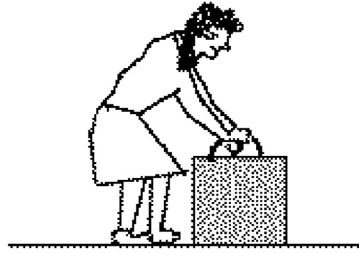
Background
Topic: Static Equilibrium and Forces
This question tests your understanding of how forces balance when an object remains at rest, specifically when multiple forces act vertically on an object that does not move.
Key Terms and Formulas:
Static Equilibrium: When an object is at rest and the net force acting on it is zero.
Normal Force (C): The upward force exerted by a surface to support the weight of an object resting on it.
Applied Force (P): The upward force exerted by the person trying to lift the crate.
Weight (W): The downward force due to gravity, .
Step-by-Step Guidance
Identify all the vertical forces acting on the crate: the upward force from the person (P), the upward normal force from the floor (C), and the downward gravitational force (W).
Since the crate does not move, it is in static equilibrium. This means the sum of all vertical forces must be zero:
Rearrange the equation to relate the magnitudes of the forces:
Think about what happens to the normal force (C) as the person increases the upward force (P) but still cannot lift the crate. The crate remains stationary, so the sum of the upward forces must always balance the weight.
Try solving on your own before revealing the answer!
Final Answer: P + C = W
While the person is trying unsuccessfully to lift the crate, the sum of the upward forces (the force from the person and the normal force from the floor) must exactly balance the downward force of gravity (the weight of the crate). This is why .
Q6. A ball is launched from the ground at an angle and follows the trajectory shown. The ball experiences negligible air resistance and passes through positions P, Q, and R, in order. Which of the following correctly represents the force(s) exerted on the ball at the three labeled positions?
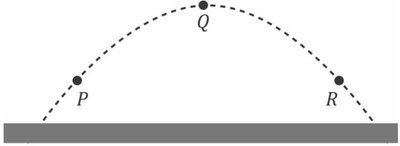
Background
Topic: Projectile Motion and Free-Body Diagrams
This question tests your understanding of the forces acting on a projectile in flight, specifically when air resistance is negligible.
Key Terms and Formulas:
Projectile Motion: The motion of an object thrown or projected into the air, subject only to gravity.
Force of Gravity: The only force acting on the projectile (downward), .
Free-Body Diagram: A diagram showing all the forces acting on an object.
Step-by-Step Guidance
Recall that once the ball is in the air and air resistance is negligible, the only force acting on it is gravity, which points downward at all points along the trajectory.
At positions P, Q, and R, the velocity of the ball changes direction and magnitude, but the force due to gravity remains constant and always points downward.
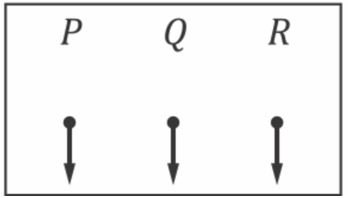
Examine the provided force diagrams and identify which one shows a single downward force at each position.
Ignore any diagrams that show horizontal or upward forces, as these do not represent the actual forces acting on the ball in projectile motion without air resistance.
Try solving on your own before revealing the answer!
Final Answer: Diagram D (all downward arrows at P, Q, R)
The only force acting on the ball at all three positions is gravity, which points downward. This is represented by the diagram with downward arrows at P, Q, and R.
