Back
Applying Newton’s Laws: Equilibrium, Forces, and Dynamics
Study Guide - Smart Notes
 Tailored notes based on your materials, expanded with key definitions, examples, and context.
Chapter 5: Applying Newton’s Laws
Equilibrium
Equilibrium describes the state in which the net force acting on an object is zero. This can occur when the object is at rest (static equilibrium) or moving at constant velocity in a straight line (dynamic equilibrium).
Static Equilibrium: Object is at rest; all forces balance.
Dynamic Equilibrium: Object moves at constant speed in a straight line; net force is zero.
Mathematical Condition: and
Example: Towing a Car in Equilibrium
When a car is towed at a steady speed, it is in dynamic equilibrium. The forces acting on the car include tension in the rope, friction, normal force, and weight.
Given: , ,
Find: Tension in the rope
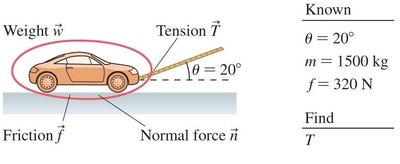
The free-body diagram shows all forces acting on the car. The tension force is at an angle, and friction opposes motion.
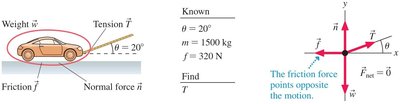
Newton’s Second Law and Force Components
Newton’s second law relates the net force to the acceleration of an object. In equilibrium, the sum of forces in each direction is zero.
Force Components:
Solving for Tension
To find the tension, use the equilibrium condition in the x-direction:
For and ,
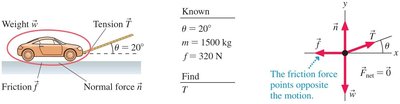
Assessment: Pulling at an angle requires more tension than pulling horizontally, as part of the tension acts upward.
Dynamics and Newton’s Second Law
Newton’s second law connects forces to motion. The net force determines acceleration, and kinematics equations describe the resulting motion.
Example: Putting a Golf Ball
A golf ball is putted with an initial speed and slowed by friction. The problem involves finding whether the ball reaches the hole.
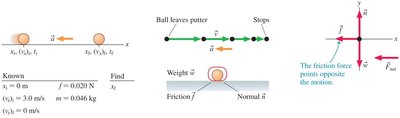
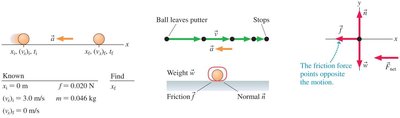
Given: , , , ,
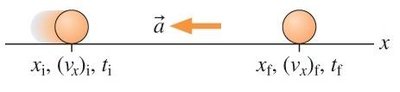
The motion diagram shows the ball decelerating due to friction.
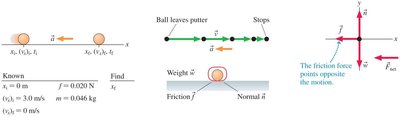
The free-body diagram identifies forces: weight, normal force, and friction.
Use kinematic equation:
For ,
Assessment: The ball will just reach the hole if the aim is true.
Mass and Weight
Mass measures an object’s inertia, while weight is the gravitational force exerted on the object by a planet.
Mass: Same everywhere; measures resistance to acceleration.
Weight: ; depends on local gravity.
On Earth:
On Moon:
On Jupiter:
Apparent Weight
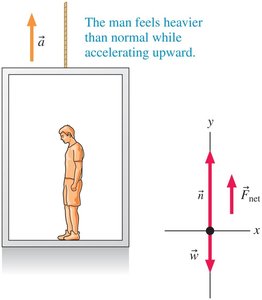
Apparent weight is the contact force supporting you, which can differ from true weight when accelerating.
When accelerating upward, apparent weight increases.
Normal Forces
The normal force is the perpendicular contact force exerted by a surface to support an object.
Adjusts to balance weight and other forces.
In an elevator accelerating upward:
At rest or constant velocity:
Friction
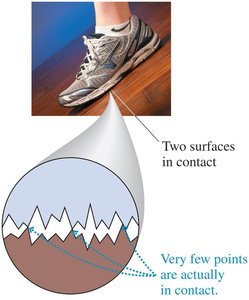
Friction opposes motion and arises from microscopic roughness between surfaces.
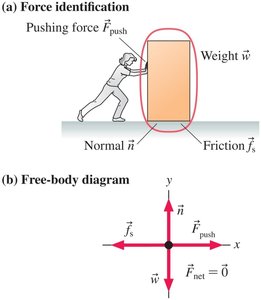
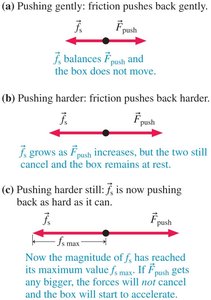
Static Friction: Prevents motion; increases with applied force up to a maximum.
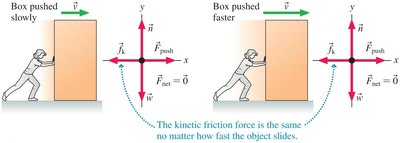
Kinetic Friction: Opposes sliding motion;
Kinetic friction is constant regardless of speed.
Interacting Objects
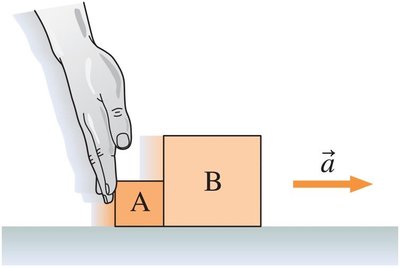
When objects are in contact, Newton’s third law applies: every force has an equal and opposite reaction force.
Action/reaction pairs act on different objects.
Objects in contact have the same acceleration.
Ropes and Pulleys
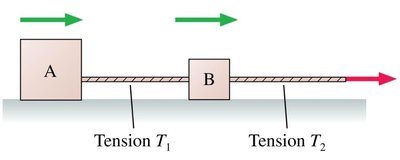
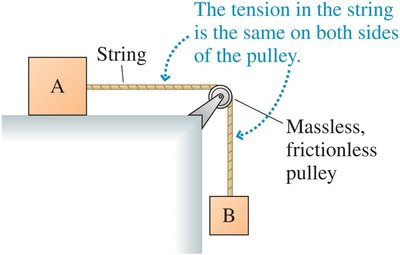
Massless ropes and pulleys transmit forces undiminished. The tension is the same throughout a massless rope and is unaffected by passing over a massless, frictionless pulley.
If a force pulls on one end, the tension equals the pulling force.
For two objects connected by a rope, tension is the same at both ends.
Example: Lifting a Stage Set
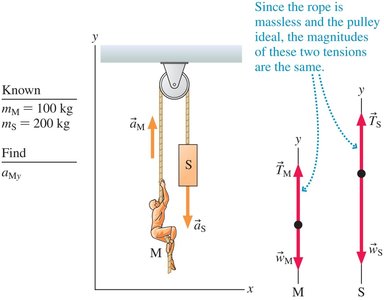
A stage set and a stagehand are connected by a rope over a pulley. The acceleration of the stagehand can be found using Newton’s second law for each object.
Since the rope and pulley are ideal, and