 Back
Chapter 10: Energy and Work – Physics with Algebra Study Notes
Study Guide - Smart Notes
 Tailored notes based on your materials, expanded with key definitions, examples, and context.
Energy and Work
Introduction to Energy
Energy is a fundamental concept in physics, representing the capacity to do work or produce change. In mechanical systems, energy can be transferred and transformed between various forms, and its conservation is a key principle in problem-solving.
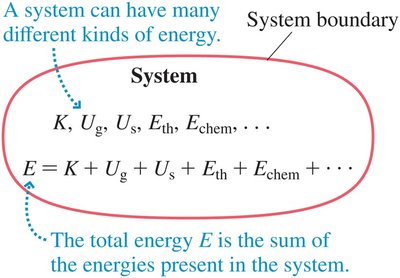
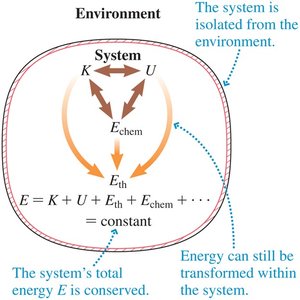
Energy is the sum of all forms present in a system.
Common forms include kinetic energy (motion), potential energy (position), thermal energy (internal), chemical energy (bonds), and nuclear energy (atomic nuclei).
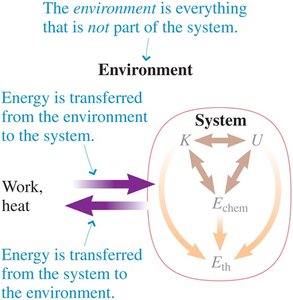
Energy can be transferred between a system and its environment via work and heat.
Forms of Energy
Mechanical motion involves several important forms of energy:
Kinetic Energy (K): Energy of motion.
Gravitational Potential Energy (U_g): Energy due to height above ground.
Elastic Potential Energy (U_s): Energy stored in stretched/compressed springs.
Thermal Energy (E_{th}): Sum of kinetic and potential energies of molecules.
Chemical Energy (E_{chem}): Energy stored in molecular bonds.
Nuclear Energy (E_{nuclear}): Energy stored in atomic nuclei.
Energy Transformations
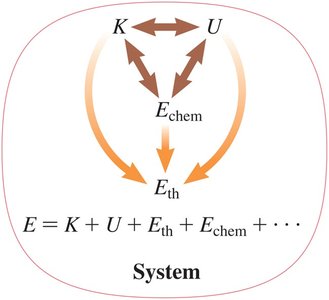
Energy can be transformed from one form to another within a system. For example:
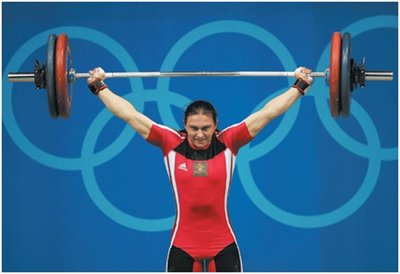
Chemical energy in muscles is converted to kinetic and gravitational potential energy when lifting weights.
Elastic potential energy in a springboard is converted to kinetic energy, then to gravitational potential energy as a diver rises.

Energy Transfers: Work and Heat
Energy can be transferred between a system and its environment:
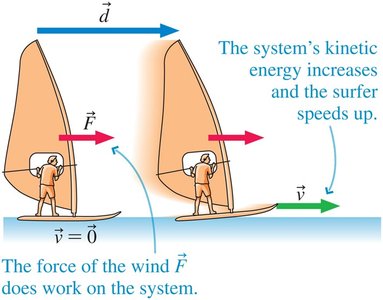
Work: Mechanical transfer of energy by force acting over a distance.
Heat: Nonmechanical transfer due to temperature difference.
Work-Energy Equation
The total energy of a system changes by the amount of work done on it:
If no energy is transferred, the system is isolated.
Work
Definition and Calculation of Work
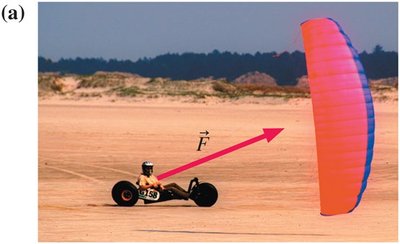
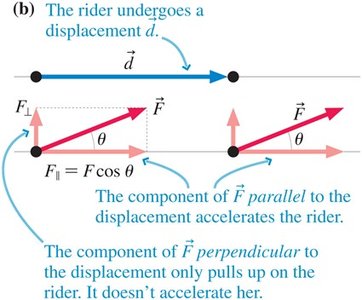
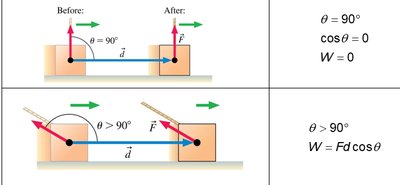
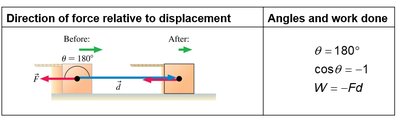
Work is done when a force causes displacement. Only the component of force in the direction of displacement does work.
Work by a constant force:
Work is a scalar quantity, measured in joules (J):
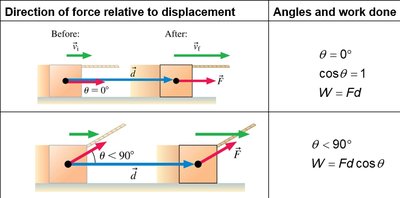
If force is at an angle to displacement:
Examples of Work
Positive work: Force and displacement in same direction.
Negative work: Force and displacement in opposite directions.
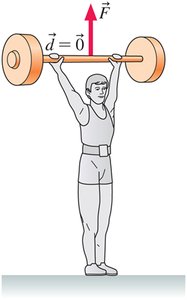
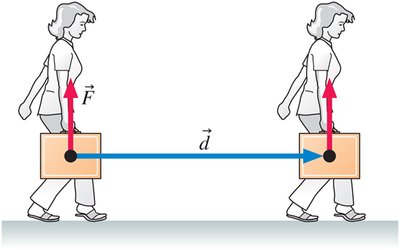
Zero work: Force perpendicular to displacement or no displacement.
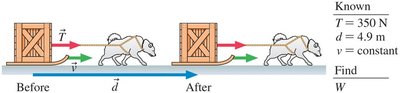
Example: Work Done by a Dog Pulling a Sled
A dog pulls a sled 4.9 m with a force of 350 N at constant speed. The work done is:
Energy goes into increasing thermal energy due to friction.
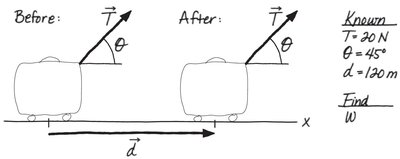
Work at an Angle
When force is applied at an angle, only the parallel component does work:
Sign of work depends on angle between force and displacement.
Forces That Do No Work
No displacement: No work done.
Force perpendicular to displacement: No work done.
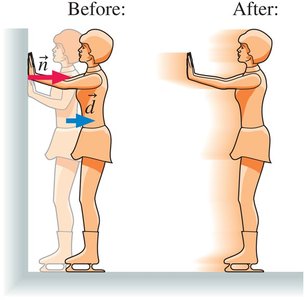
Internal energy transformations (e.g., pushing against a wall): No work done by external force.
Kinetic Energy
Translational and Rotational Kinetic Energy
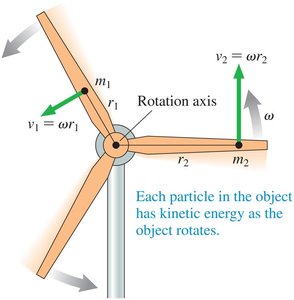
Kinetic energy is the energy of motion. It can be translational (linear) or rotational.
Translational:
Rotational:
Work done increases kinetic energy:
Potential Energy
Gravitational Potential Energy
Potential energy is stored energy due to position. Gravitational potential energy depends on height:
Gravity is a conservative force; potential energy depends only on height, not path.
Elastic Potential Energy
Elastic potential energy is stored in springs or elastic objects:
Hooke's law:
Elastic potential energy:
Conservation of Energy
Law of Conservation of Energy
The total energy of an isolated system remains constant, though energy can be transformed between forms.
(if no energy is transferred to/from environment)
Energy conservation is used to solve motion problems.
Energy Diagrams
Interpreting Energy Diagrams
Energy diagrams graph potential energy as a function of position. The distance to the energy line represents kinetic energy.
Turning points occur where the energy line crosses the potential energy curve.
Maximum speed occurs where potential energy is minimum.
Energy in Collisions
Elastic and Inelastic Collisions
Collisions involve energy and momentum transfer:
Perfectly elastic collision: Mechanical energy and momentum are conserved.
Perfectly inelastic collision: Objects stick together; mechanical energy is not conserved, but momentum is.
In inelastic collisions, some mechanical energy is converted to thermal energy.
Power
Definition and Calculation of Power
Power is the rate at which energy is transferred or transformed.
Unit: watt (W), where
For a force acting on a moving object:
Example: Output Power for a Weightlifter
Weightlifter raises a 190 kg bar 1.9 m in 1.8 s.
Change in potential energy:
Power:
Summary Table: Forms of Energy
Form of Energy | Definition | Formula |
|---|---|---|
Kinetic Energy | Energy of motion | |
Gravitational Potential Energy | Energy due to height | |
Elastic Potential Energy | Energy stored in spring | |
Thermal Energy | Internal energy of molecules | N/A |
Chemical Energy | Energy in molecular bonds | N/A |
Nuclear Energy | Energy in atomic nuclei | N/A |
