 Back
Chapter 5: Applying Newton’s Laws – Equilibrium, Dynamics, Forces, and Friction
Study Guide - Smart Notes
 Tailored notes based on your materials, expanded with key definitions, examples, and context.
Chapter 5: Applying Newton’s Laws
Overview
This chapter focuses on the application of Newton’s laws to solve problems involving equilibrium, dynamics, forces, friction, and interacting objects. Students will learn to analyze forces in both static and dynamic situations, calculate unknown forces, and understand the physical meaning of mass, weight, normal force, friction, and tension.
Equilibrium
Static and Dynamic Equilibrium
Equilibrium occurs when the net force acting on an object is zero. There are two types:
Static Equilibrium: The object is at rest (a = 0).
Dynamic Equilibrium: The object moves at constant velocity (a = 0).
In both cases, the sum of the forces in each direction is zero:
To solve equilibrium problems:
Check if a = 0.
Identify all forces and draw a free-body diagram.
Write Newton’s second law in component form.
Solve for unknown forces.
Assess the result for reasonableness and correct units.
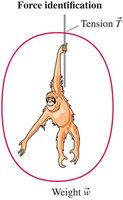
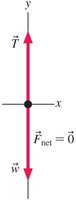
Example: Orangutan Hanging from Rope
An orangutan weighing 500 N hangs from a rope. The tension in the rope equals the weight:
The tension is upward, weight is downward, and both are equal in magnitude.
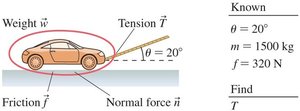
Example: Towing a Car at Constant Speed
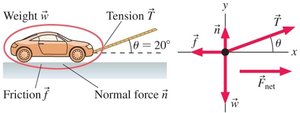
A 1500 kg car is towed at a steady speed by a rope at 20° to the horizontal. Friction opposes motion with 320 N. The tension is found using:
For ,
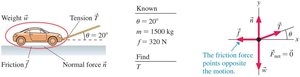
Dynamics and Newton’s Second Law
Newton’s Second Law in Component Form
Newton’s second law relates net force to acceleration:
Component form: ,
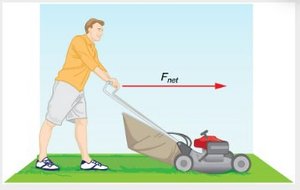
Example: Lawn Mower Acceleration
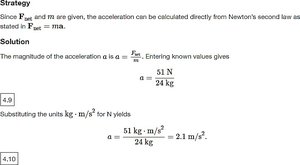
A 24 kg lawn mower is pushed with a net force of 51 N. The acceleration is:
Example: Towing a Car with Acceleration
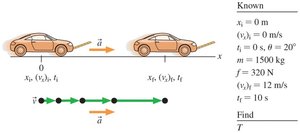
A car accelerates from rest to 12 m/s in 10 s. The acceleration is:
The tension in the rope is:
For , , , :
Mass and Weight
Definitions
Mass (m): A measure of an object’s inertia; does not change with location.
Weight (w): The gravitational force on an object; .
Weight varies with planet, but mass remains constant.
Unit Conversions
Unit | Conversion |
|---|---|
1 pound | 4.45 N |
1 N | 0.225 pound |
1 kg | 2.20 lb |
1 lb | 0.454 kg |
Apparent Weight
Definition and Calculation
Your sensation of weight is due to contact forces supporting you. Apparent weight is defined as:
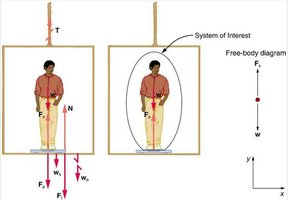
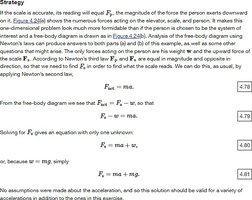
In an elevator, the normal force (apparent weight) is:
If accelerating upward, you feel heavier; if downward, lighter.
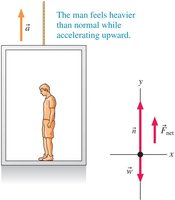
Example: Elevator Apparent Weight
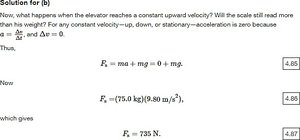
A 75 kg man in an elevator:
Upward acceleration :
Constant speed:
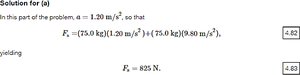
Weightlessness
Concept
Weightlessness occurs when apparent weight is zero, such as in free fall. Objects still have weight (gravitational force), but do not feel it due to lack of supporting contact forces.


Normal Forces
Definition
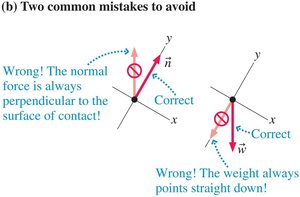
The normal force is the perpendicular contact force exerted by a surface to support an object. It adjusts to prevent penetration of the surface.
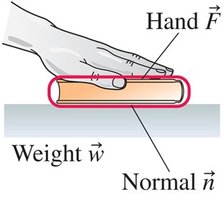
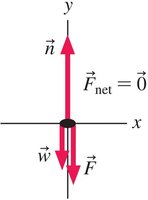
Example: Pressed Book
A 1.2 kg book pressed with 15 N. The normal force is:
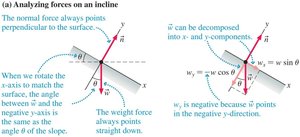
Normal Force on an Incline
On an incline, the normal force is perpendicular to the surface, and the weight is decomposed into components:
Friction
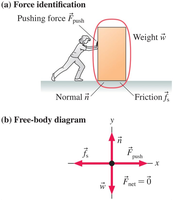
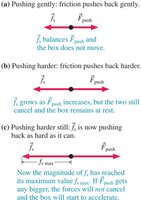
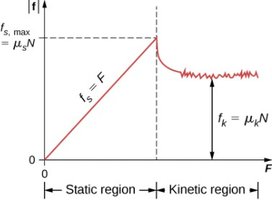
Static Friction
Static friction prevents motion between surfaces. Its direction opposes potential motion, and its magnitude adjusts up to a maximum:
is the coefficient of static friction.
Kinetic Friction
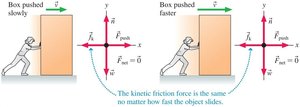
Kinetic friction acts when objects slide. Its magnitude is nearly constant:
is the coefficient of kinetic friction.
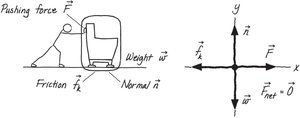
Example: Sliding a Sofa
A 32 kg sofa with is pushed at constant speed. The force required is:
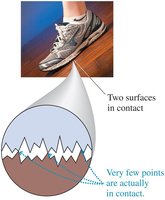
Causes of Friction
Friction arises from microscopic roughness and contact points between surfaces. The harder the surfaces are pressed together, the greater the friction.
Interacting Objects and Newton’s Third Law
Newton’s Third Law
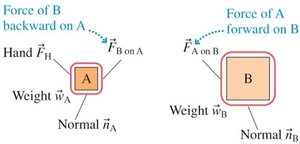
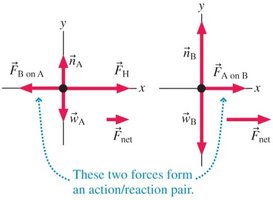
Every force occurs as one member of an action/reaction pair. The two forces:
Act on different objects
Are equal in magnitude and opposite in direction
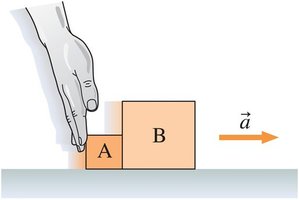
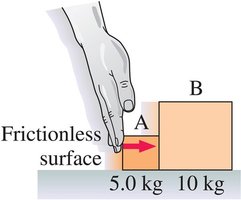
Example: Pushing Two Blocks
Block A (5 kg) pushes block B (10 kg) with a 3 N force. Both move together. The force A exerts on B is:
For , , :
Ropes and Pulleys
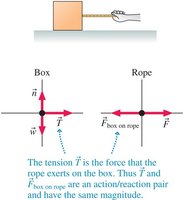
Tension in Massless Ropes
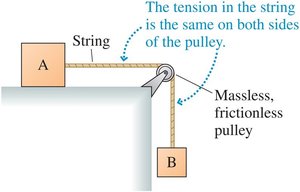
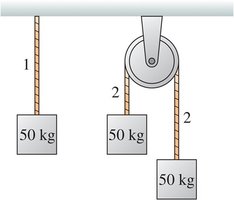
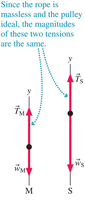
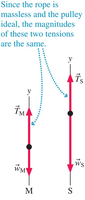
The tension in a massless rope is the same throughout its length. It transmits force undiminished from one end to the other.
Pulleys
In an ideal (massless, frictionless) pulley, the tension in the string is unchanged as it passes over the pulley.
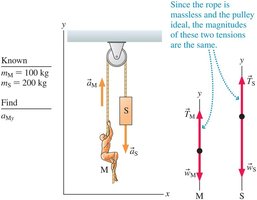
Example: Lifting a Stage Set
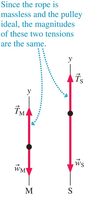
A 200 kg set and a 100 kg stagehand are connected by a rope over a pulley. When the set falls, the stagehand is hoisted upward. Their accelerations are related:
Solving:
For , :
Summary Table: Friction Coefficients
Type | Symbol | Formula |
|---|---|---|
Static Friction | ||
Kinetic Friction | ||
Rolling Friction |
Key Formulas
Newton’s Second Law:
Weight:
Static Friction:
Kinetic Friction:
Normal Force (horizontal surface):
Normal Force (incline):
Tension in massless rope: (force applied)
Additional info: These notes expand on brief points and diagrams to provide full academic context, definitions, and examples suitable for college-level Physics with Algebra students.
