 Back
Chapter 6: Circular Motion, Orbits, and Gravity – Study Notes
Study Guide - Smart Notes
 Tailored notes based on your materials, expanded with key definitions, examples, and context.
Chapter 6: Circular Motion, Orbits, and Gravity
Section 6.1: Kinematics of Uniform Circular Motion
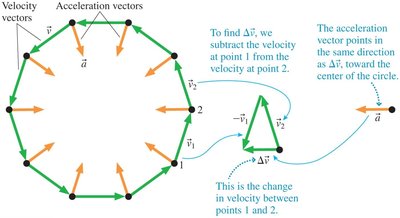
Uniform circular motion describes the motion of an object traveling at constant speed along a circular path. Although the speed is constant, the direction of the velocity changes continuously, resulting in a nonzero acceleration.
Velocity Vector (\(\vec{v}\)): Always tangent to the circle, indicating the direction of motion.
Acceleration Vector (\(\vec{a}\)): Points toward the center of the circle, called centripetal acceleration.
Centripetal Acceleration: The acceleration responsible for changing the direction of the velocity vector, not its magnitude.
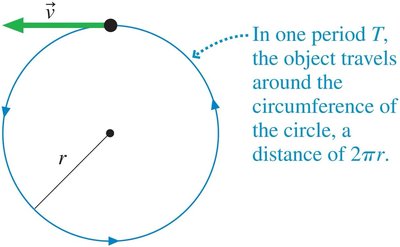
Period (T): The time for one complete revolution (units: seconds).
Frequency (f): Number of revolutions per second (units: Hz or s-1).
Speed (v): For a circle of radius \(r\), the speed is given by:
$ $ a = \frac{v^2}{r} $ $ a = \frac{2\pi f r^2}{r} = \left(\frac{2\pi}{T}\right)^2 r $
Section 6.2: Dynamics of Uniform Circular Motion
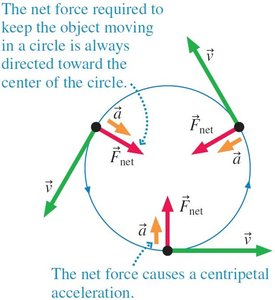
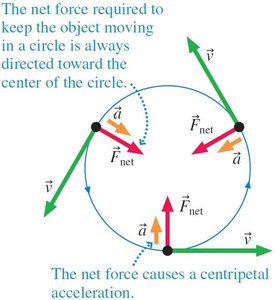
The dynamics of uniform circular motion involve the forces required to maintain the motion. The net force must always point toward the center of the circle, producing centripetal acceleration.
Net Force (\(\vec{F}_{net}\)): Directed toward the center, causing centripetal acceleration.
Centripetal Force: The force responsible for keeping the object in circular motion.
Equation:
Problem-Solving Approach: Circular Dynamics Problems
When solving circular motion problems, it is important to choose the correct coordinate frame:
For motion in a horizontal plane, the x-axis points toward the center, and the y-axis is perpendicular to the plane.
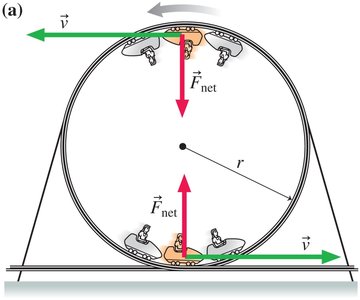
For motion in a vertical plane, the x-axis points toward the center, and the y-axis is tangent to the circle.
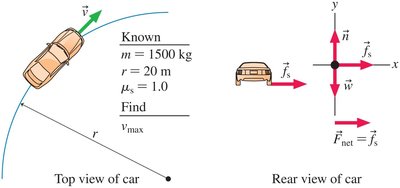
Example: Maximum Speed for a Car to Turn a Corner
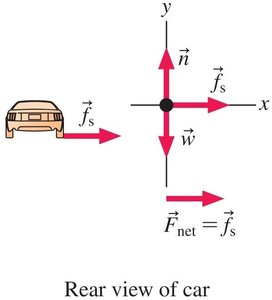
To determine the maximum speed a car can turn without sliding, consider the static friction force as the source of centripetal acceleration:
Static Friction Force (\(f_s\)): Must be directed toward the center.
Maximum Speed Equation:
Section 6.3: Apparent Forces in Circular Motion
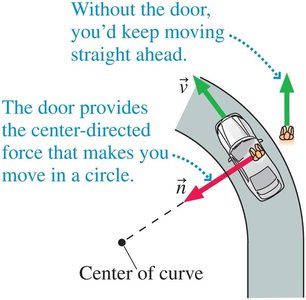
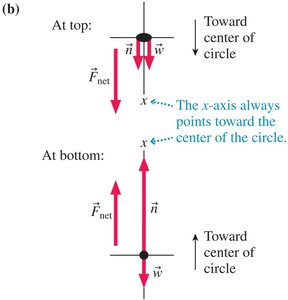
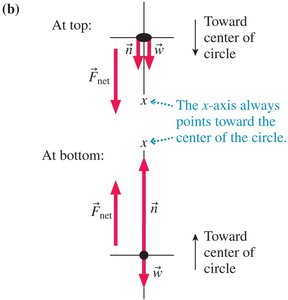
Apparent forces, such as the so-called "centrifugal force," are not real forces but are perceived due to inertia. The sensation of weight changes in circular motion, such as on a roller coaster, is due to the normal force acting on the body.
Centrifugal Force: Not a real force; does not appear in free-body diagrams.
Apparent Weight: The contact force supporting you, which can vary in circular motion.
Critical Speed (\(v_c\)): The minimum speed required to complete a vertical circle.
(at the bottom of the circle) (at the top of the circle)
Section 6.4: Circular Orbits and Weightlessness
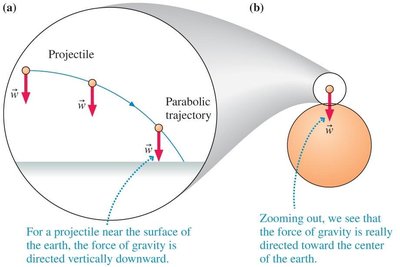
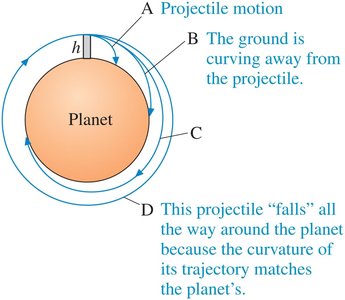
Objects in orbit are in continuous free fall, experiencing weightlessness. The curvature of their trajectory matches the curvature of the planet, so they "fall" around it.
Orbital Motion: An orbiting projectile is in free fall, with gravity providing the centripetal force.
Radius of Orbit: Determines the speed and period of the orbit.
Section 6.5: Newton’s Law of Gravity
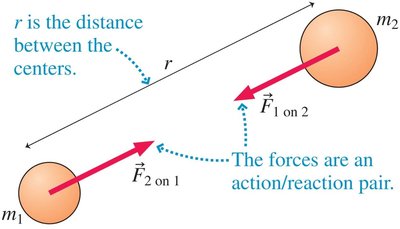
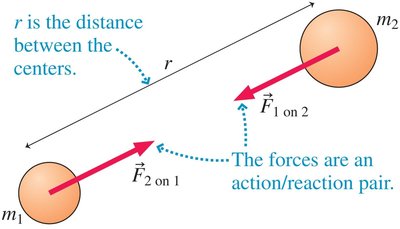
Newton’s Law of Universal Gravitation states that every mass attracts every other mass with a force proportional to the product of their masses and inversely proportional to the square of the distance between them.
Gravitational Force Equation:
Action-Reaction Pair: The force exerted by one mass on another is equal and opposite to the force exerted by the second mass on the first.
Gravity on Other Worlds
The gravitational acceleration on other planets depends on their mass and radius:
Planetary Gravity Equation:
Section 6.6: Gravity and Orbits
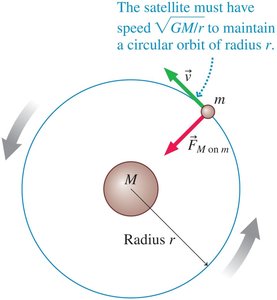
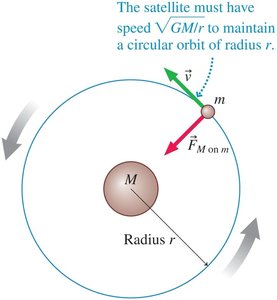
Gravity provides the centripetal force for planetary and satellite orbits. The speed and period of an orbit are determined by the mass of the central object and the radius of the orbit.
Orbital Speed Equation:
Orbital Period Equation:
Gravity on a Grand Scale
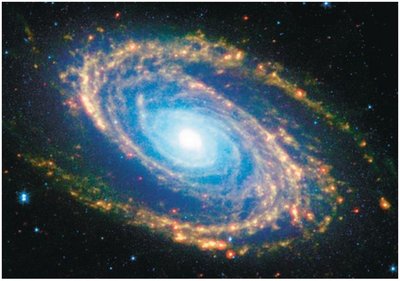
Gravity is the force that holds galaxies together and governs the motion of stars within galaxies.
Additional info: These notes expand on the original slides by providing full academic explanations, definitions, and relevant equations for each topic. All included images directly reinforce the adjacent explanations and are strictly relevant to the content.
