 Back
Chapter 7: Rotational Motion – Physics with Algebra Study Notes
Study Guide - Smart Notes
 Tailored notes based on your materials, expanded with key definitions, examples, and context.
Rotational Motion
Describing Circular and Rotational Motion
Rotational motion refers to the movement of objects that spin about an axis. Understanding this motion is essential for analyzing systems ranging from wheels to planetary orbits.
Rotational motion: The motion of an object spinning about a fixed axis.
Circular motion: The motion of a particle along a circular path.
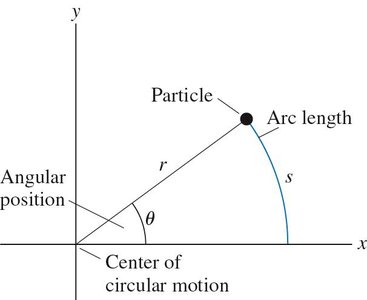
Angular position (θ): The angle from the positive x-axis to the particle's location, measured in radians. Counterclockwise is positive, clockwise is negative.
Arc length (s): The distance traveled along the circular path.
Relationship: (radians), where r is the radius.
Conversion:
Angular Displacement and Angular Velocity
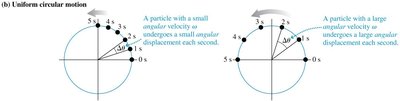
Angular displacement and angular velocity are the rotational analogs of linear displacement and velocity. They describe how much and how quickly an object rotates.
Angular displacement (Δθ): The change in angular position.
Angular velocity (ω): The rate of change of angular displacement, measured in rad/s.
Formula:
Angular speed: The absolute value of angular velocity.
Period (T): The time for one complete revolution.
Frequency (f): Number of revolutions per second.

Relating Linear and Angular Quantities
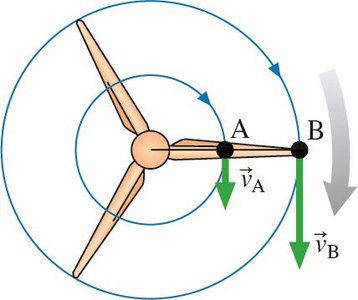
Linear and angular quantities are closely related in rotational motion. The speed of a point on a rotating object depends on its distance from the axis.
Linear speed (v):
Points farther from the axis move faster.
Angular speed must be in rad/s for calculations.
Rotation of a Rigid Body
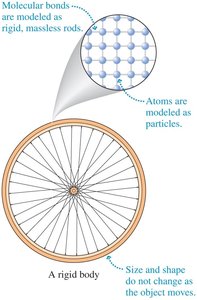
A rigid body is an object whose size and shape do not change as it moves. All points on a rigid body rotate with the same angular velocity, but their linear speeds vary with distance from the axis.
Rigid body: Extended object with constant size and shape.
All points have the same angular velocity.
Linear speed increases with distance from the axis.
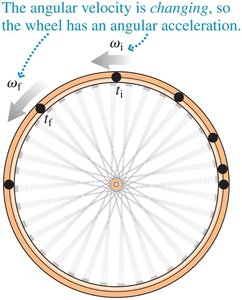
Angular Acceleration
Angular acceleration describes how quickly the angular velocity changes. It is the rotational analog of linear acceleration.
Angular acceleration (α):
Units: rad/s2
Positive α: speeding up in the counterclockwise direction.
Negative α: slowing down or speeding up in the clockwise direction.
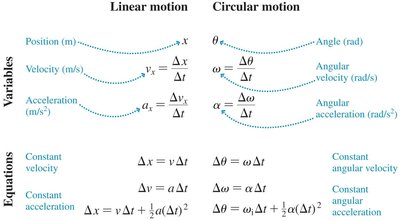
Linear and Circular Motion Analogy
Variables and equations for linear motion have direct analogs in circular motion.
Position: x (linear), θ (angular)
Velocity: v (linear), ω (angular)
Acceleration: a (linear), α (angular)
Equations:
Linear:
Angular:
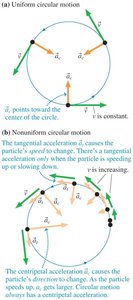
Tangential Acceleration
Tangential acceleration is the component of acceleration directed tangent to the circle. It measures how quickly the speed around the circle increases.
Tangential acceleration (at):
Relates angular acceleration to linear acceleration.
Torque
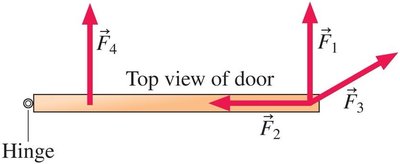
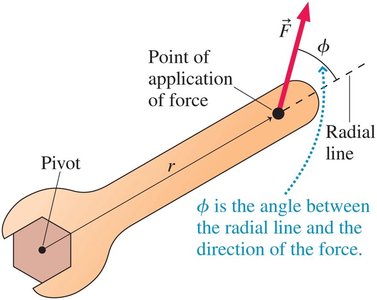
Torque is the rotational equivalent of force. It measures the ability of a force to cause rotation about an axis.
Torque (τ):
Depends on force magnitude, distance from pivot, and angle of application.
Units: N·m (newton-meters)
Moment arm: Perpendicular distance from the line of action to the pivot.
Positive torque: Counterclockwise rotation; Negative torque: Clockwise rotation.
Center of Gravity and Gravitational Torque
The center of gravity is the point where the net force of gravity acts on an object. Gravitational torque can be calculated by considering the object's weight acting at this point.
Center of gravity: Point where gravity acts as a single force.
Gravitational torque:
Objects come to rest with the center of gravity below the pivot.
Moment of Inertia
Moment of inertia is the rotational equivalent of mass. It quantifies how mass is distributed relative to the axis of rotation and affects the angular acceleration produced by a given torque.
Moment of inertia (I):
Depends on mass and its distribution.
Units: kg·m2
Common shapes:
Object
Axis
Moment of Inertia (I)
Thin rod
Center
Thin rod
End
Cylinder
Center
Cylindrical hoop
Center
Solid sphere
Diameter
Spherical shell
Diameter
Newton’s Second Law for Rotational Motion
Newton’s second law for rotation relates net torque to angular acceleration and moment of inertia.
Formula:
Analogous to in linear motion.
Rolling Motion
Rolling motion combines rotation and translation. For objects rolling without slipping, the linear speed of the center is linked to the angular speed.
Rolling constraint:
The point at the bottom of the wheel is instantaneously at rest.
Summary Table: Linear vs. Rotational Motion
Linear Motion | Rotational Motion |
|---|---|
Position (x) | Angle (θ) |
Velocity (v) | Angular velocity (ω) |
Acceleration (a) | Angular acceleration (α) |
Force (F) | Torque (τ) |
Mass (m) | Moment of inertia (I) |
Example Applications
Calculating angular velocity and speed for rotating objects (e.g., wind turbine blades, car tires).
Finding torque required to open doors or rotate objects.
Balancing seesaws and determining center of gravity.
Estimating angular acceleration for falling poles or spinning flywheels.
Additional info: These notes expand on the original slides by providing full academic explanations, formulas, and context for each concept. All equations are presented in LaTeX format for clarity. Only images directly relevant to the explanation are included.
