 Back
Chapter 7: Rotational Motion – Physics with Algebra Study Notes
Study Guide - Smart Notes
 Tailored notes based on your materials, expanded with key definitions, examples, and context.
Rotational Motion
Introduction to Rotational Motion
Rotational motion describes the movement of objects that spin about an axis. Understanding rotational motion is essential for analyzing the behavior of wheels, gears, and other rotating systems in physics.
Rotational motion involves objects rotating around a fixed axis.
Key quantities: angle (θ), angular velocity (ω), and angular acceleration (α).
Many concepts from linear motion have direct analogs in rotational motion.
Angular Position and Measurement
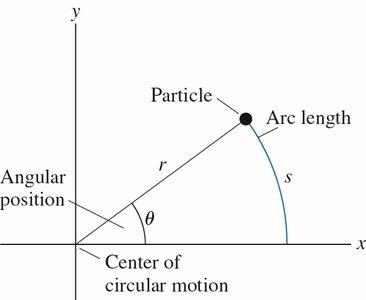
The angular position of a particle is defined by the angle θ from the positive x-axis. This angle is measured in radians, which is the standard unit for angular measurements in physics.
Angular position (θ): The angle from the positive x-axis to the particle's location.
Measured in radians (rad), not degrees.
Arc length (s): The distance traveled along the circular path.
Relationship:
One revolution: radians = 360°
Conversion:
Angular Displacement and Angular Velocity
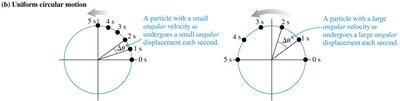
Angular displacement is the change in angular position over time. Angular velocity quantifies how quickly an object rotates, analogous to linear velocity in straight-line motion.
Angular displacement (Δθ): Change in angular position.
Angular velocity (ω):
For uniform circular motion, angular velocity is constant.
Angular speed is the absolute value of angular velocity.
Period (T):
Frequency (f):

Comparing Linear and Circular Motion
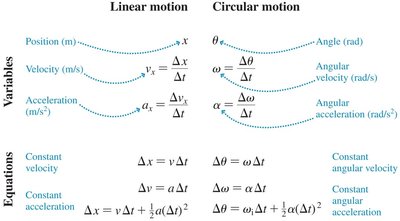
Linear and circular motion share similar variables and equations, with angular quantities replacing linear ones.
Position: (linear), (angular)
Velocity: (linear), (angular)
Acceleration: (linear), (angular)
Equations for constant velocity and acceleration:
Rigid Body Rotation
Rigid Body Model
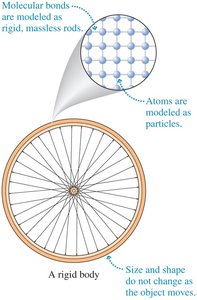
A rigid body is an object whose size and shape do not change as it moves. This model is useful for analyzing real objects in rotational motion.
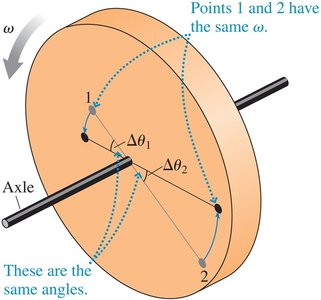
All points on a rigid body have the same angular velocity.
Points at different distances from the axis have different linear speeds.
Rotational Motion of a Rigid Body
Every point on a rotating rigid body shares the same angular velocity, but their linear speeds depend on their distance from the axis.
Speed at a point:
Points farther from the axis move faster.
Angular Acceleration
Definition and Calculation
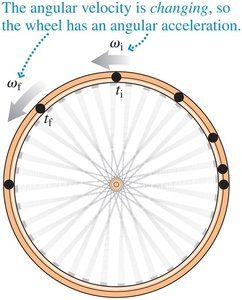
Angular acceleration measures how quickly the angular velocity changes. It is analogous to linear acceleration in straight-line motion.
Angular acceleration (α):
Units: rad/s2
Tangential Acceleration
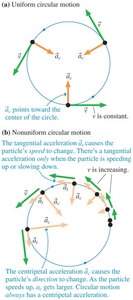
Tangential acceleration is the component of acceleration directed along the tangent to the circle. It measures the rate at which the speed around the circle increases.
Relationship:
Connects angular acceleration to linear acceleration.
Torque and Rotational Dynamics
Torque: The Rotational Equivalent of Force
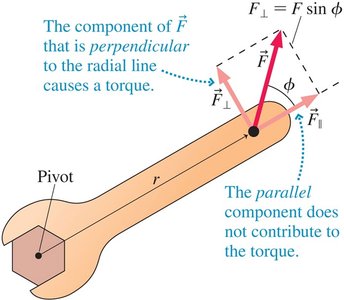
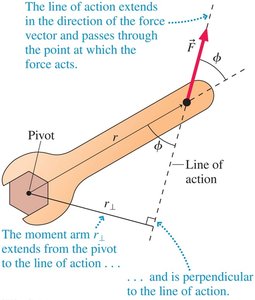
Torque is the measure of a force's ability to cause rotation. It depends on the force's magnitude, the distance from the pivot, and the angle at which it is applied.
Torque (τ):
Units: N·m (newton-meters)
Moment arm: Perpendicular distance from the pivot to the line of action of the force.
Net Torque
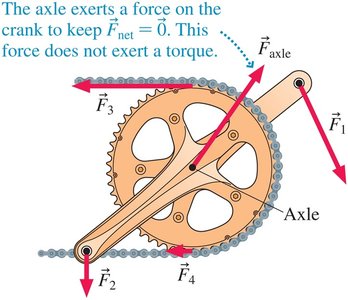
The net torque is the sum of all individual torques acting on an object. It determines the object's angular acceleration.
Center of Gravity and Gravitational Torque
Center of Gravity
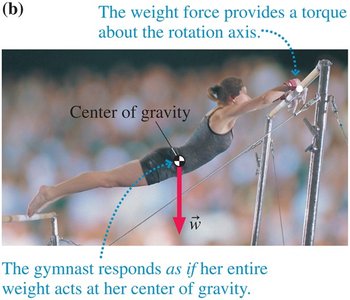
The center of gravity is the point where the entire weight of an object can be considered to act for purposes of calculating torque due to gravity.
Gravitational torque:
Objects come to rest with the center of gravity below the pivot.
Position of center of gravity (xcg):
Moment of Inertia and Rotational Dynamics
Moment of Inertia
The moment of inertia quantifies an object's resistance to changes in rotational motion. It depends on both the mass and how the mass is distributed relative to the axis of rotation.
Moment of inertia (I):
Units: kg·m2
Higher moment of inertia means more resistance to angular acceleration.
Newton's Second Law for Rotation
Newton's second law for rotational motion relates net torque to angular acceleration and moment of inertia.
Analogous to in linear motion.
Moments of Inertia for Common Shapes
Different shapes have characteristic moments of inertia, depending on their mass distribution and axis of rotation.
Object | Axis | Moment of Inertia (I) |
|---|---|---|
Thin rod | Center | |
Thin rod | End | |
Plane/slab | Center | |
Plane/slab | Edge | |
Cylinder/disk | Center | |
Cylindrical hoop | Center | |
Solid sphere | Diameter | |
Spherical shell | Diameter |
Rolling Motion
Rolling Without Slipping
Rolling motion combines rotation and translation. For an object rolling without slipping, the velocity of the center is linked to the angular velocity.
Relationship:
In one revolution, the center moves forward by one circumference:
The point at the bottom of the wheel is instantaneously at rest.
Summary Table: Linear vs. Rotational Motion
Linear Motion | Rotational Motion |
|---|---|
Position (x) | Angle (θ) |
Velocity (v) | Angular velocity (ω) |
Acceleration (a) | Angular acceleration (α) |
Force (F) | Torque (τ) |
Mass (m) | Moment of inertia (I) |
Key Equations
(rolling constraint)
