 Back
Chapter 8: Equilibrium and Elasticity – Physics with Algebra Study Notes
Study Guide - Smart Notes
 Tailored notes based on your materials, expanded with key definitions, examples, and context.
Equilibrium and Elasticity
Introduction
This chapter explores the principles of static equilibrium for extended objects and the properties of springs and elastic materials. Understanding these concepts is essential for analyzing the stability of structures and the behavior of materials under force.
Torque and Static Equilibrium
Static Equilibrium of Particles and Extended Objects
Static equilibrium occurs when an object is at rest and remains at rest under the action of forces and torques. For a particle, equilibrium is achieved when the net force is zero. For extended objects, both net force and net torque must be zero.
Net Force: The sum of all forces acting on the object must be zero.
Net Torque: The sum of all torques acting on the object must be zero.
Conditions for Static Equilibrium:
Example: Cheerleaders holding positions without movement demonstrate static equilibrium, as both net force and net torque are zero.

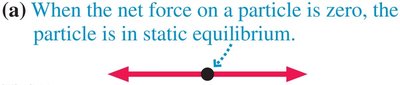
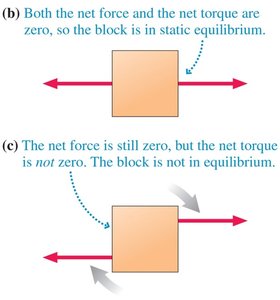
Identifying Static Equilibrium
Objects in static equilibrium have balanced forces and torques. Diagrams can help visualize these conditions.
Example: Blocks with equal and opposite forces are in equilibrium.
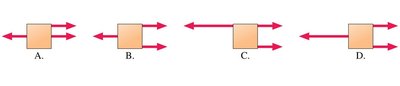
Torque and the Pivot Point
Torque is the rotational equivalent of force. The choice of pivot point can simplify calculations, especially when forces are not well specified.
Torque Formula:
Example: A seesaw with children of different masses can be balanced by adjusting their distances from the pivot.

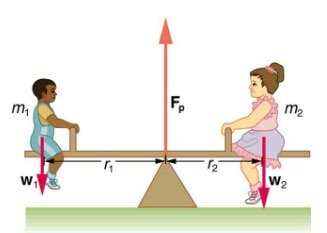
Example: Lifting a Load
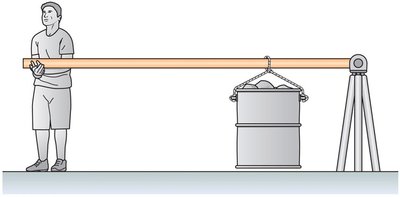
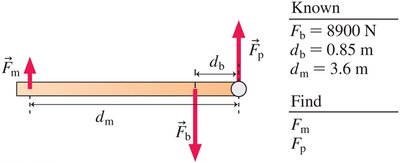
In static equilibrium problems, forces and torques must be balanced. For instance, a strongman lifting a beam with a load requires calculation of the force applied and the force at the pivot.
Force of the bucket:
Torque balance:
Force at the pivot:
Choosing the Pivot Point
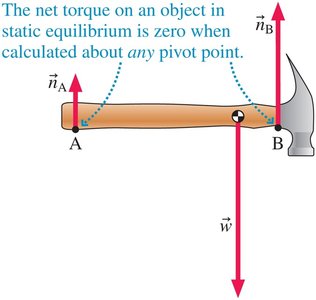
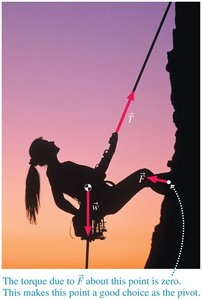
The net torque about any point must be zero for static equilibrium. Choosing a pivot point where forces are poorly specified can simplify calculations.
Example: The torque due to a force at the pivot is zero.
Problem-Solving Approach for Static Equilibrium
Steps for Solving Static Equilibrium Problems
Strategize: Choose the object and pivot point.
Prepare: Identify forces, their points of application, and distances.
Solve: Write equations for net force and net torque, then solve.
Assess: Check if the solution is reasonable.
Stability and Balance
Base of Support and Center of Gravity
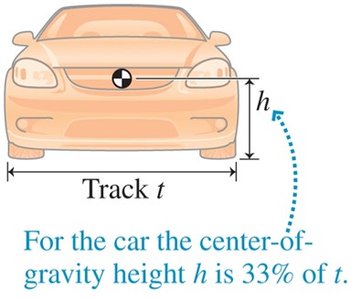
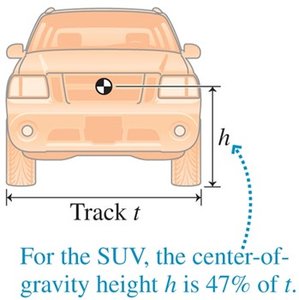
Stability depends on the base of support and the position of the center of gravity. A wider base and lower center of gravity increase stability.
Stable Equilibrium: Center of gravity over base of support.
Unstable Equilibrium: Center of gravity outside base of support.
Critical Angle Formula:
Ladder Safety and Human Balance
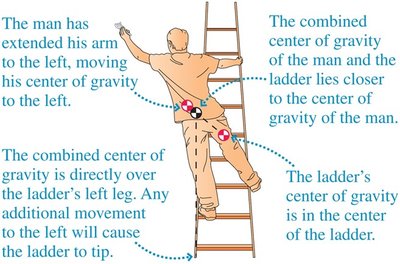
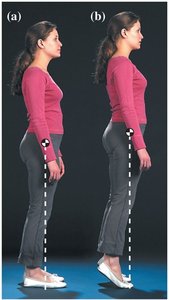
When a person leans on a ladder, the combined center of gravity must remain over the base to prevent tipping. Humans adjust their posture to maintain balance.
Example: Leaning too far shifts the center of gravity outside the base, causing instability.
Springs and Hooke’s Law
Elasticity and Restoring Forces
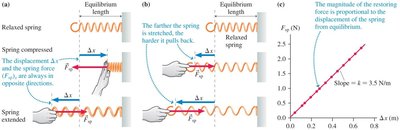
Elastic materials return to their original shape after being deformed. Springs and rubber bands are common examples.
Restoring Force: Force that returns a system to equilibrium.
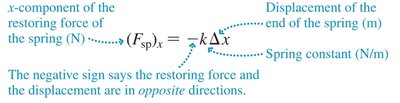
Hooke’s Law:
Spring Constant (k): Measures stiffness, units N/m.
Comparing Spring Constants
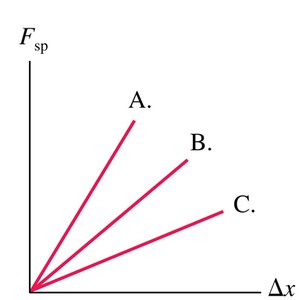
The slope of the force vs. displacement graph indicates the spring constant. A steeper slope means a stiffer spring.
Stretching and Compressing Materials
Modeling Materials as Springs
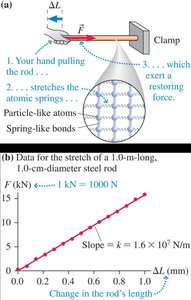
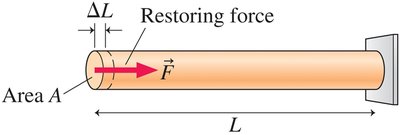
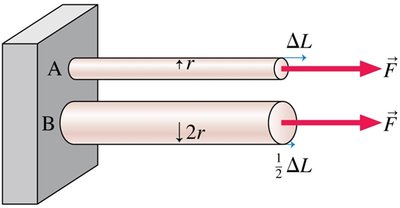
Solid materials can be modeled as atoms connected by spring-like bonds. The force required to stretch a rod depends on its material, length, and cross-sectional area.
Young’s Modulus (Y): Property of material, measures stiffness.
Spring Constant for Rod:
Stress and Strain
Stress is the force per unit area, and strain is the relative change in length. The relationship is given by:
Stress:
Strain:
Relationship:

Example: Stretch of a Cable
When a heavy object is suspended from a cable, the cable stretches. The amount of stretch depends on the force, length, area, and Young’s modulus.
Stretch Formula:

Beyond the Elastic Limit
Elastic Limit and Tensile Strength
Materials obey Hooke’s law only within the elastic region. Beyond the elastic limit, permanent deformation occurs. The ultimate stress is the maximum stress a material can withstand before breaking.
Biological Materials
Elasticity in Biological Structures
Bones and tissues have varying elastic properties. Compact bone is rigid, while spongy bone and tendons are more flexible.
Young’s Modulus for Biological Materials:
Material
Young’s Modulus ( N/m2)
Tooth enamel
6
Compact bone
1.6
Spongy bone
0.02–0.3
Spider silk
0.2
Tendon
0.15
Cartilage
0.0001
Blood vessel (aorta)
0.00005
Forces and Torques in the Body
Biomechanics and Mechanical Advantage
The human body uses levers to amplify force. The location of muscle attachment affects strength, speed, and range of motion.
Mechanical Advantage: Ratio of output force to input force.
Example: Nutcracker applies greater force to the nut than the hand.
Example: Forces in the Ankle Joint
Standing on tiptoe involves forces from the floor, Achilles tendon, and ankle joint. The tendon force is much greater than body weight due to its proximity to the pivot.
Torque Balance:
Force in Joint: Sum of upward forces minus downward force.
Summary Table: Young's Modulus for Rigid Materials
Material | Young’s Modulus ( N/m2) |
|---|---|
Cast iron | 20 |
Steel | 20 |
Silicon | 13 |
Copper | 11 |
Aluminum | 7 |
Glass | 7 |
Concrete | 3 |
Wood (Douglas Fir) | 1 |
Key Equations
Static Equilibrium: , ,
Torque:
Hooke’s Law:
Young’s Modulus:
Additional info: These notes expand on the original slides and examples, providing definitions, formulas, and context for each topic. Images are included only when directly relevant to the explanation.
