 Back
Chapter 9: Momentum, Impulse, and Conservation Laws – Study Guide
Study Guide - Smart Notes
 Tailored notes based on your materials, expanded with key definitions, examples, and context.
Momentum and Impulse
Introduction to Momentum
Momentum is a fundamental concept in physics that describes the quantity of motion an object possesses. It is directly related to both the mass and velocity of the object and is a vector quantity, meaning it has both magnitude and direction.
Definition: Momentum (p) is the product of an object's mass (m) and velocity (v).
Formula:
Units: kg·m/s
Direction: Momentum points in the same direction as the velocity vector.
Example: A moving football player or a colliding ram both possess momentum proportional to their mass and speed.


Impulse
Impulse is the effect of a force acting over a period of time, resulting in a change in momentum. It is especially important in collisions and other short-duration interactions.
Definition: Impulse (J) is the product of the average force (F_{avg}) and the time interval (\Delta t) during which the force acts.
Formula:
Units: N·s (Newton-seconds), equivalent to kg·m/s
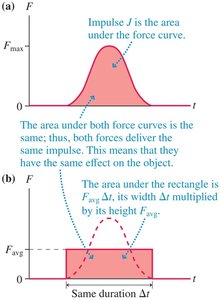
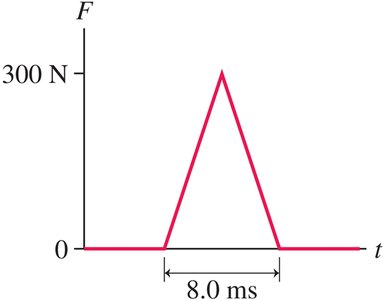
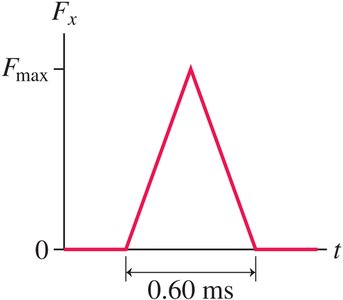
Impulse as Area: The impulse is equal to the area under the force vs. time curve.
Example: Kicking a soccer ball involves a large force over a short time, imparting impulse to the ball.


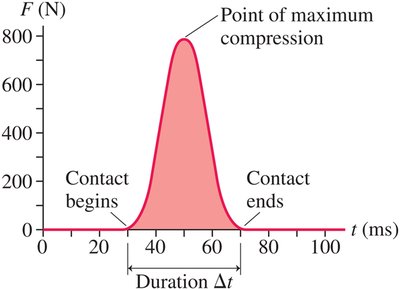
Force-Time Graphs and Impulse Calculation
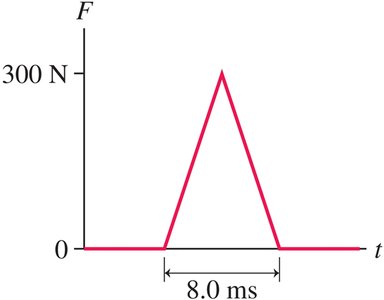
Force-time graphs are used to visualize how force is applied during collisions. The area under the curve represents the impulse delivered.
Key Point: The shape of the force curve (often triangular or bell-shaped) determines the impulse.
Average Force: The average force is defined as the constant force that would deliver the same impulse over the same time interval.
Formula:
Impulse-Momentum Theorem
The impulse-momentum theorem states that the impulse delivered to an object equals the change in its momentum.
Formula:
Component Form: and
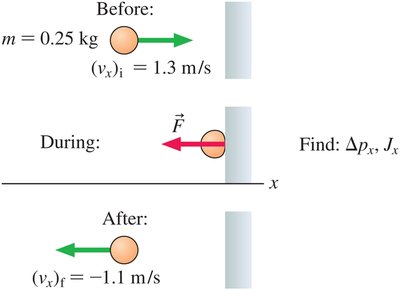
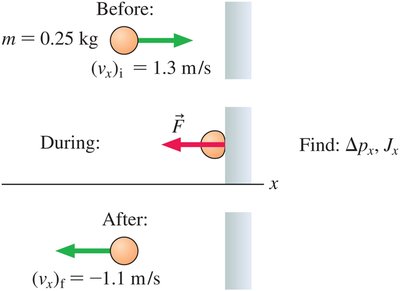
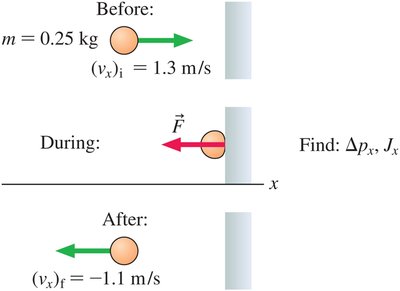
Example: A ball rebounding from a wall experiences a change in momentum equal to the impulse delivered by the wall.
Conservation of Momentum
Law of Conservation of Momentum
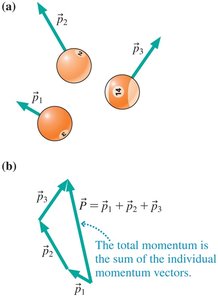
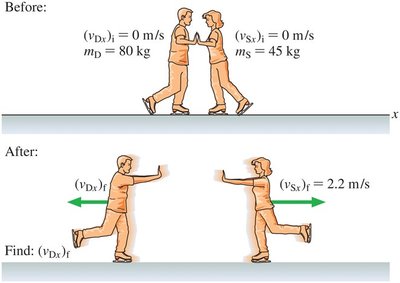
In an isolated system (no net external force), the total momentum before an interaction equals the total momentum after the interaction. This principle is fundamental in analyzing collisions and explosions.
Formula:
Vector Sum: The total momentum is the vector sum of individual momenta:
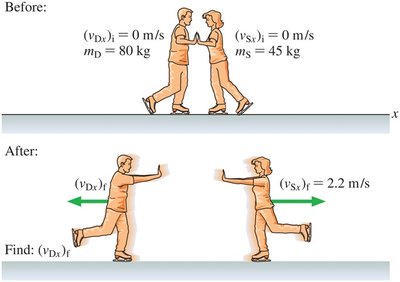
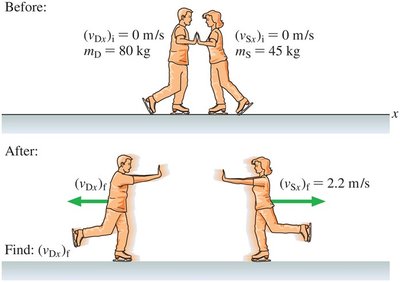
Example: Collisions between football players or rams, or ice skaters pushing off each other.

Collisions and Action-Reaction Pairs
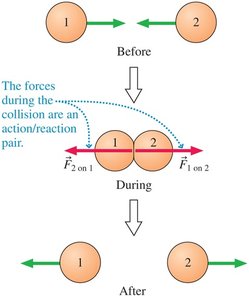
During a collision, the forces between objects are equal in magnitude and opposite in direction (Newton's third law). The impulse delivered to each object is also equal and opposite, ensuring momentum conservation.
Action-Reaction:
Example: Two balls colliding, each experiencing equal and opposite impulses.
Types of Collisions
Collisions can be classified as elastic or inelastic. In perfectly inelastic collisions, objects stick together and move with a common velocity after the collision.
Perfectly Inelastic Collision: Both objects stick together after collision.
Formula:
Example: Railroad cars coupling together after collision.
Momentum in Two Dimensions
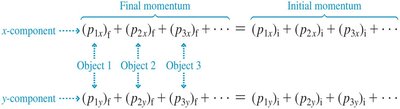
When collisions occur in two dimensions, conservation of momentum must be applied separately to each component (x and y directions).
Component Form: and
Example: Collisions involving multiple objects moving in different directions.
Angular Momentum
Definition and Conservation
Angular momentum is the rotational analog of linear momentum. It is conserved in the absence of external torques.
Definition: where I is the moment of inertia and \omega is the angular velocity.
Conservation Law: If net external torque is zero, angular momentum is conserved:
Example: Figure skaters increase their spin rate by reducing their moment of inertia.
Summary Table: Key Concepts
Concept | Definition | Formula | Units |
|---|---|---|---|
Momentum | Product of mass and velocity | kg·m/s | |
Impulse | Force applied over time | N·s or kg·m/s | |
Impulse-Momentum Theorem | Impulse equals change in momentum | kg·m/s | |
Conservation of Momentum | Total momentum constant in isolated system | kg·m/s | |
Angular Momentum | Rotational equivalent of momentum | kg·m2/s |
Problem-Solving Strategies
Impulse and Momentum Problems
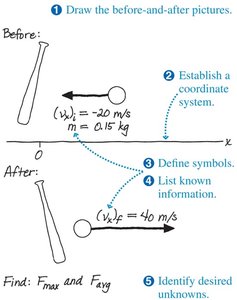
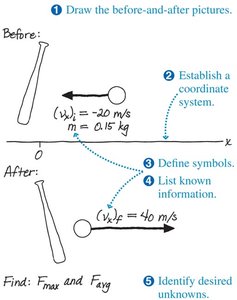
Draw before-and-after diagrams to visualize the situation.
Establish a coordinate system and define symbols for mass and velocity.
List known values and identify desired unknowns.
Apply the impulse-momentum theorem or conservation of momentum as appropriate.
Conservation of Momentum Problems
Clearly define the system and check for isolation (no net external force).
Draw before-and-after diagrams and define relevant variables.
Apply conservation of momentum equations to solve for unknowns.
Additional info:
Momentum and impulse are central to understanding collisions, explosions, and rotational motion.
Conservation laws provide powerful tools for analyzing physical interactions, especially when forces are complex or unknown.
Angular momentum extends the concept of momentum to rotational systems, with similar conservation principles.
