 Back
Conservation of Energy and Its Applications
Study Guide - Smart Notes
 Tailored notes based on your materials, expanded with key definitions, examples, and context.
Conservation of Energy
Introduction to Energy Conservation
The principle of conservation of energy states that energy cannot be created or destroyed, only transferred or transformed from one form to another. In physics, this principle is fundamental for analyzing systems and solving problems involving mechanical processes.
Analysis Models: Isolated and Nonisolated Systems
Nonisolated System (Energy)
A nonisolated system is one in which energy crosses the boundary of the system due to interactions with the environment. The work-kinetic energy theorem is an example of an energy equation for such systems, where external forces do work on the system, changing its kinetic energy. Other mechanisms for energy transfer include heat, mechanical waves, and electromagnetic radiation.
Work: Energy transferred by a force acting through a distance.
Heat: Energy transferred due to temperature difference.
Mechanical Waves: Energy transferred by oscillations (e.g., sound).
Electromagnetic Radiation: Energy transferred by light or other electromagnetic waves.
Isolated System (Energy)
An isolated system does not exchange energy with its environment. The total energy within the system remains constant. For example, a book falling under gravity (neglecting air resistance) is considered an isolated system if only the book and Earth are included.
Conservation Equation for Isolated Systems:
where is the total energy (kinetic + potential + other forms) of the system.
Energy Transfer Mechanisms
Examples of Energy Transfer
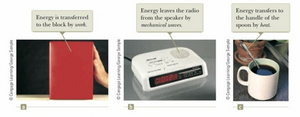
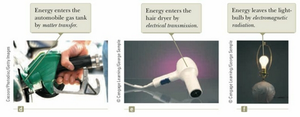
Energy can be transferred into or out of a system by various mechanisms, such as mechanical work, heat, and radiation. The following examples illustrate these mechanisms:
Energy transferred to a block by a hand (mechanical work).
Energy leaves a radio by mechanical waves (sound).
Energy transfers to the handle of a spoon by heat.
Energy enters a gas tank by matter transfer (fuel).
Energy enters a hair dryer by electrical transmission.
Energy leaves a lightbulb by electromagnetic radiation (light).
Using the Conservation Equation
Application Example
When a force is applied to an object causing it to move, the conservation equation can be used to relate the work done to the change in kinetic energy:
where is the work done by external forces and is the change in kinetic energy.
Problem Solving with Isolated and Nonisolated Systems
Example: Dropping a Ball
Consider a ball of mass dropped from height . Neglecting air resistance, the speed of the ball at height can be found using energy conservation:
Example: Spring-Loaded Popgun
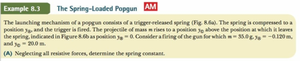
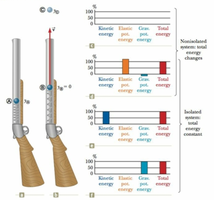
The launching mechanism of a popgun uses a compressed spring. The energy stored in the spring is converted to kinetic and gravitational potential energy of the projectile.
Situations Involving Kinetic Friction
Friction and Energy
When an object slides across a surface, kinetic friction acts at the interface, converting mechanical energy into thermal energy. The friction force is distributed across the contact area, and its exact point of application is not easily determined.
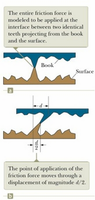
Work Done by Friction
The work-kinetic energy theorem cannot be directly used to calculate the work done by friction because the point of application is not fixed. However, Newton's second law still applies to the system.
Changes in Mechanical Energy for Nonconservative Forces
Nonconservative Forces
When nonconservative forces (like friction) act, the total mechanical energy (kinetic + potential) of a system changes. The energy lost from mechanical forms is transformed into other forms, such as heat.
Power
Definition and Equations
Power is the rate at which work is done or energy is transferred. It is defined as:
where is power, is the infinitesimal work done, and is the infinitesimal time interval. The average power is:
The SI unit for power is the watt (W), where . In the US customary system, power is often measured in horsepower (hp).
Quick Quizzes and Example Problems
Quick Quiz 8.2: Block Sliding with Friction
Consider a block sliding over a horizontal surface with friction. If the system is the block, it is nonisolated because friction acts as an external force. If the system is the surface, it is also nonisolated. If the system is both the block and the surface, it can be considered isolated if no external forces act.

Example 8.3: The Spring-Loaded Popgun
This example involves calculating the spring constant and analyzing energy transformations in a spring-mass system.
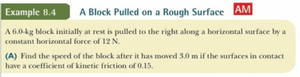
Example 8.4: A Block Pulled on a Rough Surface
A block is pulled across a rough surface. The speed after moving a certain distance can be found by considering the work done by the applied force and the energy lost to friction.
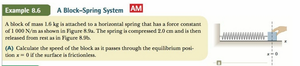
Example 8.6: A Block-Spring System
A block attached to a spring is released from rest. The speed as it passes through equilibrium can be found using conservation of energy, assuming no friction.
Quick Quiz 8.3: Dropping Rocks of Different Masses
When two rocks of different masses are dropped from the same height, the kinetic energy of the heavier rock is twice that of the lighter rock when they hit the ground, since kinetic energy is proportional to mass.

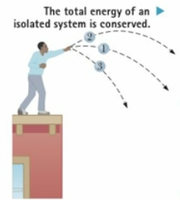
Quick Quiz 8.4: Balls Thrown from a Building
Three identical balls are thrown from a building with the same initial speed but different angles. Neglecting air resistance, all balls have the same speed when they hit the ground due to conservation of energy.

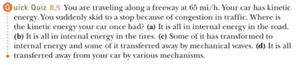
Quick Quiz 8.5: Car Kinetic Energy Dissipation
When a car suddenly stops, its kinetic energy is transformed into internal energy (mainly in the tires and road) and possibly some mechanical waves (sound, vibration).
Summary Table: Energy Transfer Mechanisms
Mechanism | Description | Example |
|---|---|---|
Work | Energy transferred by force through distance | Pushing a block |
Heat | Energy transferred due to temperature difference | Spoon in hot coffee |
Mechanical Waves | Energy transferred by oscillations | Sound from a radio |
Electromagnetic Radiation | Energy transferred by light or other EM waves | Light from a bulb |
Matter Transfer | Energy transferred by movement of matter | Fuel entering a gas tank |
Additional info: Some explanations and equations were expanded for clarity and completeness, following standard physics curriculum for algebra-based courses.
