 Back
BackKinematics Equations and Proportional Reasoning in 1D Motion
Study Guide - Smart Notes
 Tailored notes based on your materials, expanded with key definitions, examples, and context.
Kinematics Equations from Graphs
Constant Motion Equation
Kinematics is the study of motion without considering its causes. The simplest kinematics equation describes constant motion, or average velocity, and is foundational for understanding more complex motion.
Average velocity equation: , where is velocity, is displacement, and is time interval.
Application: Used when an object moves at a constant speed in a straight line.
Using Velocity-Time (V-t) Graphs to Derive Equations
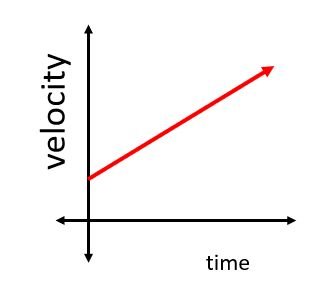
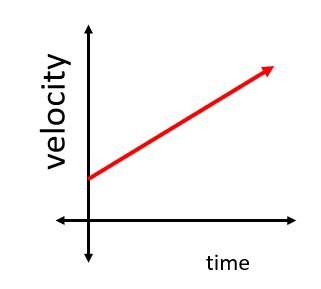
Velocity-time graphs are powerful tools for visualizing and deriving kinematics equations. The slope and area of these graphs correspond to key physical quantities.
Slope-intercept form: The equation for a straight line on a V-t graph is , where is initial velocity and is acceleration.
Interpretation: The slope of the line represents acceleration, and the y-intercept represents initial velocity.
Area Under the V-t Graph (Displacement)
The area under a velocity-time graph gives the displacement of an object. For constant acceleration, this area forms a trapezoid or triangle, depending on initial velocity.
Displacement equation:
Application: Used to find how far an object travels when it starts with an initial velocity and accelerates uniformly.
Time-Independent (Third) Kinematics Equation
Some situations require finding displacement without knowing the time. The time-independent equation is derived algebraically from other kinematics equations and is useful when time is not given.
Equation:
Variables: (displacement), (final velocity), (initial velocity), (acceleration), (time)
Solving: At least three variables must be known to solve for the others.
Example Problems
Applying kinematics equations to real-world scenarios helps solidify understanding.
Bicycle in Sandy Patch:
Given: Initial speed m/s, final speed m/s, displacement m
Find: Acceleration and time
Use: and
Drag Racer:
Given: Displacement m, time s, initial velocity
Find: Acceleration
Use:
Special Kinematics Equations
Acceleration-Independent Equation
There exists a kinematics equation that does not include acceleration, but it only applies when acceleration is constant. It is not typically found on standard equation sheets.
Equation:
Limitation: Only valid for constant acceleration; not for multi-stage motion.
Example Application
Car slowing down:
Initial velocity m/s, final velocity m/s, time s
Find: Displacement
Use:
Proportional Reasoning in Kinematics
Understanding Variable Relationships
Proportional reasoning is used to predict how one variable changes in response to another, without needing exact values. This is especially useful in physics for quick estimations and conceptual understanding.
Example: If starting velocity is doubled, how does stopping distance change?
Method: Analyze the proportional relationship in the relevant equation.
Proportional Relationships in Equations
Example equation:
If , and have a squared relationship: doubling quadruples .
If is doubled, increases by .
Rule of Ones Strategy
This strategy simplifies proportional reasoning by substituting changing variables with their change factor and others with 1.
Solve the kinematics equation for the variable of interest.
Replace all constants and unchanged variables with 1.
Replace changing variables with their change factor (e.g., 2 for doubling).
Simplify to find the proportional change in the variable of interest.
Proportional Reasoning Examples
Uniform acceleration from rest: If time is halved, distance is reduced to one-fourth.
Emergency braking: If speed is doubled, stopping distance increases by a factor of four (since for constant deceleration).
Summary Table: Kinematics Equations
Equation | Variables | When to Use |
|---|---|---|
v, v_0, a, t | Find final velocity with constant acceleration | |
\Delta x, v_0, a, t | Find displacement with initial velocity and acceleration | |
v, v_0, a, \Delta x | Find final velocity or displacement without time | |
\Delta x, v, v_0, t | Find displacement without acceleration |
Additional info: Proportional reasoning is a powerful tool for conceptual physics questions and is often tested in exams. Understanding how variables relate in kinematics equations is essential for problem-solving and deeper comprehension.
