Back
BackModels, Measurements, and Vectors: SI Units, Scientific Notation, and Measurement Accuracy
Study Guide - Smart Notes
 Tailored notes based on your materials, expanded with key definitions, examples, and context.
Models, Measurements & Vectors
Introduction to SI Units and Measurement
Physics relies on precise measurements and standardized units to describe the natural world. The International System of Units (SI) provides a universal framework for scientists and engineers to communicate measurements clearly and accurately.
SI Units and Base Quantities
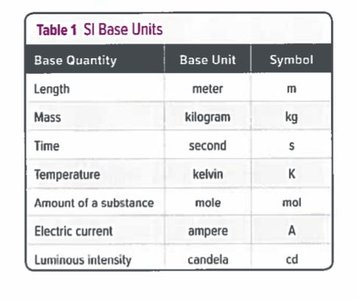
The SI (Système International d’Unités) is the improved, universally accepted version of the metric system, based on multiples of ten. It defines seven base units from which all other units are derived.
Base Quantity | Base Unit | Symbol |
|---|---|---|
Length | meter | m |
Mass | kilogram | kg |
Time | second | s |
Temperature | kelvin | K |
Amount of a substance | mole | mol |
Electric current | ampere | A |
Luminous intensity | candela | cd |
Derived units are combinations of base units (e.g., m/s for speed).
SI units use prefixes to indicate multiples or fractions of base units.
SI Prefixes
SI prefixes are used to express very large or very small quantities conveniently. Each prefix represents a specific power of ten.
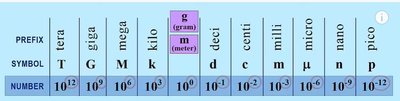
Kilo- (k) means (1,000 times the base unit).
Milli- (m) means (one-thousandth of the base unit).
Other common prefixes include mega- (M), micro- (\mu), nano- (n), and pico- (p).
Scientific Notation
Scientific notation is a method for expressing very large or very small numbers in the form , where and is an integer. This notation simplifies calculations and clarifies the magnitude of measurements.
Example:
Example:
Dimensional Analysis
Dimensional analysis is a technique for converting between units and verifying the consistency of equations. It involves multiplying by conversion factors that equal one, ensuring that units cancel appropriately.
Example: To convert 5 kilometers to meters:
Dimensional analysis can also check if both sides of an equation have the same units, confirming its validity.
Significant Figures
Significant figures are the digits in a measurement that are known with certainty plus one estimated digit. They reflect the precision of a measurement and must be considered when performing calculations.
When multiplying or dividing, the result should have as many significant figures as the measurement with the fewest significant figures.
When adding or subtracting, the result should have the same number of decimal places as the measurement with the fewest decimal places.
Percent Error: Quantifying Accuracy
Percent error is a measure of how accurate a measurement is compared to the accepted or true value. It is calculated using the formula:
Example Calculation: Measuring boiling water at 98°C when the true value is 100°C:
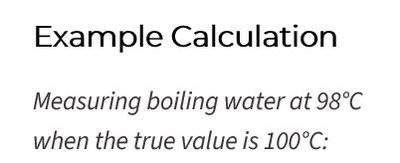
Percent error =
Key Vocabulary
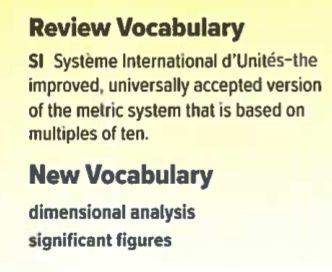
SI (Système International d’Unités): The modern metric system based on multiples of ten.
Dimensional analysis: A method for converting units and checking equation consistency.
Significant figures: The digits in a measurement that indicate its precision.