 Back
Oscillations and Simple Harmonic Motion: Physics with Algebra Study Guide
Study Guide - Smart Notes
 Tailored notes based on your materials, expanded with key definitions, examples, and context.
Oscillatory Motion and Equilibrium
Equilibrium and Restoring Forces
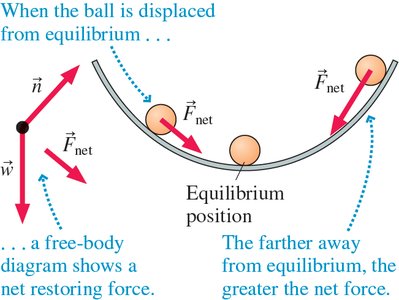
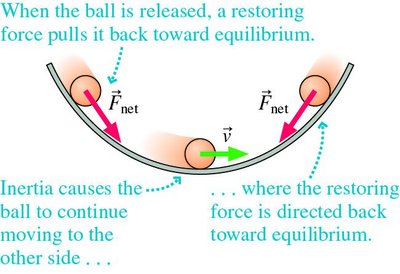
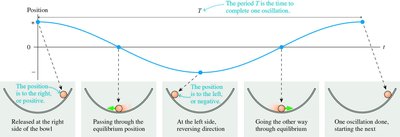
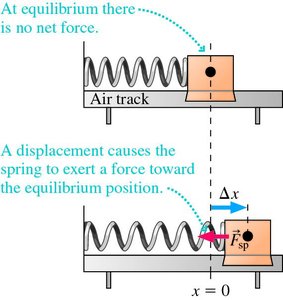
Oscillatory motion occurs when an object moves back and forth around an equilibrium position due to a restoring force. The equilibrium position is where the net force on the object is zero. When displaced from equilibrium, a restoring force acts to return the object to equilibrium, and the farther the displacement, the greater the restoring force.
Restoring Force: A force that acts to bring an object back to its equilibrium position.
Equilibrium Position: The location where the net force on the object is zero.
Example: A marble in a bowl will roll back toward the bottom if pushed away from equilibrium.
When released, the object continues past equilibrium due to inertia, resulting in repetitive motion called oscillation.
Characteristics of Oscillatory Motion
Period and Frequency
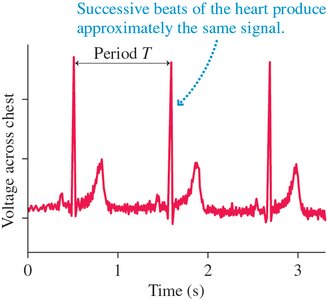
Oscillatory motion is characterized by its period (T) and frequency (f). The period is the time to complete one full cycle, and the frequency is the number of cycles per second.
Period (T): Time for one complete oscillation (measured in seconds).
Frequency (f): Number of oscillations per second (measured in hertz, Hz).
Relationship: and
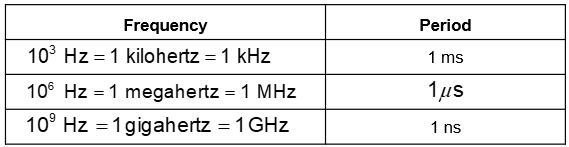
Frequency | Period |
|---|---|
Hz = 1 kHz | 1 ms |
Hz = 1 MHz | 1 μs |
Hz = 1 GHz | 1 ns |
Simple Harmonic Motion (SHM)
Definition and Sinusoidal Nature
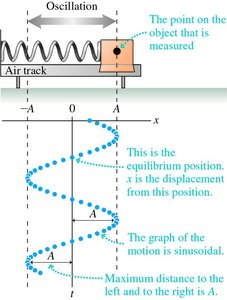
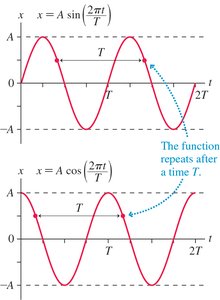
Simple harmonic motion is a type of oscillatory motion where the restoring force is proportional to the displacement and directed toward equilibrium. The motion is described by sinusoidal functions (sine or cosine).
Sinusoidal Function: or
Amplitude (A): Maximum displacement from equilibrium.
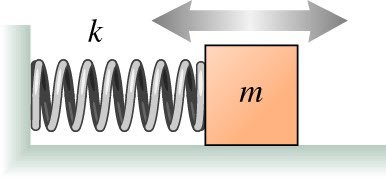
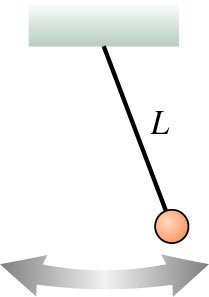
SHM Systems: Mass on a spring, pendulum.
Physical Examples of SHM
Many physical systems exhibit SHM, including masses on springs and pendulums. The frequency of oscillation depends on the system's physical properties.
Mass on a Spring: Frequency depends on mass (m) and spring constant (k).
Pendulum: Frequency depends on length (L) and gravitational acceleration (g).
Biological Example: Vibrations in the ear can be modeled as a mass on a spring.
Walking: The swinging motion of animal legs can be modeled as pendulum motion.


Mathematical Description of SHM
Equations of Motion
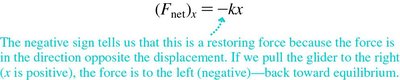
The position, velocity, and acceleration in SHM are sinusoidal functions of time. The restoring force is linear and can be described by Hooke's Law for a spring:
Position:
Velocity: ,
Acceleration: ,
Restoring Force:
Vertical and Horizontal Spring Systems
Vertical Mass on a Spring
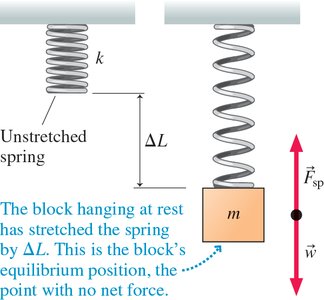
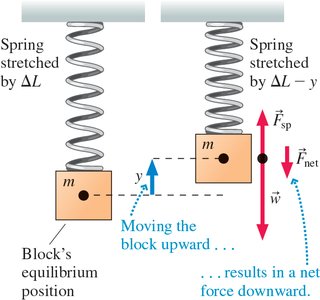
For a mass hanging from a spring, the equilibrium position is determined by the balance of the spring force and gravity. The oscillation about this position is SHM.
Equilibrium Stretch:
Restoring Force: (for displacement y from equilibrium)
Pendulum Motion
Restoring Force and Small-Angle Approximation
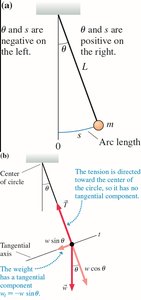
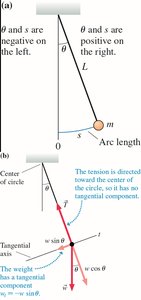
A pendulum consists of a mass suspended from a pivot. The restoring force is the tangential component of gravity. For small angles, the force is linear, and the motion is SHM.
Restoring Force: (for small )
Arc Length:
Sinusoidal Relationships and Graphs
Properties of Sinusoidal Functions
Sinusoidal functions are bounded and periodic, repeating their values every period T. The position, velocity, and acceleration graphs for SHM are sinusoidal and have specific phase relationships.
Position: Maximum at amplitude, zero at equilibrium.
Velocity: Maximum at equilibrium, zero at amplitude.
Acceleration: Maximum at amplitude, zero at equilibrium.
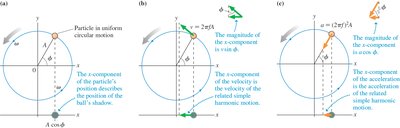
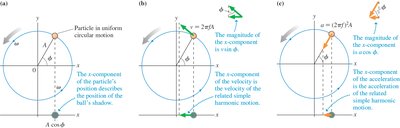
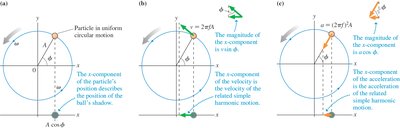
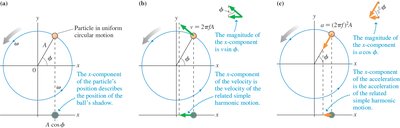
Connection to Uniform Circular Motion
Projection of Circular Motion
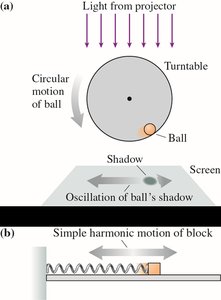
Uniform circular motion projected onto one dimension is equivalent to SHM. The x-component of a particle in circular motion follows the same equations as SHM.
Position:
Velocity:
Acceleration:
Energy in Simple Harmonic Motion
Kinetic and Potential Energy
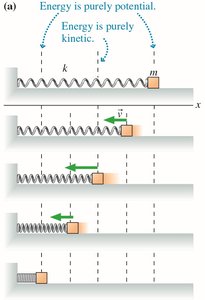
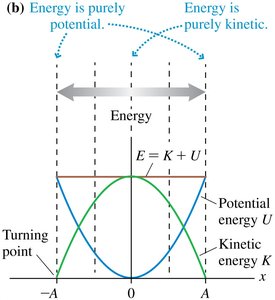
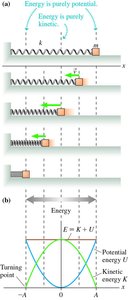
In SHM, energy oscillates between kinetic and potential forms. At maximum displacement, energy is purely potential; at equilibrium, it is purely kinetic.
Potential Energy:
Kinetic Energy:
Total Energy: (constant)
Frequency and Period of SHM
Dependence on Physical Properties
The frequency and period of SHM depend on the mass and spring constant for a spring system, and on the length and gravity for a pendulum. They do not depend on amplitude.
Spring System: ,
Pendulum: ,
Summary Table: Frequency and Period Formulas
System | Frequency (f) | Period (T) |
|---|---|---|
Mass on Spring | ||
Pendulum |
Key Points for Identifying SHM
If the net force is a linear restoring force, the motion is SHM.
Position, velocity, and acceleration are sinusoidal functions of time.
Amplitude is the maximum displacement from equilibrium.
Frequency depends on physical properties, not amplitude.
Total energy is constant, transforming between kinetic and potential forms.
