 Back
Physics with Algebra: Circuits, Magnetism, and Electromagnetism Study Guide
Study Guide - Smart Notes
 Tailored notes based on your materials, expanded with key definitions, examples, and context.
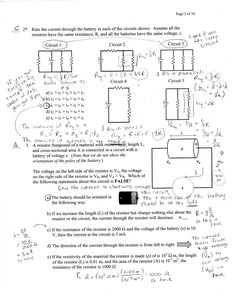
Q1. Rank the current through the battery in each of the circuits shown. Assume all the resistors have the same resistance, R, and all the batteries have the same voltage, V.
Background
Topic: Series and Parallel Circuits
This question tests your understanding of how current is distributed in circuits with different arrangements of resistors (series vs. parallel) and how to use Ohm's Law to compare total current.
Key Terms and Formulas:
Ohm's Law:
Equivalent resistance for series:
Equivalent resistance for parallel:
Current from battery:
Step-by-Step Guidance
Identify the configuration of resistors in each circuit (series or parallel).
Calculate the equivalent resistance for each circuit using the appropriate formula.
Use Ohm's Law to set up the expression for current: for each circuit.
Compare the values to determine which circuit will have the largest and smallest current.
Try solving on your own before revealing the answer!
Final Answer:
The circuit with the lowest equivalent resistance (most parallel branches) will have the highest current. The ranking is: Circuit 3 > Circuit 2 > Circuit 1 > Circuit 4.
This is because parallel circuits reduce the total resistance, increasing the current drawn from the battery.
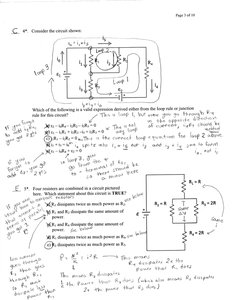
Q2. Consider the circuit shown. Which of the following is a valid expression derived either from the loop rule or junction rule for this circuit?
Background
Topic: Kirchhoff's Rules (Loop and Junction Rules)
This question tests your ability to apply Kirchhoff's loop and junction rules to analyze complex circuits and write equations for currents and voltages.
Key Terms and Formulas:
Kirchhoff's Junction Rule:
Kirchhoff's Loop Rule: around a closed loop
Step-by-Step Guidance
Identify all loops and junctions in the circuit diagram.
Assign current directions and label them (e.g., , , ).
Write an equation for the junction rule at a node where currents meet.
Write an equation for the loop rule for one of the closed loops, summing voltage drops and gains.
Try solving on your own before revealing the answer!
Final Answer:
A valid expression is (junction rule) or (loop rule).
These equations are derived from conservation of charge and energy in the circuit.
Q3. For four resistors as combined as shown, which statement about this circuit is TRUE?
Background
Topic: Series and Parallel Resistor Combinations
This question tests your understanding of how resistors combine in series and parallel, and how power is dissipated in each resistor.
Key Terms and Formulas:
Equivalent resistance for parallel:
Power dissipated: or
Step-by-Step Guidance
Identify which resistors are in series and which are in parallel.
Calculate the equivalent resistance for the parallel section.
Determine the current through each resistor using Ohm's Law.
Set up the expression for power dissipated in each resistor.
Try solving on your own before revealing the answer!
Final Answer:
The resistor with the smallest resistance in parallel dissipates the most power, because and the voltage across parallel resistors is the same.
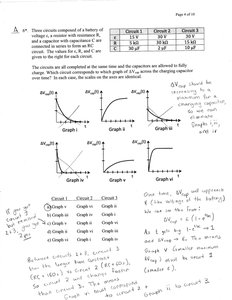
Q4. Three circuits composed of a battery of voltage V, a resistor with resistance R, and a capacitor with capacitance C are connected as shown. Which graph corresponds to which circuit as the capacitor charges over time?
Background
Topic: RC Circuits and Capacitor Charging
This question tests your understanding of how voltage across a capacitor changes over time in an RC circuit, and how the time constant affects the charging curve.
Key Terms and Formulas:
Capacitor charging equation:
Time constant:
Step-by-Step Guidance
Identify the values of R and C for each circuit.
Calculate the time constant for each circuit.
Match the charging curves to the circuits based on how quickly the voltage rises (larger means slower charging).
Try solving on your own before revealing the answer!
Final Answer:
The circuit with the largest value corresponds to the slowest charging curve (graph with gradual rise), and the smallest to the fastest charging curve.
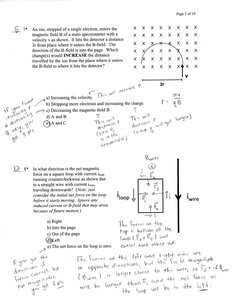
Q5. An ion, stripped of a single electron, enters the magnetic field of a mass spectrometer with a velocity v as shown. To decrease the distance D from the place where it enters to the place where it exits, which of the following will decrease D?
Background
Topic: Magnetic Force on Moving Charges
This question tests your understanding of how the radius of a charged particle's path in a magnetic field depends on its velocity, charge, mass, and the field strength.
Key Terms and Formulas:
Radius of path:
Distance D is related to the radius of curvature.
Step-by-Step Guidance
Write the formula for the radius of the ion's path in the magnetic field.
Identify which variables affect the radius (and thus D).
Determine how changing each variable (v, q, B, m) will affect D.
Try solving on your own before revealing the answer!
Final Answer:
Decreasing the velocity v or increasing the magnetic field B will decrease D, since .
Q6. In what direction is the net magnetic force on the wire shown?
Background
Topic: Magnetic Force on Current-Carrying Wires
This question tests your ability to use the right-hand rule to determine the direction of the force on a wire in a magnetic field.
Key Terms and Formulas:
Force on wire:
Right-hand rule for direction
Step-by-Step Guidance
Identify the direction of current and magnetic field in the diagram.
Apply the right-hand rule: thumb in direction of current, fingers in direction of field, palm points in direction of force.
Determine the net force direction based on the diagram.
Try solving on your own before revealing the answer!
Final Answer:
The net force is perpendicular to both the current and the magnetic field, as determined by the right-hand rule.
Q7. Which of the following current-carrying loops in an external B-field rotates clockwise?
Background
Topic: Torque on Current Loops in Magnetic Fields
This question tests your understanding of how a current loop experiences torque in a magnetic field and how to determine the direction of rotation.
Key Terms and Formulas:
Torque:
Magnetic moment:
Step-by-Step Guidance
Identify the direction of current in each loop.
Determine the direction of the magnetic moment for each loop.
Use the right-hand rule to find the direction of torque and rotation.
Try solving on your own before revealing the answer!
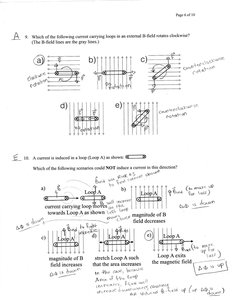
Final Answer:
The loop with current direction and field orientation that produces a clockwise torque will rotate clockwise.
Q8. A current is induced in a loop (Loop A) as shown. Which of the following scenarios could NOT induce a current in this direction?
Background
Topic: Electromagnetic Induction (Faraday's Law)
This question tests your understanding of how changing magnetic flux induces current and how to determine the direction of induced current.
Key Terms and Formulas:
Faraday's Law:
Lenz's Law: Induced current opposes the change in flux
Step-by-Step Guidance
Identify the direction of the magnetic field and the loop's orientation.
Determine how changing the field or loop area affects the flux.
Use Lenz's Law to predict the direction of induced current for each scenario.
Try solving on your own before revealing the answer!
Final Answer:
The scenario that does not change the magnetic flux through the loop cannot induce a current.
Q9. A bar magnet is dropped through a solenoid as shown. Which of the following plots represents the current we expect from this experiment?
Background
Topic: Electromagnetic Induction and Motional EMF
This question tests your understanding of how a changing magnetic field induces current in a solenoid and how to interpret current vs. time graphs.
Key Terms and Formulas:
Faraday's Law:
Current direction depends on the change in flux
Step-by-Step Guidance
Analyze how the magnetic flux changes as the magnet enters, passes through, and exits the solenoid.
Predict the direction and magnitude of induced current at each stage.
Match the expected current pattern to the provided plots.
Try solving on your own before revealing the answer!
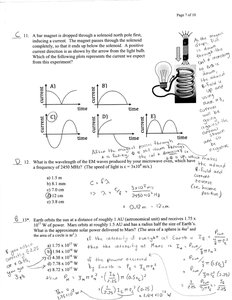
Final Answer:
The plot with positive and negative peaks as the magnet enters and exits the solenoid represents the expected current.
Q10. What is the wavelength of the EM wave that has a frequency of 2.40 x 10^9 Hz?
Background
Topic: Electromagnetic Waves
This question tests your ability to relate frequency and wavelength using the speed of light.
Key Terms and Formulas:
Speed of light: m/s
Wavelength:
Step-by-Step Guidance
Write the formula relating wavelength, frequency, and speed of light.
Plug in the values for and .
Set up the calculation for .
Try solving on your own before revealing the answer!
Final Answer:
m
This is the wavelength for the given frequency.
Q11. Earth orbits the sun at a distance of roughly 1 AU and receives 1 kW/m^2 of sunlight. What is the total power output of the sun?
Background
Topic: Power and Intensity of Electromagnetic Waves
This question tests your ability to use the concept of intensity and area to find the total power output of a source.
Key Terms and Formulas:
Intensity:
Area of sphere:
Step-by-Step Guidance
Write the formula for intensity in terms of power and area.
Calculate the area of a sphere with radius equal to Earth's distance from the sun (1 AU).
Set up the equation to solve for the sun's power output.
Try solving on your own before revealing the answer!
Final Answer:
; using m, W
This is the total power output of the sun.
Q12. Below are shown 4 cases in which a rod made of an insulating material and with a net positive excess charge is brought near to an electrically neutral metal sphere (without touching) and then taken far away. The sphere is connected to ground differently in each case. In which cases will the sphere end up with a net negative charge?
Background
Topic: Electrostatics and Induction
This question tests your understanding of how grounding and induction can cause a neutral object to acquire a net charge.
Key Terms and Formulas:
Induction: Redistribution of charges due to nearby charged object
Grounding: Allows electrons to flow to/from the earth
Step-by-Step Guidance
Analyze each case to see when the sphere is grounded and when the rod is present.
Determine whether electrons flow onto or off the sphere in each scenario.
Predict the net charge after the rod is removed and the sphere is disconnected from ground.
Try solving on your own before revealing the answer!
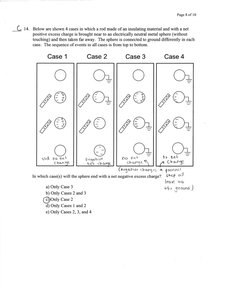
Final Answer:
The sphere ends up with a net negative charge in cases where it is grounded while the rod is nearby, and then the rod is removed before disconnecting the ground.
Q13. Three charges are arranged in a line. A -6Q charge is a distance d from a +Q charge, which is a distance d away from a +Q charge. What is the direction of the E field created by the -6Q and +Q charges at the spot occupied by the +Q charge?
Background
Topic: Electric Fields from Point Charges
This question tests your ability to calculate and add electric fields from multiple point charges.
Key Terms and Formulas:
Electric field from point charge:
Superposition principle: Add fields vectorially
Step-by-Step Guidance
Calculate the electric field at the location of the middle +Q charge due to the -6Q charge.
Calculate the electric field at the same location due to the rightmost +Q charge.
Add the fields vectorially to determine the net direction.
Try solving on your own before revealing the answer!
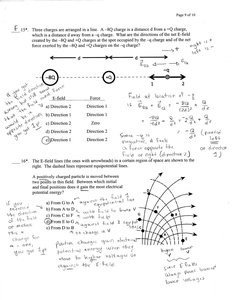
Final Answer:
The net electric field at the middle +Q charge points to the left, since the field from the -6Q charge dominates.
