 Back
Physics with Algebra: Mechanics I – Units, Motion, Forces, and Friction
Study Guide - Smart Notes
 Tailored notes based on your materials, expanded with key definitions, examples, and context.
Units and Scientific Notation
SI Base Units and Derived Units
The International System of Units (SI) is the standard for scientific measurement. All physical quantities encountered in introductory physics can be expressed in terms of five base units: meter (m) for length, kilogram (kg) for mass, second (s) for time, ampere (A) for electric current, and kelvin (K) for temperature. Derived units are combinations of these base units, such as the joule (J) for energy, where .
Dimensional Consistency: Physical equations must be dimensionally consistent; units on both sides must match.
Scientific Notation: Used for very large or small numbers, e.g., kg for Earth's mass.
SI Prefixes: Prefixes like milli- (), kilo- (), and mega- () simplify expression of quantities.
Example: Mass Calculation
Given mass density kg/m3 and volume m3, mass kg. Units confirm dimensional consistency.
Rates: Speed and Velocity
Speed
Speed is the rate of distance traveled per unit time, defined as . It is a scalar quantity (no direction).
Instantaneous Speed: The speed at a specific moment, as shown by a speedometer.
Average Speed: Total distance divided by total time.
Velocity
Velocity is a vector quantity, including both magnitude and direction. Average velocity is , where is the change in position.
Positive/Negative Velocity: Direction is chosen by convention (e.g., right or up is positive).
Relative Motion: Velocity depends on the reference frame. For example, a passenger walking inside a moving train has different velocities relative to the train and the ground.
Example: Relative Velocity
If a train moves at 4 m/s and a passenger walks at 3 m/s relative to the ground, the passenger's velocity relative to the train is m/s (toward the rear).
Graphical Representation of Motion
Position vs. time graphs show velocity as the slope; velocity vs. time graphs show acceleration as the slope. Positive slope means positive velocity, negative slope means negative velocity, and horizontal lines indicate zero velocity.
Acceleration
Definition and Units
Acceleration is the rate of change of velocity, . It is a vector quantity with SI units of m/s2.
Speeding Up: Acceleration increases speed.
Slowing Down: Acceleration decreases speed.
Direction: Acceleration direction determines whether an object speeds up or slows down.
Example: Constant Acceleration
If an object starts from rest and accelerates at 10 m/s2, its velocity increases by 10 m/s each second.
Acceleration in Circular Motion
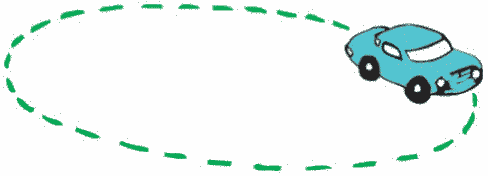
Even if speed is constant, an object moving in a circle is accelerating because its direction changes.
Galileo's Discovery of Uniform Acceleration
Ramp Experiments
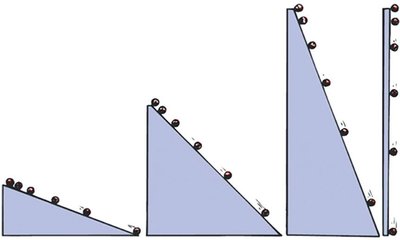
Galileo used inclined ramps to study motion, finding that distance traveled is proportional to the square of elapsed time () for uniform acceleration.

Free Fall and Gravitational Acceleration
Definition of Free Fall
An object is in free fall when gravity is the only force acting on it. Near Earth's surface, the acceleration due to gravity is m/s2 (approximated as 10 m/s2).
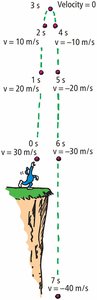
Velocity in Free Fall:
Distance in Free Fall: for an object starting from rest.
Example: Falling Objects in Vacuum
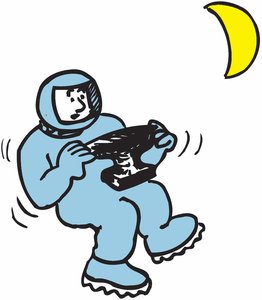
In a vacuum, all objects fall with the same acceleration, regardless of mass. This was demonstrated on the Moon with a hammer and feather.

Vectors and Vector Addition
Vector Quantities
Velocity and acceleration are vectors, indicated by bold symbols or arrows. The magnitude of a vector is .
Vector Addition: Place vectors head-to-tail; the sum extends from the tail of the first to the head of the last.
Perpendicular Vectors: Use the Pythagorean theorem:
Example: Airplane and Crosswind
An airplane flying at 40 m/s with a 30 m/s crosswind has a ground speed of 50 m/s, using the 3:4:5 Pythagorean triple.

Newton's First Law: Inertia and Equilibrium
Galileo's Concept of Inertia
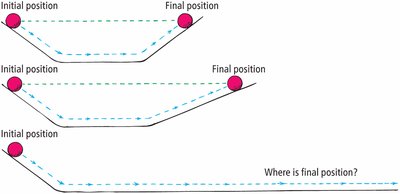
Objects naturally maintain their state of motion unless acted upon by a force. Galileo's ramp experiments showed that, in the absence of friction, a ball continues moving indefinitely at constant speed.
Inertial Reference Frames
Newton's first law states that in an inertial reference frame, an object subject to zero net force moves with constant velocity ().
Translational Equilibrium
An object with zero net force is in translational equilibrium; its velocity is constant or it remains at rest.
Normal Force
The normal force is the component of contact force perpendicular to a surface, balancing gravity for objects at rest.
Newton's Second Law: Force and Acceleration
Inertial Mass vs. Gravitational Mass
Inertial mass measures resistance to acceleration; gravitational mass measures response to gravity. In practice, these are equal to high precision.
Newton's Second Law:
SI Unit of Force: Newton (N), where
Gravitational Force
Near Earth's surface, , where is weight and m/s2.
Friction Between Solids
Types of Friction
Friction opposes relative motion between surfaces. Static friction prevents sliding, while kinetic (sliding) friction acts during motion. Both depend on the normal force but are nearly independent of contact area.
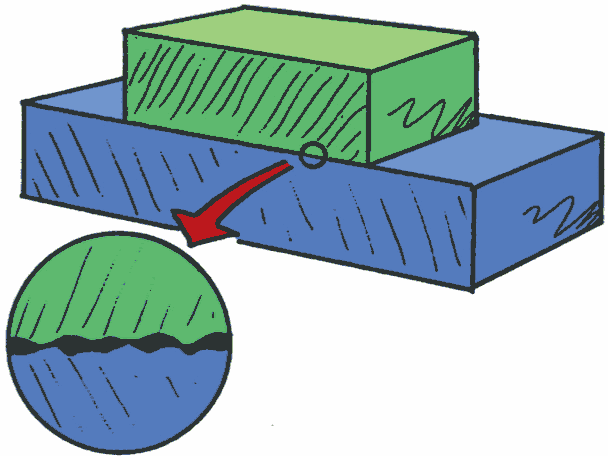
Static Friction: Adjusts to prevent motion up to a maximum value.
Kinetic Friction: Acts once sliding begins, typically less than maximum static friction.
Fluid Resistance (Drag)
Drag Force
Objects moving through fluids experience drag, which opposes motion and increases with speed and frontal area. At terminal velocity, drag balances weight and the object falls at constant speed.

Terminal Velocity: The speed at which drag force equals gravitational force.
Dependence: Drag increases with speed and area, unlike sliding friction.
