 Back
Rotational Motion: Physics with Algebra Study Guide
Study Guide - Smart Notes
 Tailored notes based on your materials, expanded with key definitions, examples, and context.
Rotational Motion
Circular and Rotational Motion
Rotational motion refers to the movement of objects that spin about an axis. This type of motion is fundamental in understanding the behavior of many physical systems, from playground equipment to machinery.
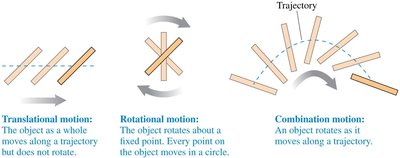
Rotational motion: The motion of an object around a fixed axis.
Circular motion: A special case where every point on the object moves in a circle around the axis.
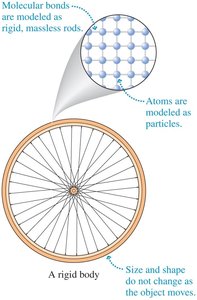
Rigid body: An object whose size and shape do not change as it moves.
Combination motion: An object rotates as it moves along a trajectory.
Translational motion: The object moves along a trajectory but does not rotate.
Angular Position, Displacement, and Velocity
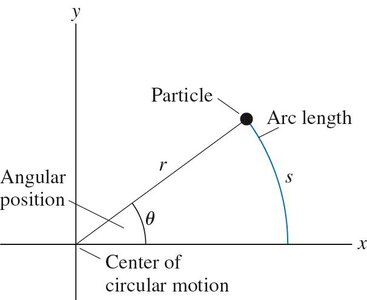
Angular position describes the orientation of a particle in circular motion relative to a reference axis. Angular displacement and angular velocity quantify how this position changes over time.
Angular position (θ): The angle measured from the positive x-axis to the radius connecting the center to the particle.
Arc length (s): The distance traveled along the circular path.
Relationship: (radians)
One revolution: radians
Conversion:
Angular Displacement and Angular Velocity
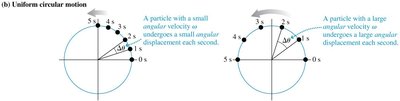
Angular displacement () is the change in angular position. Angular velocity () is the rate of change of angular displacement.
Angular displacement:
Angular velocity:
Linear speed:
Period (T): Time for one revolution,
Frequency (f): ,
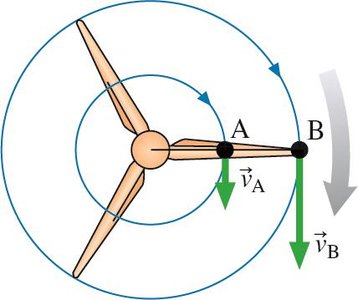
Example: Wind Turbine Blade
For a wind turbine with blades of length 50 m rotating at 10 rpm:
Period: s
Angular speed: rad/s
Tip speed (r = 50 m): m/s
Speed at 25 m: m/s
Rotation of a Rigid Body
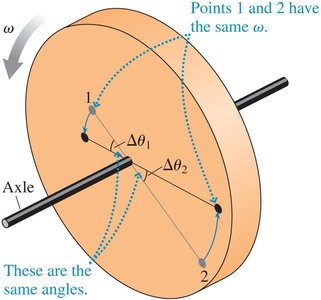
A rigid body is an object whose size and shape remain constant during motion. Every point on a rotating rigid body has the same angular velocity, but points farther from the axis move faster.
Angular velocity (): Same for all points on the body.
Linear speed (): ; increases with distance from the axis.
Angular Acceleration
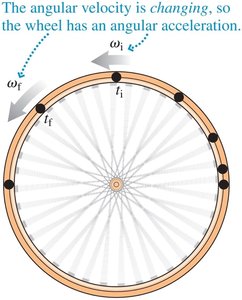
Angular acceleration () measures how quickly angular velocity changes. It is defined as:
Angular acceleration:
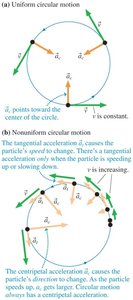
Uniform circular motion:
Non-uniform circular motion:
Relationship: Tangential acceleration
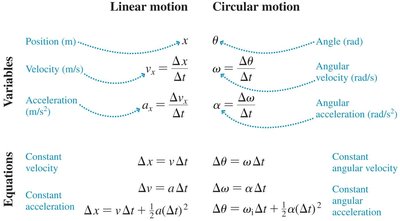
Synthesis: Linear and Circular Motion Analogs
Variables and equations for linear motion have direct analogs in circular motion.
Position: (linear), (angular)
Velocity: ,
Acceleration: ,
Equations:
Linear:
Angular:
Torque
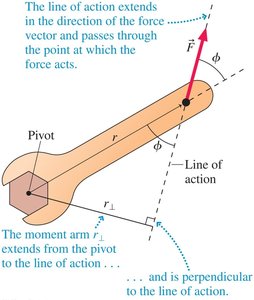
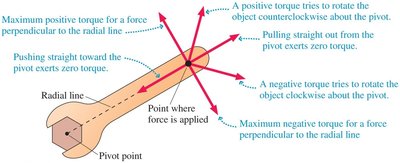
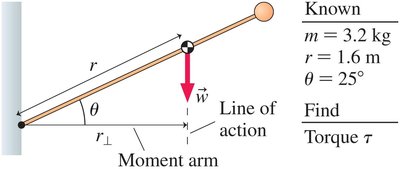
Torque () is the rotational analog of force. It measures the tendency of a force to rotate an object about an axis.
Definition:
Moment arm ():
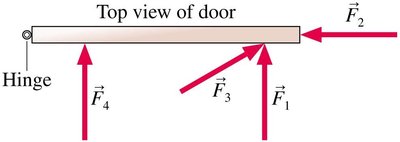
Direction: Counterclockwise (+), Clockwise (–)
Net torque: Sum of all individual torques
Gravitational Torque and Center of Gravity
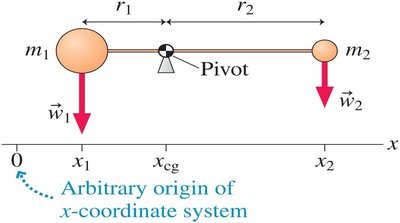
Gravitational torque is the torque caused by the weight of an object. The center of gravity is the point where the total gravitational torque is zero.
Gravitational torque:
Center of gravity (xcg):
Y-coordinate:
Rotational Dynamics and Moment of Inertia
Rotational dynamics describes how torques cause angular acceleration. Moment of inertia () quantifies an object's resistance to rotational acceleration.
Moment of inertia:
Newton's Second Law for Rotation:
For a cylinder:
Example: Spinning Up a Flywheel
A 540 kg cylinder with radius 0.30 m is spun up by a motor providing 2.8 Nm torque. To reach 13,000 rpm:
Angular speed: rad/s
Moment of inertia: kg·m2
Angular acceleration: rad/s2
Time to reach speed: s (3.3 hours)
Summary: Rotational Motion Equations
Key equations and relationships for rotational motion:
Linear Motion | Circular Motion |
|---|---|
Position (m): x | Angle (rad): θ |
Velocity (m/s): vx = Δx/Δt | Angular velocity (rad/s): ω = Δθ/Δt |
Acceleration (m/s2): ax = Δvx/Δt | Angular acceleration (rad/s2): α = Δω/Δt |
Δx = v Δt + ½ a (Δt)2 | Δθ = ω Δt + ½ α (Δt)2 |
