 Back
Vectors and Motion in Two Dimensions: Study Guide
Study Guide - Smart Notes
 Tailored notes based on your materials, expanded with key definitions, examples, and context.
Vectors and Motion in Two Dimensions
Introduction to Vectors
Vectors are fundamental tools in physics for representing quantities that have both magnitude and direction. Understanding vectors is essential for analyzing motion in two dimensions, such as projectile motion, motion on ramps, and circular motion.
Vector: A quantity with both magnitude (size) and direction.
Scalar: A quantity with only magnitude, such as speed or mass.
Examples: Displacement, velocity, and acceleration are vectors; speed and distance are scalars.
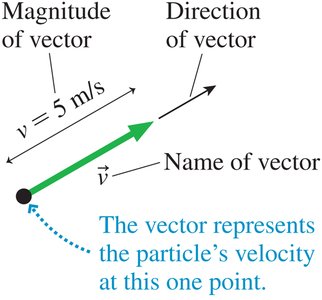
Representing Vectors
Vectors are typically represented as arrows. The length of the arrow indicates the magnitude, and the direction of the arrow shows the direction of the vector.
Notation: Vectors are often denoted with an arrow above the letter, e.g., .
Magnitude: The magnitude of a vector is always positive and is denoted without the arrow, e.g., .
Equality: Two vectors are equal if they have the same magnitude and direction, regardless of their starting points.
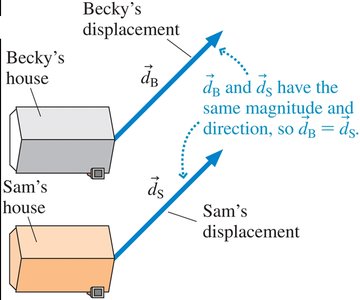
Vector Addition and Subtraction
Vectors can be added or subtracted using geometric methods. The two main methods are the tip-to-tail rule and the parallelogram rule.
Tip-to-Tail Rule: Place the tail of the second vector at the tip of the first vector. The resultant vector is drawn from the tail of the first to the tip of the second.
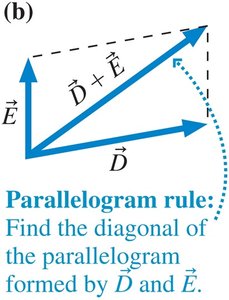
Parallelogram Rule: Place both vectors at the same point and complete the parallelogram. The diagonal represents the resultant vector.
Commutativity: Vector addition is commutative: .
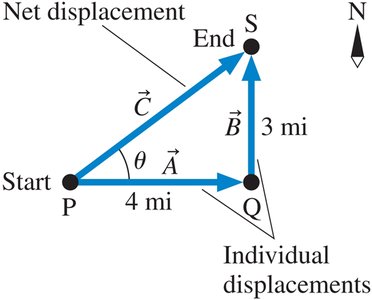
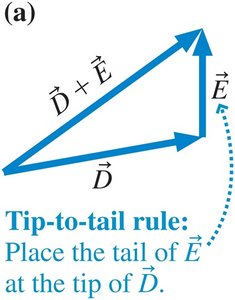
Multiplication by a Scalar
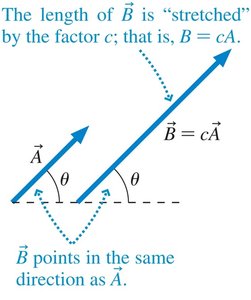
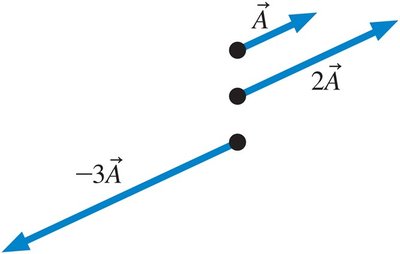
Multiplying a vector by a scalar changes its magnitude but may also reverse its direction if the scalar is negative.
Positive Scalar: The vector's magnitude changes, but its direction remains the same.
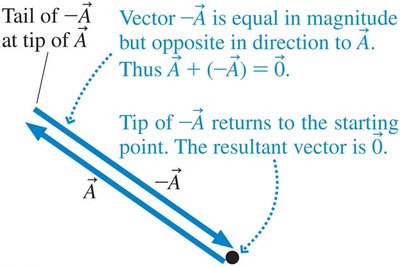
Negative Scalar: The vector's direction is reversed.
Zero Scalar: The result is the zero vector, which has no direction or magnitude.
Vector Components and Coordinate Systems
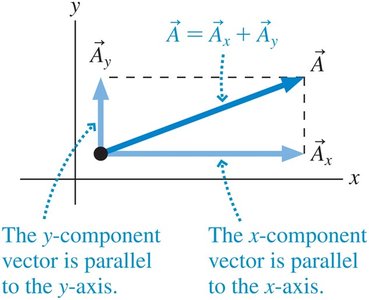
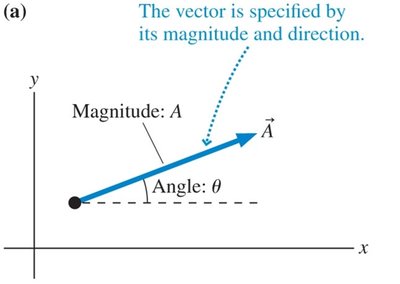
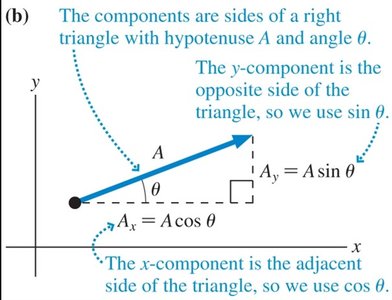
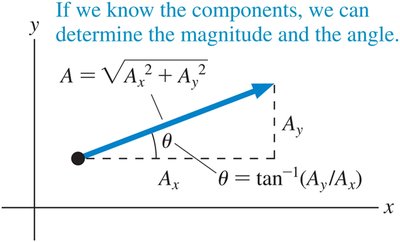
Vectors can be decomposed into components along the axes of a coordinate system, usually Cartesian (x, y).
Component Vectors: Any vector can be written as the sum of its x- and y-components: .
Finding Components: Use trigonometry to find the components:
Magnitude and Direction: If components are known:
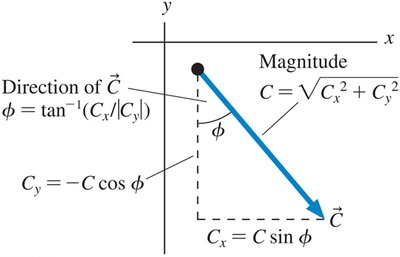
Adding Vectors Using Components
Vectors can be added algebraically by summing their respective components.
Component Addition: ,
Resultant Vector:
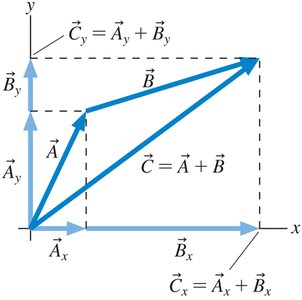
Tilted Axes and Motion on a Ramp
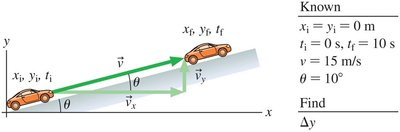
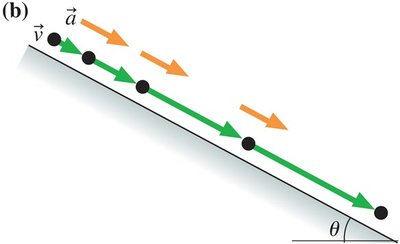
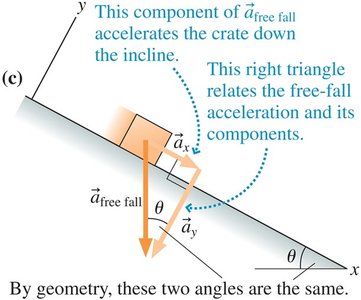
For problems involving slopes or ramps, it is often useful to rotate the coordinate axes so that one axis is parallel to the ramp.
Tilted Axes: Components are found using the same trigonometric relationships, but with respect to the tilted axes.
Ramp Motion: The acceleration parallel to the ramp is a component of gravity:
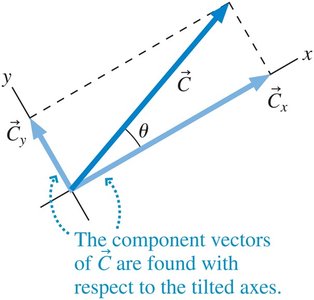
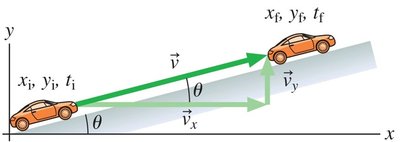
Motion in Two Dimensions
Objects moving in two dimensions have displacement, velocity, and acceleration vectors that change in both magnitude and direction.
Displacement:
Velocity:
Acceleration:
Projectile Motion
Projectile motion is a classic example of two-dimensional motion, where an object moves under the influence of gravity alone.
Independence of Components: The horizontal and vertical motions are independent.
Horizontal Motion: Constant velocity,
Vertical Motion: Constant acceleration,
Kinematic Equations: Horizontal: Vertical:
Circular Motion
Uniform circular motion occurs when an object moves at constant speed around a circle. The direction of velocity changes continuously, resulting in centripetal acceleration.
Centripetal Acceleration: Points toward the center of the circle.
Velocity: Tangent to the circle at any point.
Relative Motion
Relative motion describes how the velocity of an object depends on the observer's frame of reference.
Relative Velocity Equation:
Applications: Used to analyze situations like moving walkways, wind, or water currents.
Summary Table: Vector Operations
Operation | Equation | Description |
|---|---|---|
Addition | Tip-to-tail or parallelogram method | |
Subtraction | Add to | |
Scalar Multiplication | Change magnitude, reverse direction if is negative | |
Component Form | Decompose along axes |
Key Formulas
Example Applications
Projectile Motion: Calculating the range and height of a projectile.
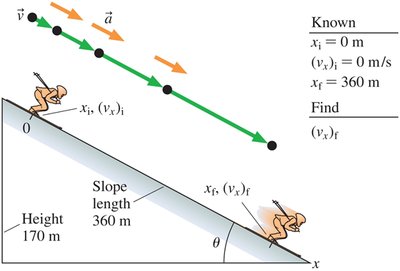
Motion on a Ramp: Decomposing acceleration and velocity vectors.
Circular Motion: Determining centripetal acceleration for objects moving in a circle.
Relative Motion: Analyzing velocities in different reference frames.
Additional info:
These notes expand on the brief points in the original slides, providing full academic context, definitions, and examples.
Images included are directly relevant to the explanation of vector operations, components, and motion in two dimensions.
