 Back
Work, Energy, and Systems: Physics with Algebra Study Notes (Chapter 7)
Study Guide - Smart Notes
 Tailored notes based on your materials, expanded with key definitions, examples, and context.
Work, Energy, and Systems
Systems and Environments
In physics, a system is a defined portion of the universe chosen for analysis, while everything outside this boundary is considered the environment. The system can be a single object, a collection of objects, or even a region of space. The system boundary separates the system from its environment and can be physical or conceptual. Forces and energy can cross this boundary, influencing the system.
System examples: A moving car, a ball in flight, or the gas inside a cylinder.
System boundary: The surface of an object, or an imaginary line enclosing a region.
Work Done by a Constant Force
In physics, work is done when a force causes a displacement of an object. The amount of work depends on the magnitude of the force, the displacement, and the angle between the force and displacement vectors. Work is a scalar quantity, not a vector.
Definition: Work is only done if the object moves in the direction of the force.
Formula: The work W done by a constant force F over a displacement \Delta r at an angle \theta is:
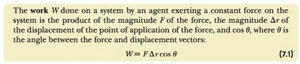
Units: Joules (J), where 1 J = 1 N·m.
Example: Pulling a vacuum cleaner with a force at an angle to the floor (see Example 7.1).

Work and Direction
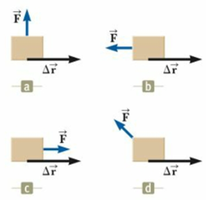
The direction of the force relative to the displacement affects the work done:
If the force is in the same direction as displacement, work is positive.
If the force is opposite to displacement, work is negative.
If the force is perpendicular to displacement, work is zero.
Physics vs Everyday Life: Work
In everyday language, 'work' can mean effort or fatigue, but in physics, work requires displacement. For example, holding a heavy object stationary does not constitute work in the physics sense, even if it feels tiring.
The Scalar (Dot) Product of Two Vectors
The scalar product (or dot product) is a mathematical operation that combines two vectors to produce a scalar. In the context of work, it is used to calculate the work done by a force over a displacement.
Formula:
Work is the dot product of force and displacement:
Work Done by a Varying Force
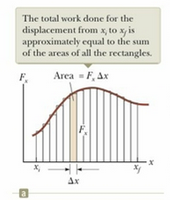
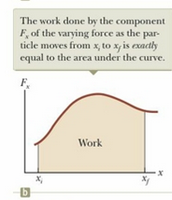
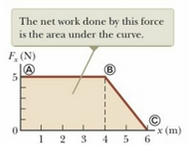
When the force acting on an object varies with position, the work done is found by calculating the area under the force vs. displacement graph. This is equivalent to integrating the force over the path of motion.
Approximate calculation: Sum the areas of rectangles under the curve.
Exact calculation: The work is the exact area under the curve between the initial and final positions.
Work Done by a Spring (Hooke's Law)
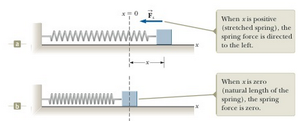
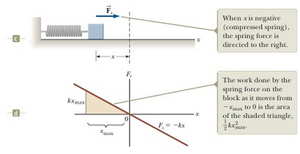
A spring exerts a force proportional to its displacement from equilibrium, described by Hooke's Law: , where k is the spring constant and x is the displacement.
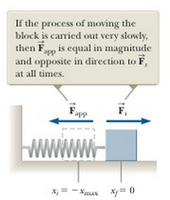
Work done by a spring: The work done by the spring force as it moves from to is:
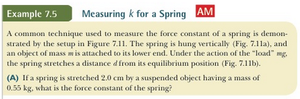
Measuring the Spring Constant
The spring constant k can be measured by hanging a mass from a vertical spring and measuring the displacement caused by the weight. The force exerted by the spring balances the weight at equilibrium: , where d is the displacement.
Kinetic Energy and the Work-Kinetic Energy Theorem
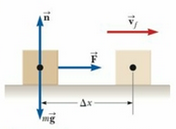
Kinetic energy is the energy of motion. The work-kinetic energy theorem states that the net work done on an object is equal to the change in its kinetic energy:
If net work is positive, the object's speed increases.
If net work is negative, the object's speed decreases.
Potential Energy of a System
Potential energy is stored energy due to the position or configuration of a system. Common forms include gravitational and elastic potential energy.
Gravitational potential energy: (for height h above a reference point)
Elastic potential energy: (for a spring displaced by x)
Conservative and Nonconservative Forces
Conservative forces (e.g., gravity, spring force) are path-independent and allow the definition of potential energy. Nonconservative forces (e.g., friction) are path-dependent and dissipate mechanical energy as heat or other forms.
Work done by conservative forces can be recovered; by nonconservative forces, it cannot.
Friction is a nonconservative force because the work done depends on the path taken.
Relationship Between Conservative Forces and Potential Energy
For conservative forces, the work done is related to the change in potential energy:
Energy Diagrams and Equilibrium
Energy diagrams plot potential energy as a function of position. Equilibrium points occur where the force is zero (the slope of the potential energy curve is zero):
Stable equilibrium: Small displacements result in a restoring force back to equilibrium.
Unstable equilibrium: Small displacements result in a force away from equilibrium.
Neutral equilibrium: Small displacements result in no net force.
At stable equilibrium, the potential energy is at a minimum; at unstable equilibrium, it is at a maximum.
Quick Quizzes and Examples
Quiz/Example | Description |
|---|---|
Quick Quiz 7.1 | Work done by gravitational force on Earth in orbit (answer: zero, since force is perpendicular to displacement). |
Quick Quiz 7.2 | Ranking work done by force in different directions relative to displacement (see image_5 for scenarios). |
Example 7.1 | Calculating work done by a force at an angle (see image_3). |
Example 7.5 | Measuring the spring constant using a hanging mass (see image_12). |
